

Understanding what is AI output consistency is not optional for developers who ship AI-powered pipelines. You send the same prompt twice and get two different JSON structures back. One parses cleanly; the other breaks your downstream service at 2 a.m. That is not a fringe scenario. It is the default behavior of generative models, and treating it otherwise is how production bugs multiply. This guide covers the definition, causes, measurement methods, and enforcement techniques you need to design reliable AI systems.
Table of Contents
- Key takeaways
- What AI output consistency actually means
- How to measure output consistency
- Techniques to enforce consistent output
- Pitfalls and limits of consistency enforcement
- My take on output consistency as an engineering contract
- Fix AI output inconsistency with Datatool
- FAQ
Key takeaways
| Point | Details |
|---|---|
| Consistency means output stability | AI output consistency is the degree to which a model produces the same structure and meaning for identical or similar inputs. |
| Variability is architectural, not accidental | Inconsistency arises from model architecture, not failure; it must be engineered around, not assumed away. |
| Measurement requires multiple samples | Single-run checks miss variance; use statistical methods across multiple outputs to quantify consistency reliably. |
| Schema enforcement is your primary control | Strict output contracts at pipeline boundaries convert silent failures into loud, retryable errors. |
| Consistency has trade-offs | Over-constraining a model removes useful variation; balance structure with flexibility based on your application type. |
What AI output consistency actually means
AI output consistency is the stability of a model's outputs for the same or similar inputs. In practice, this means two things: structural stability (does the model return the same format?) and semantic stability (does it return the same meaning?). Both matter. A model that returns valid JSON every time but changes which fields it includes is structurally inconsistent. A model that always returns the same fields but alternates between conflicting answers is semantically inconsistent.
The root cause is the probabilistic nature of generative AI. These models sample from a probability distribution over tokens. Temperature, top-p, and top-k parameters all influence that sampling. The result is that even a perfectly identical prompt can produce meaningfully different outputs across runs.
Several specific factors drive inconsistency in production:
- Sampling randomness. Temperature above zero introduces non-determinism by design.
- Prompt sensitivity. Tiny changes in wording, whitespace, or token encoding shift the output distribution.
- Model version drift. A model update from the provider can change behavior without warning, even with identical prompts and parameters.
- Context window differences. Varying conversation histories or injected context alter output behavior.
The key distinction developers need to internalize: inconsistency is not a bug in the model. Probabilistic generative models are built to produce variable output. Creativity is the point in some contexts. In production pipelines that parse structured data, it is a liability. You have to engineer around it.
How to measure output consistency
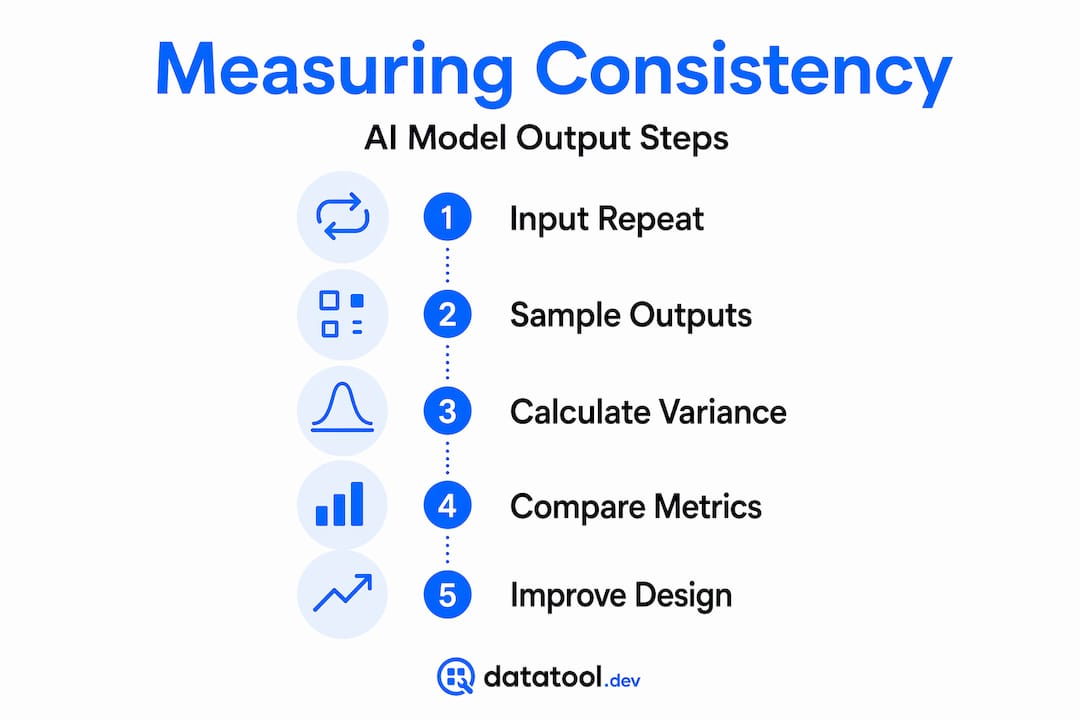
Knowing consistency is a problem is not enough. You need to quantify it. The difference between a system you can trust and one you are guessing about is measurement.

The most reliable approach is running multiple samples from the same input and measuring the variance of a functional metric across those samples. A single run tells you nothing about stability. Semantic similarity kernels and pairwise output agreement give you a measurable signal across a sample set. Perfect consistency corresponds to minimal variance in those functional outputs.
The table below compares the main approaches:
| Method | What it measures | Best used for |
|---|---|---|
| Pairwise semantic similarity | Meaning-level agreement across output pairs | NLP tasks, summarization, Q&A |
| Field extraction accuracy variance | Structural consistency across JSON/schema fields | Structured data pipelines |
| U-statistics over output functionals | Statistical variance of any measurable output property | General-purpose consistency benchmarking |
| Trajectory-level agreement | Consistency of intermediate steps, not just final output | Multi-step agents and workflows |
For single-step outputs, field extraction accuracy variance is the most practical metric. Pick the fields your pipeline depends on, run 20 to 50 samples, and calculate how often each field is present and correctly typed. That number is your consistency score.
For multi-step agents, trajectory-level metrics matter more than final output similarity alone. Two agent runs can produce identical final answers via completely different action sequences. That divergence can mask brittleness your output-only checks will never catch.
Pro Tip: Self-consistency sampling, where you generate multiple candidate outputs and select the majority answer, reduces uncertainty exponentially and can cut API costs by approximately 50% compared to naive reliability approaches.
Techniques to enforce consistent output
Once you measure the problem, you can address it. AI performance stability does not happen by accident. It requires layered controls applied at multiple points in your pipeline.
-
Set temperature to zero or near zero. This is the first lever. Lower temperature values make outputs more deterministic but do not guarantee perfect reproducibility. Set it anyway. It reduces the variance surface significantly.
-
Use few-shot prompting with static examples. Include two or three concrete input/output pairs directly in your prompt. Explicit examples and format restrictions remove ambiguity and push the model toward near-deterministic output when combined with low temperature.
-
Enforce a strict output schema. Define exactly what fields you expect, their types, and their constraints. Reject anything that does not conform. Here is what the difference looks like in practice:
"``python
Inconsistent output — no schema enforcement
response = llm.generate(prompt) data = json.loads(response) # May be missing fields, wrong types, or break entirely
Consistent output — schema validation at the boundary
from pydantic import BaseModel, ValidationError
class ExtractedEntity(BaseModel): name: str category: str confidence: float
try: validated = ExtractedEntity(**json.loads(response)) except (ValidationError, json.JSONDecodeError): # Fail fast, log, and retry rather than pass corrupt data downstream raise OutputContractViolation("Model output failed schema contract")
4. **Treat schema violations as retryable errors.** A [Pydantic-contract approach](https://www.iamraghuveer.com/posts/agent-output-schema-validation/) runs validation immediately after generation. If the output fails, retry before the data touches any downstream system. This converts silent failures into loud, detectable events.
5. **Pin model versions.** Version drift from provider updates can silently break output behavior. Lock to a specific model version in production and run consistency benchmarks before upgrading.
**Pro Tip:** *Combine [output observability monitoring](https://blog.datatool.dev/blog/ai-output-observability-explained-a-developers-guide) with schema enforcement. Validation catches failures; observability tells you when your consistency score degrades before it starts causing outages.*
## Pitfalls and limits of consistency enforcement
Improving AI output accuracy is a legitimate goal. But some constraints about what you can actually achieve are worth knowing before you over-engineer.
- **Complete determinism is not achievable.** Even with temperature set to zero, floating-point arithmetic differences, hardware variation, and batching behavior can produce slightly different outputs across runs. Design for high consistency, not perfect reproducibility.
- **Not all inconsistency is bad.** A creative writing assistant or a brainstorming tool benefits from output variation. Enforcing strict schemas in those contexts removes value. Know your application type before adding constraints.
- **Multi-step agents compound the problem.** Structural failures in agentic systems are often invisible to final-output metrics. Two agent runs that agree on the answer may have taken entirely different paths to get there, with different risks of failure along the way.
- **Over-constraining narrows useful output.** A model instructed to return exactly three fields may truncate genuinely useful information to fit the contract. Validate structure but leave semantic content room to breathe.
- **Consistency benchmarking must be continuous.** A model that scored well last month may score poorly today. Runtime and version differences require ongoing monitoring, not one-time checks.
The importance of AI consistency comes from understanding it as a design goal with real costs on both sides. Too loose, and your pipeline breaks silently. Too rigid, and you clip the model's ability to handle edge cases well.
## My take on output consistency as an engineering contract
I've watched teams spend weeks debugging production failures that traced back to a single missing field in a JSON response. The model was never broken. The contract was just never defined. That distinction matters more than most developers realize.
In my experience, the teams that handle consistency best treat it the way they treat API contracts between services. You do not call an external service and hope the response shape is the same as last week. You assert it, and you fail fast if it is not. AI outputs deserve exactly the same discipline.
What I've learned from building on top of LLM outputs is that single-run accuracy metrics are genuinely misleading. A model that scores 95% correct on one pass may score 78% on the next. Without [unit testing AI-generated outputs](https://blog.datatool.dev/blog/unit-testing-ai-generated-data-reliable-validation-methods) across multiple samples, you are measuring a snapshot, not a property.
The combination that actually works: low temperature plus few-shot examples plus schema validation plus retry logic. No single layer is enough. Each one covers a failure mode the others miss. The teams that skip validation because their prompt engineering "feels solid" are the ones filing incident reports.
> *— Gregory*
## Fix AI output inconsistency with Datatool
[](https://datatool.dev/how-it-works/)
Datatool is built for exactly the problems this article describes. AI-generated structured data breaks in predictable ways: missing fields, wrong types, truncated objects, invalid JSON escaping, and schema drift across model versions. Datatool catches all of it at the pipeline boundary.
You paste or pipe in the output. Datatool validates it against your schema, repairs what it can, and flags what it cannot. That means your downstream services get clean, consistent data rather than silent corruption. For developers who need reliable structured AI output without building a full validation layer from scratch, [fix broken AI output](https://datatool.dev) with Datatool today. Also see the [detecting malformed AI output guide](https://blog.datatool.dev/blog/detect-malformed-output-ai-agents-a-developers-guide) for implementation patterns that pair well with schema enforcement.
## FAQ
### What is AI output consistency in plain terms?
AI output consistency is how reliably a model produces the same structure and meaning for the same or similar inputs. It is not about getting identical text, but about getting outputs that conform to the same contract every time.
### Why do AI models produce inconsistent output?
Output inconsistency is caused by sampling randomness, prompt sensitivity, model version drift, and floating-point variability in model inference. It is an architectural property of generative models, not a defect.
### How do you measure AI output consistency?
Run 20 to 50 samples from the same input and measure the variance of a functional metric such as field extraction accuracy or semantic similarity. Statistical methods using U-statistics over multiple outputs give you a reliable consistency score.
### Does setting temperature to zero fix the problem?
It reduces variability significantly but does not guarantee reproducibility. Lower temperature values narrow the output distribution; hardware differences and runtime variation can still produce slightly different results.
### What is the most reliable way to enforce output consistency?
Use strict schema validation at your pipeline boundary and treat every schema violation as a retryable error. Combining schema enforcement with retry logic turns silent failures into detectable, recoverable events.
## Recommended
- [What Is AI Output Determinism: A Developer's Guide](https://blog.datatool.dev/blog/what-is-ai-output-determinism-a-developers-guide)
- [AI output observability explained: a developer's guide](https://blog.datatool.dev/blog/ai-output-observability-explained-a-developers-guide)
- [AI output testing best practices for reliable structured data](https://blog.datatool.dev/blog/ai-output-testing-best-practices)
- [Detect malformed output AI agents: a developer's guide](https://blog.datatool.dev/blog/detect-malformed-output-ai-agents-a-developers-guide)