

Most AI data extraction pipelines fail in production not because the model is wrong, but because the surrounding structure is missing. Data engineers wire up an LLM call, get back some JSON, and assume the hard work is done. It isn't. Understanding what an AI data extraction pipeline actually is, from ingestion through to validated output, is what separates a proof of concept from something you can trust in a real workflow. This article breaks down the full architecture, stage by stage, with concrete implementation detail.
Table of Contents
- Key takeaways
- What is an AI data extraction pipeline?
- Schema-first design and validation
- Human-in-the-loop quality control
- Handling multimodal inputs
- Integration and observability
- My take after working with real pipelines
- Fix broken AI extraction output with Datatool
- FAQ
Key takeaways
| Point | Details |
|---|---|
| Pipeline has 8 stages | Collection through integration, each stage needs explicit quality gates to prevent bad data propagating downstream. |
| Schema-first design wins | Strict schema contracts catch more extraction failures than model tuning or prompt engineering alone. |
| Confidence scoring routes work | Per-field confidence thresholds determine whether records go to automated output or human review queues. |
| Multimodal inputs need routing logic | Scanned PDFs, tables, and charts each require separate processing paths, not a single generic parser. |
| Observability is non-negotiable | Monitoring schema drift, field-level accuracy, and model version changes keeps production pipelines stable. |
What is an AI data extraction pipeline
The formal term for this process is an intelligent document processing (IDP) pipeline, though "AI data extraction pipeline" is widely used in data engineering contexts to describe the same architecture. At its core, it is a sequence of automated stages that takes raw, unstructured source data and produces clean, validated, structured output your downstream systems can consume.
The 8-stage pipeline runs from raw data collection through cleaning, structuring, optional model training, AI extraction, contextual understanding, post-processing, and final integration. Each stage has a specific job. None of them are optional in production.
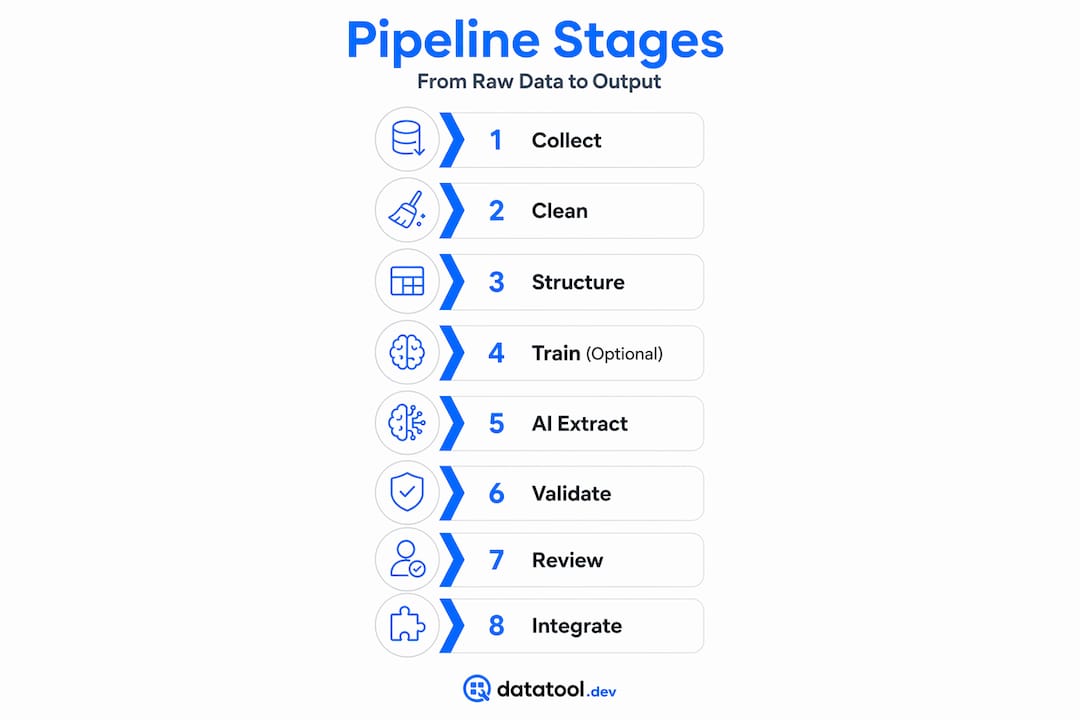
| Stage | Role | Common tools |
|---|---|---|
| Collection | Ingest documents from APIs, storage, or streams | S3, Azure Blob, Kafka |
| Cleaning | Remove noise, fix encoding, normalize whitespace | Custom scripts, pandas |
| Structuring | Classify document type, segment sections | Rule-based classifiers, ML |
| Training (optional) | Fine-tune extraction model on domain data | PyTorch, Hugging Face |
| Extraction | Pull target fields using AI model calls | GPT-4o, Claude, Gemini |
| Contextual understanding | Resolve ambiguity, apply business rules | LangChain, custom logic |
| Post-processing | Validate output, apply cross-field checks | Pydantic, JSON Schema |
| Integration | Route to data warehouse, analytics, or RAG | Parquet, BigQuery, Snowflake |
The critical insight here is that the AI model call sits at stage five. Everything before it prepares data so the model has a fair chance at accuracy. Everything after it catches what the model got wrong.
Schema-first design and validation
Schema-first extraction means you define the exact shape and constraints of your output before you write a single model call. The schema is a contract between your extraction pipeline and every system that consumes its output.

Strict validation is the single largest contributor to extraction reliability, more so than model choice or prompt tuning. Here is why. An LLM can return a plausible-looking but logically broken response. A required date field comes back as a string. A currency value has a symbol embedded. A total field does not match the sum of its line items. Per-field schema validation catches type errors. But cross-field validation catches the logical inconsistencies that schema checks alone miss.
A Pydantic model that enforces both layers looks like this:
"``python from pydantic import BaseModel, validator from typing import List
class LineItem(BaseModel): description: str quantity: int unit_price: float line_total: float
@validator("line_total")
def check_line_total(cls, v, values):
    expected = values["quantity"] * values["unit_price"]
    if abs(v - expected) > 0.01:
        raise ValueError(f"line_total {v} does not match quantity * unit_price {expected}")
    return v
class Invoice(BaseModel): invoice_number: str total: float items: List[LineItem]
@validator("total")
def check_invoice_total(cls, v, values):
    computed = sum(i.line_total for i in values.get("items", []))
    if abs(v - computed) > 0.01:
        raise ValueError(f"Invoice total {v} does not match sum of line items {computed}")
    return v
Without the cross-field validators, a model that hallucinates a total passes schema validation silently. With them, the failure surfaces immediately and routes to your error handler.
**Pro Tip:** *[Pin your extraction model version](https://landing.ai/llms/how-to-architect-a-document-extraction-pipeline-at-scale) in every API call. When a platform silently updates gpt-4o to a new checkpoint, your extraction behavior can change without warning. Version pinning gives you reproducibility and a stable baseline for testing.*
## Human-in-the-loop quality control
Human review is not a fallback for when things go wrong. It is a [designed architectural component](https://www.docsumo.com/blog/human-in-the-loop-systems) in any production extraction pipeline that handles uncertainty correctly. The model does not know what it does not know. Your pipeline needs to know instead.
Confidence scoring assigns a probability to each extracted field. Fields below your threshold get flagged. The routing logic then decides what happens next. A well-designed human-in-the-loop (HITL) system has five explicit components:
1. **Confidence thresholds per field type.** Critical fields like invoice amounts or patient IDs get stricter thresholds than metadata fields.
2. **Review queues by severity.** Low-confidence records go to a prioritized queue. Failed validation records go to a separate escalation path.
3. **Reviewer UI with field-level context.** Show reviewers the source document alongside the extracted value. Side-by-side context cuts review time significantly.
4. **Correction feedback loops.** Every reviewer correction is logged as a labeled training example. That data improves the next model version.
5. **Quality measurement dashboards.** Track field-level accuracy, review volume, and correction rates over time to detect model drift before it affects downstream data.
The feedback loop is where HITL pays compound returns. Each correction is a signal. Aggregate enough signals and you have a fine-tuning dataset that is specific to your document domain.
## Handling multimodal inputs
Not all documents are clean digital PDFs. Production pipelines handle scanned images, mixed-format files, embedded tables, and charts. Each input type needs its own processing path.
Common patterns for handling multimodal content include:
- **OCR for scanned image PDFs.** Use Tesseract or a cloud OCR API as a fallback when text extraction returns empty or garbled output. Confidence scores from OCR inform downstream extraction confidence.
- **Page splitting and relevance detection.** For large documents, split pages and run a classifier to identify which pages contain target data. Processing only relevant pages reduces cost and improves accuracy by keeping context windows clean.
- **Table extraction with holistic detection.** Naive PDF parsing breaks table structure. Use a dedicated table detection model or service, then assemble rows before passing to the extraction stage. [Splitting multipage tables](https://dev.to/dokubrain/how-to-extract-tables-from-pdfs-with-ai-4-methods-that-actually-work-2026-3gd2) across pages requires explicit row-assembly logic before validation.
- **Chart digitization with AI vision.** [Chart data extraction](https://www.llamaindex.ai/glossary/chart-data-extraction) converts visual chart elements into structured numerical arrays. Pass the image directly to a vision-capable model with a schema-constrained output prompt.
**Pro Tip:** *Apply [ingestion-time quality contracts](https://dzone.com/articles/multimodal-data-pipelines-ai-training) to every modality. Validate OCR confidence scores, check minimum page counts, and reject corrupt files at the gate. Propagating bad input data through five stages costs more than catching it at stage one.*
## Integration and observability
Processed output typically lands in JSON, CSV, or Parquet depending on the downstream consumer. Analytics pipelines prefer Parquet. RAG systems prefer JSON. [Output routing](https://princetonits.com/blog/ai-automation/case-study-into-document-extraction-pipeline-with-ai-builder/) to Excel, SharePoint, or Power Automate is common in enterprise workflows before human validation gates final delivery.
Observability is what keeps a working pipeline from quietly degrading over time. Monitor these layers:
| Layer | What to monitor | Tool options |
| --- | --- | --- |
| Data quality | Field null rates, type errors, cross-field failures | Great Expectations, custom checks |
| Model behavior | Confidence score distributions, extraction accuracy | MLflow, custom dashboards |
| Schema drift | New fields appearing, required fields missing | AI data quality monitoring |
| Pipeline health | Throughput, error rates, queue depth | Prometheus, Datadog |
Separate ownership of parsing logic from routing and output decisions. This architectural principle reduces fragility. The component that extracts does not decide where output goes. The component that routes does not parse. Each part fails and recovers independently.
## My take after working with real pipelines
I've seen more pipeline failures caused by missing validation than by model mistakes. The typical pattern is the same every time: a developer gets clean results in testing, ships to production, and three days later a slightly different document format causes the model to return a wrapped JSON string instead of a bare object. No one catches it because there is no schema check. The data lands in the warehouse with a string where a float should be.
What I've learned is that the AI model call is almost never the problem. The scaffolding around it usually is. Teams spend weeks on prompt engineering and ignore post-processing. They trust model output because it looks right. It's not enough for output to look right. It needs to pass validation, cross-field checks, and a confidence-based review before it ever touches a production database.
Human review is not overhead. It is quality infrastructure. Build it from day one, not when your data is already broken.
> *— Gregory*
## Fix broken AI extraction output with Datatool
When your pipeline outputs malformed JSON, you need a fix that works on real-world LLM failures, not just syntax errors.
[](https://datatool.dev/how-it-works/)
[Datatool](https://datatool.dev) handles the exact failures that show up in production AI data extraction workflows: broken JSON, truncated objects, partial responses, invalid escaping, and schema drift. Paste broken output, get valid structured data back. It fits directly into your post-processing and validation stage without rebuilding your pipeline from scratch. If you are working with AI data contracts, the [data contract guide](https://blog.datatool.dev/blog/what-is-a-data-contract-in-ai-systems-a-developers-guide) on the Datatool blog is a useful companion resource for schema design decisions.
## FAQ
### What is an AI data extraction pipeline?
An AI data extraction pipeline is a multi-stage automated workflow that ingests raw unstructured data, applies AI models to identify and extract target fields, validates the output against a schema, and delivers clean structured data to downstream systems. The standard architecture covers eight stages from collection through integration.
### How does schema validation fit into the extraction process?
Schema validation runs in the post-processing stage after the AI model returns its output. It checks each field for correct type, format, and value constraints, and cross-field validators catch logical errors like mismatched totals that per-field checks miss.
### When should a pipeline route records to human review?
Records route to human review when per-field confidence scores fall below defined thresholds, when schema validation fails, or when cross-field checks detect inconsistencies. Human corrections are logged as training data to improve model accuracy over time.
### What output formats do AI extraction pipelines produce?
Common output formats are JSON, CSV, and Parquet. The choice depends on the downstream consumer: Parquet for analytics pipelines, JSON for APIs and RAG systems, and CSV for spreadsheet-based workflows or legacy integrations.
### Why do AI extraction pipelines fail in production?
Production failures most often come from missing post-processing validation, no model version pinning, inadequate handling of diverse document formats, and the absence of monitoring for schema drift or confidence score degradation over time.
## Recommended
- [What Is a Data Contract in AI Systems? A Developer's Guide](https://blog.datatool.dev/blog/what-is-a-data-contract-in-ai-systems-a-developers-guide)
- [What is AI data grounding? A developer's guide](https://blog.datatool.dev/blog/what-is-ai-data-grounding-a-developers-guide)
- [Monitoring AI Data Quality in Production: 2026 Guide](https://blog.datatool.dev/blog/monitoring-ai-data-quality-in-production-2026-guide)
- [What is instruction following AI: A developer's guide](https://blog.datatool.dev/blog/what-is-instruction-following-ai-a-developers-guide)