

The fastest reliable pattern for fact checking LLM outputs is a hybrid pipeline: decompose the response into atomic claims, retrieve evidence for each one, then score claim-to-evidence entailment with a compact verifier instead of trusting the model's own confidence. Use a BM25 or dense retriever to pull candidate evidence, a cross-encoder NLI model or a probabilistic aggregator to score each claim, and set a threshold that routes uncertain cases to human review. The sections below walk through the research behind this recipe and give you working code.
TL;DR:
- A hybrid fact-checking pipeline combining claim decomposition, retrieval, and a compact verifier like Provenance offers an effective balance of cost and accuracy for production use.
- Using small, efficient NLI models such as MiniCheck can achieve near GPT-4 grounding performance at roughly 400 times lower computational cost, enabling scalable verification.
- Flagging claims below a set threshold for human review and logging all evidence and repair decisions ensures a transparent, auditable process suited for real-world deployment.
- Deteministic repair rules for structured data fields are preferred over model-generated fixes, with logs capturing every change for auditability.
- Regular evaluation using datasets like FactQA and FactBench, along with evidence-removal tests, helps identify verifier reliance on parametric memory and improves overall reliability.
Table of Contents
- LLM Fact Checking Methods: Which One to Use When
- Building a Fact-Checking Pipeline: Atomize, Retrieve, Verify, Aggregate
- How to Fact Check AI Output in Code: Detect, Verify, Repair
- Evaluation Metrics for LLM Fact Checking Systems
- Common Failure Modes When Verifying LLM Claims
- What Actually Moves the Needle in Production Fact Checking
- Fixing the Structured Data a Fact Checker Flags
- Sources
- FAQ
LLM Fact Checking Methods: Which One to Use When
Four research directions cover most production needs. Pick based on cost, latency, and how much you trust retrieval to be complete.
- PCC (Probabilistic Certainty and Consistency): use claim-conditioned probability at the token level when you need to decide, cheaply, whether a claim even needs retrieval. PCC's approach shows token-level certainty beats a model's own stated confidence for flagging likely hallucinations before you spend retrieval budget on them.
- FACTREASONER: use this when you're checking long-form answers where claims depend on each other. It atomizes the response, retrieves context per atom, then runs probabilistic graphical reasoning to estimate support probability across the whole claim graph, not just claim by claim.
- Provenance: the pick for RAG systems that need low latency. Its compact cross-encoder NLI approach scores claim-to-source entailment and traces which context chunk caused a hallucination, which matters when you're debugging a broken pipeline, not just scoring it.
- MiniCheck: the pick when compute is the constraint. MiniCheck-FT5 is a 770M-parameter model, and MiniCheck's benchmark results show it matches GPT-4-level grounding verification at roughly 400 times lower compute cost.
- OpenFactCheck: not a verifier itself, but the toolkit you use to test the other four. It ships a ResponseEvaluator, LLMEvaluator, and CheckerEvaluator alongside the FactQA and FactBench datasets so your benchmark numbers are comparable across runs.
The 400x number matters more than it looks. A 770M-parameter model matching GPT-4 grounding accuracy means you can run fact verification on every response in a production pipeline without the latency or bill of routing everything through a frontier model as judge.
Building a Fact-Checking Pipeline: Atomize, Retrieve, Verify, Aggregate
Five stages, each with a decision point that changes your cost and accuracy profile.
- Atomize. Break the response into self-contained claims. A prompt like "list each factual claim in this text as an independent sentence with no pronouns" works for most cases. FACTREASONER's atom-level decomposition is worth copying here because it keeps each unit checkable against a single piece of evidence.
- Retrieve. Pull candidate evidence per claim. BM25 is cheap and good for keyword-heavy domains (legal, medical codes). Dense retrievers catch paraphrased evidence but cost more and need tuning. Cap candidates at 3 to 5 passages per claim. More than that adds noise, not accuracy.
- Verify. Score claim-to-evidence entailment. For RAG-style grounding, a Provenance-style cross-encoder NLI model is fast and cheap per call. For claims with no direct source but strong internal consistency requirements, a probabilistic aggregator like FACTREASONER's graphical model handles cross-claim dependencies better than pairwise NLI alone. Use LLM-as-verifier only when neither fits, since it's the slowest and most expensive option.
- Aggregate. Combine per-source entailment scores into one factuality score per claim. Weighted-average scoring (weighting by source relevance) tends to outperform simple min or max in practice, and it's what Provenance uses to produce a single thresholdable score per claim.
- Mitigate. Below your threshold: flag for human review. Just below the safe zone: annotate with a confidence calibration label. Clear failures on structured fields: apply deterministic repair, never a speculative guess.
Latency stacks up fast if you run all five stages on every claim in every response. Batch retrieval calls, cache evidence for repeated claim patterns, and reserve the expensive verifier tier for claims that fail a cheap first-pass check.
How to Fact Check AI Output in Code: Detect, Verify, Repair
Here's what breaks. An LLM returns a product summary with a structured field:
{
  "product": "Model X200 Router",
  "max_speed_mbps": 1200,
  "certification": "FCC and CE certified, approved for use in all 50 states"
}
The router's actual spec sheet says nothing about "all 50 states." Nobody certifies hardware "for all 50 states" as a category. That claim came from the model pattern matching on similar product copy, not from evidence in context. Ship this and a customer support team finds it in a client's compliance audit.
The fix, in three steps:
- Extract and check the claim.
claims = atomize(output["certification"])
# ["FCC certified", "CE certified", "approved for use in all 50 states"]

for claim in claims:
    evidence = retrieve(claim, index=product_docs, top_k=4)
    score = nli_verifier(claim, evidence)  # cross-encoder, Provenance-style
    if score < THRESHOLD:
        flag_for_review(claim, evidence, score)
- Route the failing claim. "Approved for use in all 50 states" scores below threshold because no retrieved passage supports it. It gets flagged, not auto-deleted.
- Repair the structured field deterministically. Speculative string edits on a flagged field (guessing at a "safer" replacement claim) introduce a second unverified claim. Strip the unsupported clause and log the evidence IDs that triggered the flag instead.
output["certification"] = repair_field(
    output["certification"],
    remove=["approved for use in all 50 states"],
    log_evidence=evidence
)
Pro Tip: Prefer deterministic repair rules for structured fields over model-generated fixes, and log every repair decision with its evidence IDs. That log is what lets you audit a year of automated corrections instead of trusting a black box.

Evaluation Metrics for LLM Fact Checking Systems
AUC and ROC tell you how well a verifier separates supported from unsupported claims across every possible threshold, which matters more than a single accuracy number because you'll tune that threshold per use case (high-risk medical claims need a stricter cutoff than product blurbs).
- Precision/recall tradeoff: high precision means fewer false accepts (bad claims marked "true"), which matters most when auto-publishing. High recall matters more when you're building a review queue and can't afford to miss a real hallucination.
- F1@K: for long-form outputs with many claims, F1@K scores the top-K flagged claims, which better reflects real review workload than a flat F1 across every atom.
- Fact-Ablated Evaluation (FAE): iteratively removes cited evidence to see if the verifier's prediction changes. If it doesn't change, the verifier is relying on parametric memory, not the evidence you gave it. REAL training is the proposed fix, and it's worth running FAE on any verifier before you trust it in production.
Run OpenFactCheck's benchmark suite against your chosen verifier before deployment. It's the closest thing to a standard comparison point across the research above.
Common Failure Modes When Verifying LLM Claims
- Parametric-memory bias. Verifiers sometimes agree with a claim because it matches training data, not because the retrieved evidence supports it. Run FAE tests regularly, not just once at launch.
- Noisy or conflicting retrieval. Contradictory passages confuse NLI scoring. Weight sources by recency and reliability, and add explicit contradiction detection before aggregation.
- Verifier brittleness at scale. Large judgeless get expensive fast. Favor small NLI models for the bulk of RAG traffic and reserve human review for claims near the decision boundary, where near-threshold entailment scores are the least trustworthy signal you have.
What Actually Moves the Needle in Production Fact Checking
Research papers optimize for benchmark scores. Production teams need something they can debug at 2 a.m. That gap is the real argument for favoring small, auditable NLI models and deterministic repair rules over an opaque LLM-as-judge setup: when a small cross-encoder gets a claim wrong, you can trace exactly which evidence chunk it scored and why. When a large judge model gets it wrong, you get a paragraph of plausible-sounding reasoning and no path to fix it.
Instrument every stage. Log provenance, log scores, log every human-review trigger. Reproducible benchmarks beat impressive demo numbers, every time a claim ends up in front of a customer.
— Gregory
Fixing the Structured Data a Fact Checker Flags
Provenance and MiniCheck tell you a claim is wrong. They don't fix the malformed JSON field that claim is sitting in, and that's a different problem than most fact-checking research addresses. There is a deterministic repair engine for the broken, partial, or badly escaped structured output that LLMs produce alongside their factual errors.
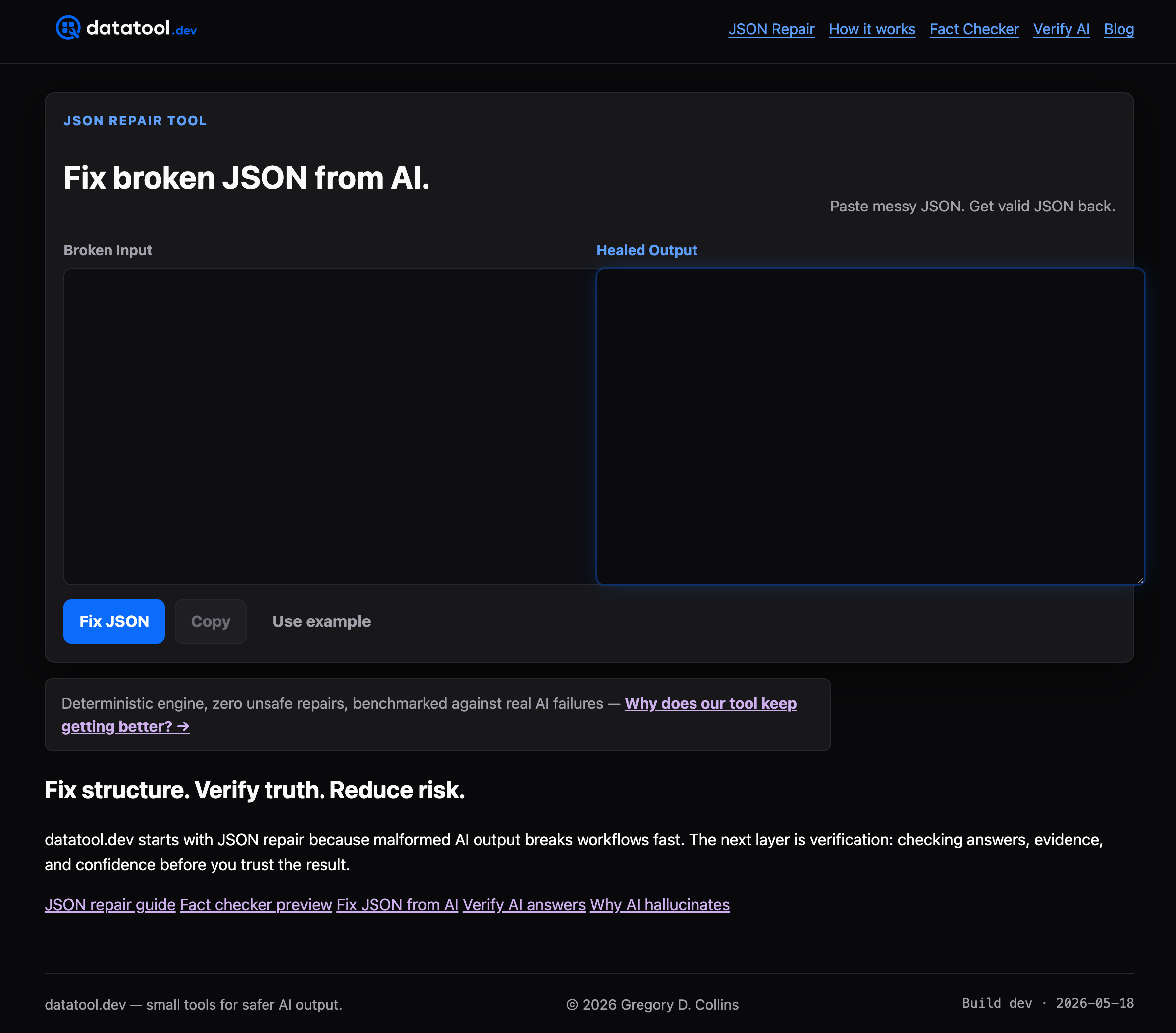
The JSON repair tool fixes truncated objects, invalid escaping, and schema drift without guessing at replacement values in ambiguous fields, and every repair gets logged so you can audit exactly what changed and why. If you're already running a verification pipeline like the one above, pair it with the @datatool/json-heal engine described on the how it works page to handle the structural side of the problem. Paste in a malformed response from your own pipeline and see what it catches.
Sources
- MiniCheck: Efficient Fact-Checking of LLMs on Grounding Documents (ACL 2024)
- Provenance: A Light-weight Fact-checker for Retrieval Augmented LLM Generation Output (arXiv 2024)
- OpenFactCheck: A Unified Framework for Factuality Evaluation of LLMs
FAQ
What Is the Best Method for Fact Checking LLM Outputs?
There's no single best method. A hybrid pipeline combining claim decomposition, retrieval, and a compact NLI verifier like Provenance covers most production cases, while MiniCheck is the better pick when compute cost is the binding constraint.
How Do You Verify AI Generated Content Without a Large Judge Model?
Use a small cross-encoder NLI model to score claim-to-evidence entailment instead of routing every response through a large LLM as judge. MiniCheck's 770M-parameter model matches GPT-4-level grounding accuracy at a fraction of the compute cost.
What Is Evidence-Dependency Testing and Why Does It Matter?
Evidence-dependency testing, like Fact-Ablated Evaluation, checks whether a verifier's judgment actually changes when you remove the cited evidence. If a verifier's prediction stays the same, it's relying on parametric memory rather than the evidence provided, which means it will fail silently on genuinely novel claims.
Can Datatool Help With Fact Checking LLM Outputs?
Datatool doesn't run claim verification itself. It handles the structured-data side of the problem: repairing and validating the malformed JSON fields that often accompany factual errors in LLM output, with every repair logged for audit. Current pricing and trial details are available on the JSON repair tool page.
What Datasets Are Used to Benchmark LLM Factuality Checkers?
LLM-AggreFact and OpenFactCheck's own FactQA and FactBench datasets are the standard benchmarks for comparing verifier accuracy across methods. Running your chosen verifier against these before deployment gives you a comparable baseline against published research results.