

LLM output validation is the practice of checking a model's response against schema, content, and safety rules before your code acts on it. The single best control: always run schema validation and sanitize the output before it touches a database, a UI, or a tool call. Two trusted building blocks make this concrete: Pydantic for schema enforcement in Python, and native structured-output modes for constraining what the model can even return. If you want a faster path than building this from scratch, Datatool repairs and validates malformed AI output directly.
TL;DR:
- Structural validation with schema enforcement, using tools like Pydantic, catches malformed JSON, type mismatches, and schema drift early in the process.
- Content and grounding checks verify the factual accuracy of responses against retrieved sources, reducing hallucinations and fabricated citations.
- Implementing retries with precise error feedback improves the reliability of model outputs, but should be limited to avoid endless loops.
- Combining lightweight runtime signals with expensive off-line evaluations creates an effective funnel for high-stakes validation while managing cost and latency.
- Prioritize core schema validation, sanitization, and a structured retry loop in early deployment to prevent widespread errors and build on more complex checks later.
Table of Contents
- Why LLM Output Validation Matters More Than You Think
- The Five Categories of Output Validation You Need
- How to Build a Parse, Validate, Act Pipeline
- Constrained Decoding vs API Structured Modes vs Post-Hoc Parsing
- Runtime Detection vs Offline Evaluation: What Runs When
- Metrics That Actually Tell You If Validation Is Working
- Building Tests and Logging That Catch Regressions Early
- Testing structured AI output at scale reveals the same handful of failure patterns appear across nearly every customer's traffic, regardless of which model or provider they're using.
- Verifying Facts Against External Knowledge Bases
- Turning User Feedback Into Better Validation Rules
- Customizing Validation Rules for Your Domain
- Where Current Validation Approaches Still Fall Short
- What I'd Actually Prioritize in Your First Two Weeks
- How Datatool.dev Fixes What Validation Alone Can't Catch
- Sources
Why LLM Output Validation Matters More Than You Think
Every developer who has shipped an LLM feature has hit this: the model works fine in testing, then breaks in production on some input you never tried. The output looks almost right. That's the problem.
LLM output validation exists because "almost right" is exactly what breaks production systems. A model doesn't fail loudly like a crashed server. It fails quietly, by returning something that parses but is wrong, or something that doesn't parse at all.
Here's what actually shows up in production logs, based on patterns Datatool sees repeatedly across customer traffic:
- Broken JSON — a trailing comma, an unescaped quote inside a string value, or a missing closing brace.
- Code fences wrapping the payload — the model returns
json ...instead of raw JSON, and yourjson.loads()throws immediately. - Truncated lists — the response gets cut off mid-array because it hit a token limit.
- Wrong types — a field defined as an integer comes back as the string
"12"or, worse,"twelve". - Hallucinated fields — the model invents a key that isn't in your schema because it "felt" relevant.
- Fabricated citations — a source URL or case number that looks plausible and doesn't exist.
- PII leakage — a phone number or email address the model pulled from training data or a prior turn in the conversation.
- Injection vectors — raw HTML or SQL fragments embedded in a text field, ready to execute if you don't sanitize.
Each of these maps to a real downstream risk. Broken JSON throws an unhandled exception. Wrong types corrupt a database column or silently fail a type check further down the pipeline. Fabricated citations erode user trust the moment someone clicks a dead link. PII leakage and injection vectors are compliance and security incidents, not just bugs.
The three-stage discipline of parse, validate, and act exists precisely because skipping any one of those stages lets a malformed response reach your application logic unchecked. Teams that skip validation entirely tend to discover the cost the hard way, usually during an incident review after a bad write hit production data.
Statistic callout: Structural failures aren't rare edge cases. They're a routine tax on any LLM integration that skips validation, showing up anywhere requests involve long outputs, nested objects, or nontrivial formatting instructions. Treat "the model will occasionally return garbage" as a baseline assumption, not an exception path.
The Five Categories of Output Validation You Need
Not every check belongs in the same place, and not every check catches the same failure. Splitting validation into five categories gives you a way to decide what runs where, instead of bolting one generic "is this okay?" check onto everything.
Structural validation checks that the shape of the output matches what you expect: correct JSON, correct field names, correct types. This is what Pydantic does. It catches malformed syntax and type mismatches but says nothing about whether the content is true or safe. Enforce it immediately after parsing, before anything else touches the payload.
Content validation checks whether the substance of the output is correct: does the summary reflect the source document, does the extracted date actually appear in the text, is the answer grounded in retrieved context. This is where hallucination detection lives. Structural validation can pass while content validation fails completely, a response can be perfectly formed JSON and still be wrong.
Behavioral validation checks whether the model did the task it was asked to do, not just whether it produced valid-looking output. A classification model that returns a valid category label but picks the wrong category has passed structural and even content checks while failing behaviorally. This category typically requires either a rules-based check against expected outcomes or a judge model comparing output against task intent.
Authorization validation checks whether the model's proposed action is something the calling user or agent is actually permitted to do. An agent that generates a valid, well-grounded API call to delete a customer record has passed every content check and still needs to be blocked if the calling context lacks delete permission. This check belongs at the tool-call boundary, not earlier.
Safety validation checks for PII, toxic content, and injection payloads (HTML, SQL, script tags) hiding inside otherwise valid fields. Per OWASP's guidance on improper output handling, LLM output should be treated as untrusted input, no different from a form field submitted by an anonymous user on the internet. Sanitize after schema validation, before anything downstream renders or executes the content.
The right way to think about placement: structural and safety checks run right after the model call, before the payload goes anywhere. Content and behavioral checks run before the result is presented as fact or acted upon by an agent. Authorization checks run at the exact moment an action would execute, never earlier, because permissions can change between generation and execution.
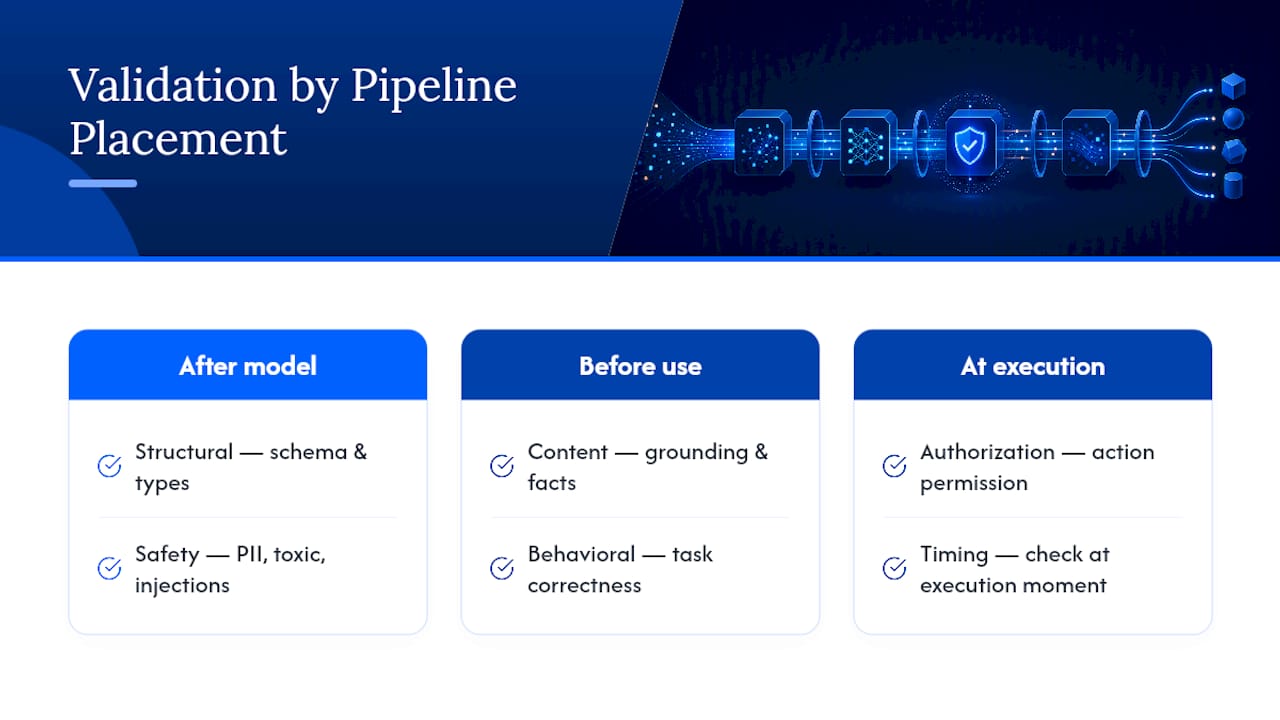
Validation is genuinely destination-aware: a field going into a UI tooltip needs different sanitization than a field going into a SQL query builder. A single generic validator applied everywhere is close to no validator at all.
Pro Tip: For a two-week pilot, run structural and safety checks on everything, but only add behavioral and content checks to the one or two highest-risk output paths. Trying to build all five categories at once before shipping anything is how validation projects stall.
How to Build a Parse, Validate, Act Pipeline
The production pattern is three ordered steps, and skipping the order is where most home-grown validation breaks: parse the raw response, validate it against schema and content rules, then act (accept, retry, fall back, or escalate to a human).
- Parse. If you're using an API with native structured-output modes, parsing is close to free. Otherwise, strip markdown code fences, trim leading and trailing whitespace, and extract the first valid JSON object with a regex before attempting
json.loads(). - Validate. Run the parsed object through a schema. This is where Pydantic earns its place in almost every Python LLM stack.
- Act. On success, pass the object downstream. On failure, decide: retry with the error message included, fall back to a default, or escalate to a human reviewer.
Here's the failure most teams hit first. You ask the model for a structured product record, and it returns this:
raw_response = '''
{
  "product_name": "Wireless Mouse",
  "price": "twenty-nine ninety-nine",
  "in_stock": "yes"
}
'''
That's valid JSON. It will parse without error. It will also corrupt your database, because price should be a float and in_stock should be a boolean. Without schema validation, this record sails straight through.
Here's the fix, using Pydantic to define the contract and enforce it:
from pydantic import BaseModel, Field, ValidationError

class Product(BaseModel):
    product_name: str
    price: float = Field(ge=0)
    in_stock: bool

try:
    product = Product.model_validate_json(raw_response)
except ValidationError as e:
    print(e)
    # price: Input should be a valid number, unable to parse string as a number
    # in_stock: Input should be a valid boolean, unable to interpret input
Pydantic v2 raises a ValidationError naming exactly which fields failed and why, instead of letting a string silently sit in a numeric column. It also supports nested models and field constraints like Field(ge=0), so you can catch a negative price or an empty required string in the same pass.
The retry step is what turns a single failure into a recoverable one. Feed the validation error back into the model as part of the next prompt:
def validate_with_retry(raw_response, call_model_fn, max_retries=2):
    for attempt in range(max_retries + 1):
        try:
            return Product.model_validate_json(raw_response)
        except ValidationError as e:
            if attempt == max_retries:
                raise
            retry_prompt = (
                f"Your last response failed validation with this error:
{e}
"
                "Return corrected JSON matching the schema exactly."
            )
            raw_response = call_model_fn(retry_prompt)
Including the exact error text in the retry prompt, rather than a generic "try again," is what makes retries actually work. Models correct specific, named errors far more reliably than vague instructions.
Pro Tip: Cap retries at two or three. If the model still can't produce valid output after that, the problem usually isn't a fluke, it's a bad prompt, a schema mismatch, or a task the model can't reliably do. Escalate to a fallback default or a human reviewer instead of retrying forever.
Fallback policy matters as much as the retry loop itself. Decide upfront, per field or per output type, what happens on final failure: return a cached default, mark the record for manual review, or block the action entirely. An agent proposing a database write should never fall back to "guess and proceed."
For teams staging this before a full rollout, a pre-production validation setup that separates structural gates from content gates makes the pilot phase far easier to reason about than trying to validate everything at once.
Constrained Decoding vs API Structured Modes vs Post-Hoc Parsing
Three architectural approaches solve the same problem at different points in the pipeline, and picking the wrong one for your constraints causes most of the "why does this keep failing" frustration teams report.
Constrained decoding uses a finite-state machine or token-masking to make invalid tokens impossible to generate in the first place. If you self-host a model, this is the strongest guarantee available, because the model literally cannot emit a token that violates your grammar. The trade-off is operational: you need to run and maintain the constraint engine yourself, and it adds complexity to your inference stack.
API-native structured-output modes, offered by hosted providers as JSON-mode or schema-constrained generation, give you a similar guarantee without self-hosting anything. You define a schema, the API enforces it server-side, and you get back valid JSON close to every time. The limitation: you're bound to whatever schema features and nesting depth the provider supports, and behavior can change between API versions without much warning.
Post-hoc parsing means asking the model nicely for JSON in the prompt, then parsing whatever comes back. It's the universal fallback, it works with any model or provider, but it's the least reliable of the three by a wide margin. Constrained decoding and native structured modes both reduce the invalid-output rate that post-hoc parsing has to clean up after the fact.
Here's how the trade-offs actually break down:
- Constrained decoding: highest reliability, requires self-hosting infrastructure, adds ongoing operational cost.
- API-native structured output: high reliability, no hosting burden, limited by provider schema support and version drift.
- Post-hoc parsing: lowest reliability, works everywhere, must always be paired with retries and full schema validation to be usable in production.
If you're moving a prototype toward something you can actually ship, the gap between "worked in a demo" and "survives production traffic" is almost always closed by picking one of these deliberately instead of defaulting to post-hoc parsing because it was the first thing that worked. The team at Vibeprod writes specifically about that jump from prototype behavior to production-ready systems, and output handling is usually the first thing that needs to change.
Most teams end up running two of these at once: API-native structured output for the primary call, with post-hoc parsing and full Pydantic validation as the safety net for whatever the API mode doesn't catch.
Runtime Detection vs Offline Evaluation: What Runs When
Runtime detectors check output as it happens, in the request path, with a hard budget on latency. Offline evaluation runs after the fact, on batches of logged output, with no latency pressure and a much bigger budget for expensive checks. You need both, because they catch different things and cost wildly different amounts to run.
Cheap runtime signals you can afford on every single request:
- Token log-probabilities — low-confidence tokens in a factual claim are a cheap proxy for uncertainty.
- Length and format heuristics — a response that's suspiciously short, or missing an expected section, is a fast red flag.
- Simple consistency checks — does the extracted date actually appear as a substring in the source document.
Expensive checks you reserve for high-stakes or already-flagged responses:
- Grounding checks against retrieved context — does the claim actually appear in what was retrieved.
- LLM-as-judge review — a second model scores the response against the source and the task.
- Cross-model review — a different model family checks the first model's work, catching shared blind spots a same-family judge might miss.
This funnel structure, cheap signals on everything, expensive checks on the flagged subset, keeps latency and cost manageable while still catching the cases that matter. Retrieval-augmented systems have an advantage here: grounding checks convert vague, hard-to-verify claims into concrete, checkable ones by giving the judge something specific to compare against.
One detail matters more than it looks: the judge model's own output has to be structured and schema-validated too. A judge that returns free-form prose like "this seems mostly fine" is useless as an automated gate. Force it to return structured JSON and validate that output the same way you validate the primary response.
| Signal type | Example check | Cost | When to run |
|---|---|---|---|
| Cheap runtime | Token log-probability | Low | Every request |
| Cheap runtime | Length/format heuristic | Low | Every request |
| Expensive runtime | Grounding vs retrieved context | Medium/High | Flagged or high-stakes requests |
| Expensive runtime | LLM-as-judge review | High | Flagged or high-stakes requests |
| Offline | Batch regression scoring | Low (no latency limit) | Nightly or on deploy |
A grounding check's structured output typically looks like this:
{
  "claim": "Refunds are processed within 5 business days.",
  "grounded": false,
  "confidence": 0.42,
  "action": "abstain"
}
Map action to a small fixed set: pass (send it), abstain (don't answer, say so), retry (regenerate with added context), or escalate (route to a human). Keeping that action space small is what makes the whole detector maintainable once you have five or six checks feeding into it.
Metrics That Actually Tell You If Validation Is Working
Tracking "it feels more reliable" isn't a metric. Here's what to log and chart instead.
- Structural pass rate — the percentage of responses that pass schema validation on the first try, before any retry.
- Schema error rate by field — which specific fields fail most often, which usually points at a prompt or schema mismatch, not a model problem.
- Citation precision and recall — of the sources a response cites, how many are real and relevant (precision), and of the sources that should have been cited, how many were (recall).
- Runtime abstain rate — how often the abstain action fires, a rising trend usually means the task got harder or the model changed.
- User escalation rate — how often a human had to step in, the single clearest proxy for "is this actually saving anyone time."
Statistic callout: Structural pass rate is the metric to alert on first. It's cheap to compute, has no ambiguity, and a sudden drop almost always means either a prompt change, a model version bump, or an upstream data change, all things worth paging someone about.
LLM-as-judge scorers work well alongside statistical scorers, but don't run them alone. A judge model can be inconsistent between runs on the same input, so pair it with a deterministic check (schema pass, citation lookup) for anything you plan to alert on automatically.
Resist the pull toward BLEU or ROUGE for LLM output. Those metrics were built for measuring overlap with a single reference translation or summary, and they penalize a correct answer phrased differently from the reference just as hard as a wrong one. For open-ended generation, they mostly measure phrasing similarity, not correctness.
Combine two or three of the metrics above into a composite score, and set alert thresholds on the composite rather than any single number. A small dip in citation precision alongside a stable structural pass rate is a different problem than both dropping together, and your alerting should be able to tell the difference.
Building Tests and Logging That Catch Regressions Early
A validator you never test is a validator you can't trust. Here's the minimum test and logging setup worth building before you scale traffic.
- Unit test the schema and behavior together. Mock a model response, run it through your Pydantic model and any behavioral check, and assert both the pass and fail paths explicitly.
- Add a regression suite of known-tricky inputs. Every malformed response you've seen in production becomes a permanent test case, so a prompt change or model upgrade can't silently reintroduce it.
- Wire the regression suite into CI. Run it on every pull request that touches a prompt, schema, or model version, not just at release time.
A minimal unit test looks like this:
def test_product_rejects_bad_price():
    mock_response = '{"product_name": "Mouse", "price": "n/a", "in_stock": true}'
    with pytest.raises(ValidationError):
        Product.model_validate_json(mock_response)

def test_product_accepts_valid_payload():
    mock_response = '{"product_name": "Mouse", "price": 29.99, "in_stock": true}'
    product = Product.model_validate_json(mock_response)
    assert product.price == 29.99
On the logging side, four things belong in every record, every time:
- The raw model output, unmodified, before any parsing.
- The parsed payload, after extraction and cleanup.
- Validator errors, with field names and the exact rule that failed.
- Judge verdicts, when a runtime detector ran one, including its confidence score.
Retain these logs long enough to support an audit trail, not just a debugging session. When a bad output reaches a customer, you want to reconstruct exactly what the model said, what your validator caught or missed, and why. Guidance on structuring these tests as a repeatable suite, rather than one-off scripts, pays off the first time a model provider ships a silent update that changes your failure rate overnight.
Testing structured AI output at scale reveals the same handful of failure patterns appear across nearly every customer's traffic, regardless of which model or provider they're using.
- Broken JSON from trailing commas, unescaped quotes inside string values, or a missing closing bracket.
- Wrapped responses, where the model answers "Sure, here's the JSON:" and wraps the payload in a markdown code fence your parser doesn't expect.
- Escaping issues, especially with nested quotes or backslashes inside string fields, that produce JSON which looks fine to the eye and fails every parser.
- Truncation, where a response gets cut off mid-object because it hit a token limit, leaving a dangling comma or an unclosed array.
The pattern that catches teams off guard most often isn't a single catastrophic failure. It's a small, consistent rate of malformed responses that pass unnoticed until a batch job or a customer-facing feature starts throwing errors at scale. By the time someone notices, thousands of records may already be corrupted.
The recommended fix, drawn from datatool.dev's detection and remediation guides, is a deterministic repair pass before validation: normalize whitespace, strip code fences, fix common escaping mistakes, then hand the result to your schema validator. That order matters. Repairing after validation just means you validate garbage twice.
A short excerpt from that kind of repair pass, credited to datatool.dev's testing patterns:
INPUT:  ```json
{"name": "Widget", "qty": 5,}
```
REPAIR: stripped code fence, removed trailing comma
OUTPUT: {"name": "Widget", "qty": 5}
STATUS: valid, passed schema check
The lesson from testing this at scale: don't treat malformed output as an edge case you'll handle "if it comes up." Build the repair and detection guide into your pipeline setup from day one, because it comes up constantly, not occasionally.
Verifying Facts Against External Knowledge Bases
Schema validation confirms a response is shaped correctly. It says nothing about whether the claims inside it are true. That's a separate problem, and it needs a separate technique: checking generated claims against an external source of truth instead of trusting the model's confidence.
The most reliable version of this pattern is retrieval-augmented generation paired with a grounding check. You retrieve relevant documents first, generate an answer constrained to that context, then verify afterward that each claim in the answer actually traces back to something in the retrieved text. This works because it converts an open-ended, hard-to-verify claim into a specific, checkable one: instead of asking "is this true," you ask "does this sentence appear, in substance, in this specific document," which is a much easier question for a second model or a rules-based matcher to answer.
Chain-of-Verification is a related technique worth knowing. Instead of generating an answer and stopping, the model generates a draft, then generates verification questions about its own draft, answers those questions independently, and revises the draft based on the answers. Looping generation and verification this way has been shown to reduce hallucination rates compared to a single-pass response, particularly for policy or factual questions with a clear right answer.
Neither technique eliminates the need for schema validation. They solve a different layer of the problem, and both work best when the verification step itself returns structured, schema-checked output, not free-form prose you then have to re-parse by hand.
Turning User Feedback Into Better Validation Rules
Every validation rule you write today was informed by a failure you already saw. The fastest way to keep improving is to make user feedback a direct input into your rule set, not just a support ticket that gets closed and forgotten.
Start by tagging every user-reported issue with which validation category it should have caught: structural, content, behavioral, authorization, or safety. This immediately tells you where your current gate has a hole. A pattern of users reporting "the numbers are wrong" points at content validation, not a schema problem, and building another Pydantic constraint won't fix it.
Build a feedback loop with three stages. First, capture the specific bad output and the user's correction, verbatim, not paraphrased. Second, add that exact case to your regression test suite, so the same failure can't silently reappear after a model update. Third, decide whether the fix belongs in the prompt, the schema, or a new runtime check, and implement it in that order because prompt fixes are cheapest to test and revert.
Thumbs up/down widgets are a weak signal on their own, they tell you something was wrong but not what. Pair them with a short "what was wrong" field, even optional, and route flagged responses into the same log stream as your validator errors and judge verdicts. That gives you one place to see whether a spike in user complaints correlates with a drop in structural pass rate or a rise in abstain rate, which tells you whether the fix belongs in code or in the model configuration.
Customizing Validation Rules for Your Domain
Generic schema checks catch generic problems. A medical, legal, or financial application needs validation rules that reflect what "wrong" actually means in that domain, and those rules rarely come out of a general-purpose library.
Start with the failure modes that are unique to your field, not the ones every LLM integration shares. A legal document generator needs to check that cited statutes exist and are current, not just that the JSON parses. A medical summarization tool needs to flag any dosage figure for human review, regardless of how confident the model sounds. These checks belong on top of, not instead of, the standard structural and safety layers.
Domain-specific validators tend to fall into three buckets: range and unit checks (a dosage in milligrams that falls outside a clinically plausible range), reference checks (a citation, statute, or product code that must exist in an authoritative list), and terminology checks (flagging non-standard terms in a field that should use a controlled vocabulary). Each of these can be implemented as a custom Pydantic validator function attached to the relevant field, so the domain rule and the schema rule live in the same place and fail with the same kind of error.
Build these rules incrementally, driven by real failures, not a speculative list of everything that could theoretically go wrong. A rule with no observed failure behind it is a guess, and guesses tend to either miss real problems or generate so many false positives that engineers start ignoring the alerts entirely.
Where Current Validation Approaches Still Fall Short
None of the techniques covered here fully solve output validation, and pretending otherwise sets teams up for a false sense of safety.
LLM-as-judge scoring, one of the most widely used content-validation techniques, has a consistency problem: the same judge model can score the same input differently on different runs, and different judge models often disagree with each other on subjective quality dimensions. Grounding checks help with factual claims but do little for behavioral correctness, whether the model actually did the right thing, which usually still needs either a rules-based check or human review.
Self-verification techniques split into two families that behave differently and get conflated more often than they should: sampling-based consistency (does the model give the same answer across multiple tries) and critique-based revision (does the model catch its own mistake when asked to review its work). A system that only implements one and calls it "self-verification" is covering half the problem.
Cost and latency remain real constraints. Running an LLM-as-judge check on every single response is often too slow and too expensive for high-volume applications, which is why the funnel approach, cheap signals first, expensive checks second, exists as a compromise rather than an ideal solution.
The direction most worth watching is tighter integration between constrained decoding and content-level checks, so structural correctness and factual grounding get enforced closer to generation time instead of entirely after the fact. Until that matures further, the honest position is that validation today catches most structural and safety problems reliably, and catches content and behavioral problems only partially, no matter how many layers you stack.
What I'd Actually Prioritize in Your First Two Weeks
If you're starting from zero, don't try to build all five validation categories before shipping anything. Prioritize three things: schema validation on every output with Pydantic, sanitization on anything rendered in a UI or written to a database, and a retry loop that feeds the exact validation error back to the model. That combination catches the majority of what actually breaks in production, and it's buildable in days, not weeks.
The mistake I see most often isn't a missing technique. It's sequencing. Teams build the impressive parts, an LLM-as-judge pipeline, a grounding checker, before they've wired up basic schema validation and a gate that blocks bad output from reaching users. That's backwards. A judge model scoring output that never got structurally validated is polishing a result you shouldn't have shipped in the first place.
The second mistake is delaying validation until "after we see how it performs in production." By then you've already shipped the corrupted records, the broken renders, the fabricated citations a user screenshotted and posted somewhere public. Validation gates belong in the pipeline before the first real user sees output, not after.
— Gregory
How Datatool.dev Fixes What Validation Alone Can't Catch
Some platforms provide a fast path to reliable structured output when you don't want to build a repair and validation layer from scratch. They target common failures, including broken JSON, wrapped responses, partial objects, invalid escaping, and truncation, using a deterministic repair engine instead of relying on another model to guess at a fix.
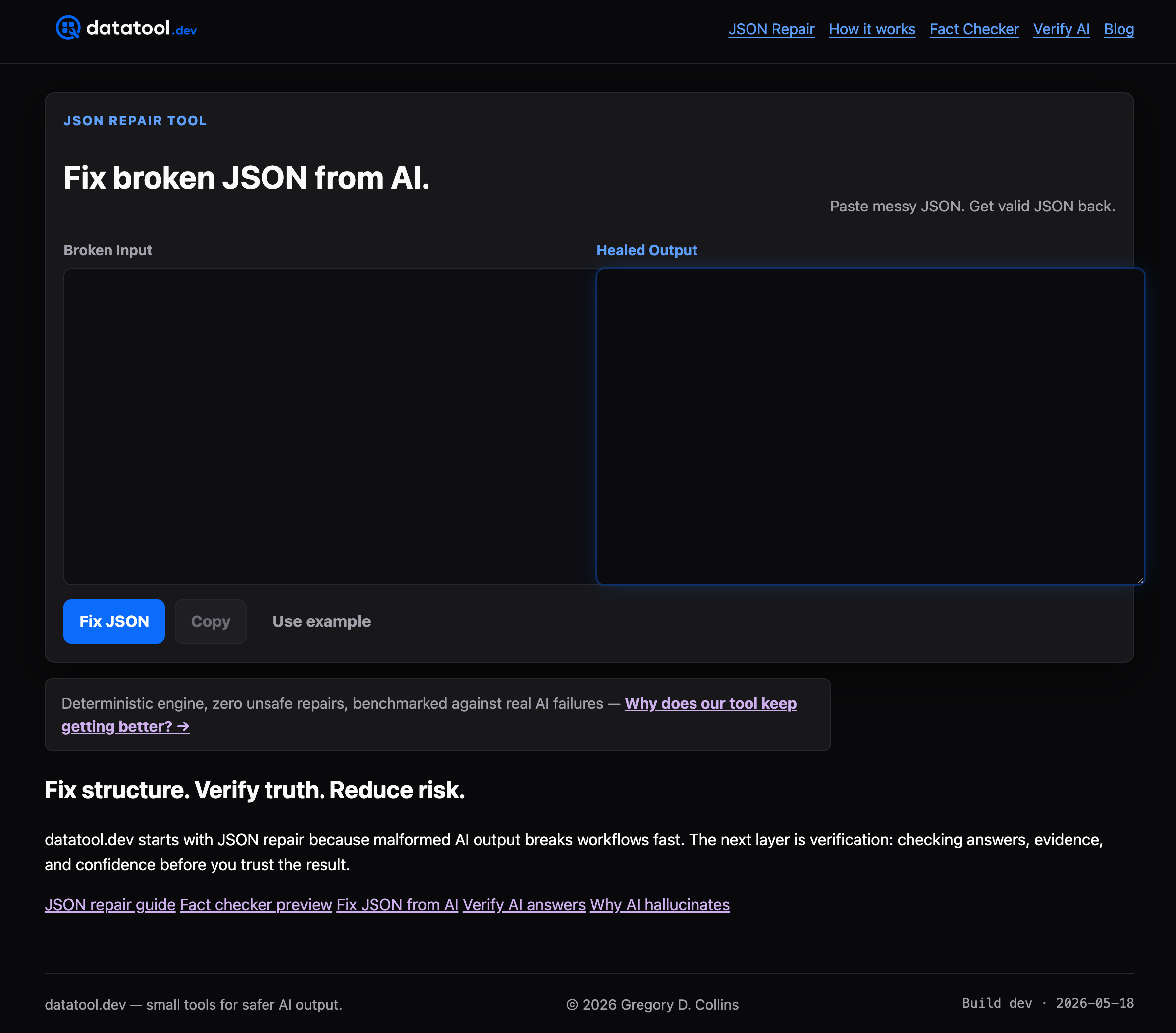
Certain core capabilities align with the pipeline described here: deterministic JSON repair for malformed output, schema validation to enforce your contract, and testing tools to catch regressions before they reach users. When evaluating a tool, consider if the API integrates into your existing pipeline without a rewrite, fits with your CI checks alongside your test suite, and whether sample test cases cover the failure patterns seen in your logs.
If schema drift, escaping bugs, or truncated responses are costing you engineering time right now, Datatool and paste in your last broken response to see how it handles it.
Sources
These sources back the specific claims made throughout this article and are worth reading in full if you're building a validation layer from scratch.
- The Complete Guide to Using Pydantic for Validating LLM Outputs
- LLM Output Validation: Parsing, Schema & Retries | AI/TLDR
- LLM output validation — the controls that actually work | Drel