

JSON validators act as structural gatekeepers between your model's output and every downstream system that depends on it. Their job is to enforce a machine-readable contract — shape, types, required fields, enums, and nullability — before corrupted or malformed data reaches your database, your API, or the next agent step. They do not prove that the data is true. That distinction matters more than most pipeline designs acknowledge.
Here is what validators do, what they don't, and where to add one right now:
- What they enforce: field presence, correct types, enum membership, format patterns, and whether extra keys are allowed (
additionalProperties: false). - What they do not guarantee: factual accuracy, semantic correctness, or that the model didn't hallucinate a plausible-looking value that passes every schema check.
- Immediate action: pick your highest-impact extractor or agent step, attach a schema, and run a validation test on the last 50 raw outputs. You will find failures.
Key Takeaways
JSON validators are structural gatekeepers that enforce schema contracts between model output and downstream systems, but they require semantic checks, deterministic repair, and capped retries to build a fully reliable pipeline.
| Point | Details |
|---|---|
| Validator role | Enforce shape, types, required fields, enums, and additionalProperties — not factual correctness. |
| Placement | Validate immediately after the model call, between agent steps, and before every DB write or API boundary. |
| Repair before retry | Run a deterministic repair library first; reserve LLM retries for unresolved semantic failures only. |
| Schema versioning | Version schemas in CI, test against historical payloads, and log schema version with every validation outcome. |
| Datatool | Datatool's deterministic repair engine and schema validator handle malformed LLM outputs before they reach your retry budget. |
Table of Contents
- What JSON validators actually check inside an AI pipeline
- Where to place validators in your pipeline
- Failure classes validators catch — and those they don't
- The Generate → Validate → Repair → Retry loop
- Provider-enforced structured outputs vs. application-side validators
- Which validators and repair libraries to use now
- What JSON Schema validators can't prove
- Treat schemas as contracts, not suggestions
- Datatool handles broken JSON and schema failures at scale
- Sources
What JSON validators actually check inside an AI pipeline
A JSON validator is an executable contract. You define the expected structure in JSON Schema, Pydantic, or Zod, and the validator confirms that every output from your model conforms to it before anything downstream touches the data.
The checks a validator enforces cover six categories:
- Shape — are the right keys present at the right nesting level?
- Types — is
agea number, not a string? - Required fields — does
invoice_idexist in every response? - Enums — is
statusone of["pending", "approved", "rejected"]? - Formats and patterns — does
emailmatch an RFC 5322 pattern? additionalProperties— are unexpected keys blocked or allowed?
A schema violation is easy to miss without a validator. Here is a minimal example:
// Schema expects: { "invoice_id": string, "amount": number, "status": string }
// Model output:
{
  "invoice_id": null,
  "amount": "not_a_number",
  "currency": "USD"
}
Three failures in one response: invoice_id is null when it's required, amount is a string instead of a number, and status is missing entirely. A validator catches all three in one pass and returns structured errors you can act on.
Schema compliance is a syntactic guarantee, not a semantic one. A response where
invoice_idis"INV-0001"andamountis99.99passes every schema check even if the invoice doesn't exist in your system. Validators stop structural corruption. They don't stop confident lies.
This is the core limitation engineers underestimate. Structured outputs and JSON Schema are necessary but not sufficient — production pipelines must add semantic checks on top of schema validation.
Where to place validators in your pipeline
Placement determines what you prevent. Validating too late means corrupted data has already propagated. Validating too early, before parsing, means you're checking raw text instead of structure.
The canonical pipeline looks like this:
Model call → Parse → Validate → Semantic checks → Persist / downstream action
Each insertion point has a specific purpose:
- Immediately after the model/generator: catch structural failures before any business logic runs. This is the most important gate. A malformed response that passes this point will cause silent corruption downstream.
- Between agent steps: in multi-agent or chained-LLM systems, each step's output becomes the next step's input. Validate at every handoff. One bad object propagating through three agent steps is three times harder to debug.
- Before persistence or DB writes: a final schema check before writing to a database or external store prevents corrupt records. Treat this as a hard stop, not a warning.
- At API boundaries: when your pipeline exposes or consumes an external API, validate both the request you send and the response you receive. External APIs change without notice.
AI data pipelines should be treated as reliability-critical systems with observability and quality gates at each stage. Validation failures must be traceable. Log the raw model output, the schema version, the model version, and the validation error at every gate. Without that context, a failure in production is nearly impossible to reproduce. For a deeper look at what to track, the AI output observability guide covers lineage and tracing patterns that complement schema gates.
Failure classes validators catch — and those they don't
Not every failure calls for the same response. A truncated response needs a retry. A semantic error needs a human. Mapping the failure class to the right action is what separates a reliable pipeline from one that silently degrades.
| Failure class | Detection signal | Safe first response |
|---|---|---|
| Transport / provider error | HTTP 5xx, timeout, empty body | Retry with exponential backoff |
| Refusal / truncation | Response ends mid-object, finish_reason: length | Retry with shorter prompt or increased max_tokens |
| Invalid JSON / syntax | json.JSONDecodeError, SyntaxError | Run deterministic repair; retry if repair fails |
| Schema mismatch | Validator returns ValidationError with field path | Repair if deterministic fix exists; else retry with error context |
| Semantic / business-rule failure | Value passes schema but fails a downstream rule | LLM retry with explicit constraint in prompt |
| Hallucination / evidence failure | Value is structurally valid but factually wrong | Human review; evidence validation layer |
LLM output validation follows a parse → validate → act-on-failure sequence. The table above maps directly onto that sequence. The key discipline is to never treat a schema mismatch and a hallucination as the same class of error — they require different responses and different escalation paths.
For a broader taxonomy of structural failures seen in production, the common AI deployment data failures guide covers truncation, injection, and schema drift with concrete mitigations.
The Generate → Validate → Repair → Retry loop
This four-step loop is the standard pattern for reliable LLM pipelines. Run deterministic repairs first, then reserve LLM retries for unresolved issues. Blind retries waste tokens and add latency without fixing the root cause.
Step 1 — Generate. Call the model. Log the raw output, the model version, the schema version, the provider request ID, and a timestamp. Keep the raw string even if it's broken. You need it for auditing and for the repair step.
Step 2 — Validate. Parse the raw output to JSON, then run your schema validator. If parsing fails, you have a syntax error. If parsing succeeds but validation fails, you have a schema mismatch. Classify the failure before deciding what to do next.
Step 3 — Repair. For syntax errors, run a deterministic repair library (json_repair in Python, fast-json-repair in TypeScript). These handle the most common LLM output problems: trailing commas, unquoted keys, markdown code fences wrapping the JSON, and truncated objects. Datatool's testing shows that deterministic repair resolves the majority of syntax-class failures without a single additional model call.
Step 4 — Retry. If repair fails or the schema mismatch is semantic, retry the model call. Include the structured ValidationError in the retry prompt so the model knows exactly what it got wrong. Cap retries at 2–3 attempts. Log each attempt separately.
Here is a concrete example showing a real failure and the fix:
import json
import json_repair
from pydantic import BaseModel, ValidationError

class Invoice(BaseModel):
    invoice_id: str
    amount: float
    status: str

# Step 1: Raw model output (broken — markdown fence + missing field)
raw_output = """```json
{
  "invoice_id": "INV-001",
  "amount": "not_a_number"
}
```"""

# Step 2: Parse fails immediately
try:
    data = json.loads(raw_output)
except json.JSONDecodeError as e:
    print(f"Parse error: {e}")
    # Parse error: Expecting value: line 1 column 1 (char 0)

# Step 3: Deterministic repair
repaired_str = json_repair.repair_json(raw_output)
# json_repair strips the markdown fence and returns valid JSON

try:
    data = json.loads(repaired_str)
    invoice = Invoice(**data)
except ValidationError as ve:
    # Schema mismatch: amount is a string, status is missing
    print(ve.json())
    # Retry prompt includes the ValidationError details
    retry_prompt = f"""
    Your previous response failed schema validation:
    {ve.json()}
    Return a valid JSON object matching this schema:
    invoice_id (string), amount (number), status (string).
    """
    # ... call model with retry_prompt, then validate again

# Step 4: After retry, model returns clean output
clean_output = '{"invoice_id": "INV-001", "amount": 149.99, "status": "approved"}'
invoice = Invoice(**json.loads(clean_output))
print(invoice)
# invoice_id='INV-001' amount=149.99 status='approved'
Retry policy checklist:
- Cap retries at 2–3 per request. More than that signals a prompt or schema problem, not a transient failure.
- Use exponential backoff for transport errors. Don't backoff for schema mismatches — those are deterministic.
- Keep each attempt idempotent. Don't write partial results to your database between attempts.
- Escalate to human review when all retries are exhausted. Log the full attempt chain.
Pro Tip: Version your schemas in CI alongside your prompts. Test each schema version against a set of historical raw outputs before deploying. When a provider updates its supported JSON Schema subset, your CI tests will catch the regression before it reaches production. Store the provider request ID with every validation outcome so you can reproduce failures exactly.
Pipelines should log run IDs and emit data-quality metrics as first-class outputs so validation failures are traceable. For implementation patterns on what to measure and how to surface it, the AI data quality monitoring guide covers validation error rate, retry rate, and repair success rate as primary dashboard metrics.
Provider-enforced structured outputs vs. application-side validators
Use provider-side constrained decoding when it's available. Always validate in your application anyway.
Provider structured outputs (OpenAI's response_format, Anthropic's tool-use JSON mode) reduce structural failures by constraining the model's token generation to valid JSON. That is architecturally useful. But provider SDKs implement a subset of JSON Schema, and that subset changes across providers and SDK versions. You cannot assume your schema will behave identically across OpenAI, Anthropic, and a self-hosted model.
Typical provider limitations to test for before deployment:
- Supported schema subset: recursive schemas,
$ref,oneOf,anyOf, andpatternPropertiesmay not be supported or may behave differently. - Max schema size: very large schemas (many properties, deep nesting) may be rejected or silently truncated.
additionalPropertiesbehavior: some providers ignoreadditionalProperties: falseand return extra keys anyway.strict: truesemantics: OpenAI's strict mode requires all properties to be listed and all to be required. That conflicts with schemas that use optional fields.
| Layer | Guarantee level | Latency / cost impact | Deployment constraint |
|---|---|---|---|
| Provider constrained decoding | Structural (within supported subset) | Low added latency | Provider-specific; subset limits apply |
| Application-side schema validator | Full schema contract | Negligible | None; works across all providers |
| Semantic / business-rule checks | Domain correctness | Depends on check complexity | Must be built per use case |
Run automated compatibility tests against your target provider before deployment. Send a representative sample of schemas and verify that the provider's behavior matches your application-side validator's expectations. For CI patterns that catch provider-subset regressions, the generative AI pipeline testing guide covers this in detail.
Which validators and repair libraries to use now
The right tool depends on your language, your provider, and whether you want zero-retry guarantees or repair-first resilience.
-
JSON Schema (spec): the underlying standard. Use it directly when you need provider-agnostic schema definitions or when working with non-Python/non-TypeScript environments. Libraries like
jsonschema(Python) andajv(JavaScript) implement it. -
Pydantic (Python): the default choice for Python pipelines. Define your data model as a class, and Pydantic validates and parses in one step. Integrates directly with FastAPI and most LLM frameworks. Use it when your pipeline is Python-native.
-
Zod (TypeScript): the TypeScript equivalent. Schema-first, with strong type inference. Use it in Node.js pipelines or TypeScript-based agent frameworks.
-
OpenAI Structured Outputs: provider-side constrained decoding. Reduces structural failures at the source. Use it when you're on OpenAI and your schema fits within the supported subset. Always pair with application-side validation.
-
Haystack JsonSchemaValidator: a pipeline component for Haystack-based systems. Validates LLM outputs inline within a Haystack pipeline. Use it when you're already in the Haystack ecosystem and want validation as a named pipeline step.
-
Instructor / Pydantic AI wrappers: these wrap the model call and the Pydantic validation step together, handling retries automatically. Useful for reducing boilerplate. Check that the retry logic matches your own retry policy before adopting.
-
json_repair(Python) /fast-json-repair(TypeScript): deterministic repair libraries for syntax-class failures. Run these before any LLM retry. They handle markdown fences, trailing commas, unquoted keys, and truncated objects. For a broader survey of AI data quality tools including repair and validation options, that guide covers the current field.
For a practical walkthrough of how to validate AI-generated structured data step by step, that resource covers implementation patterns for each of these tools. The AI output schema validation guide also documents how Pydantic, Zod, and Instructor reduce error rates in production LLM systems.
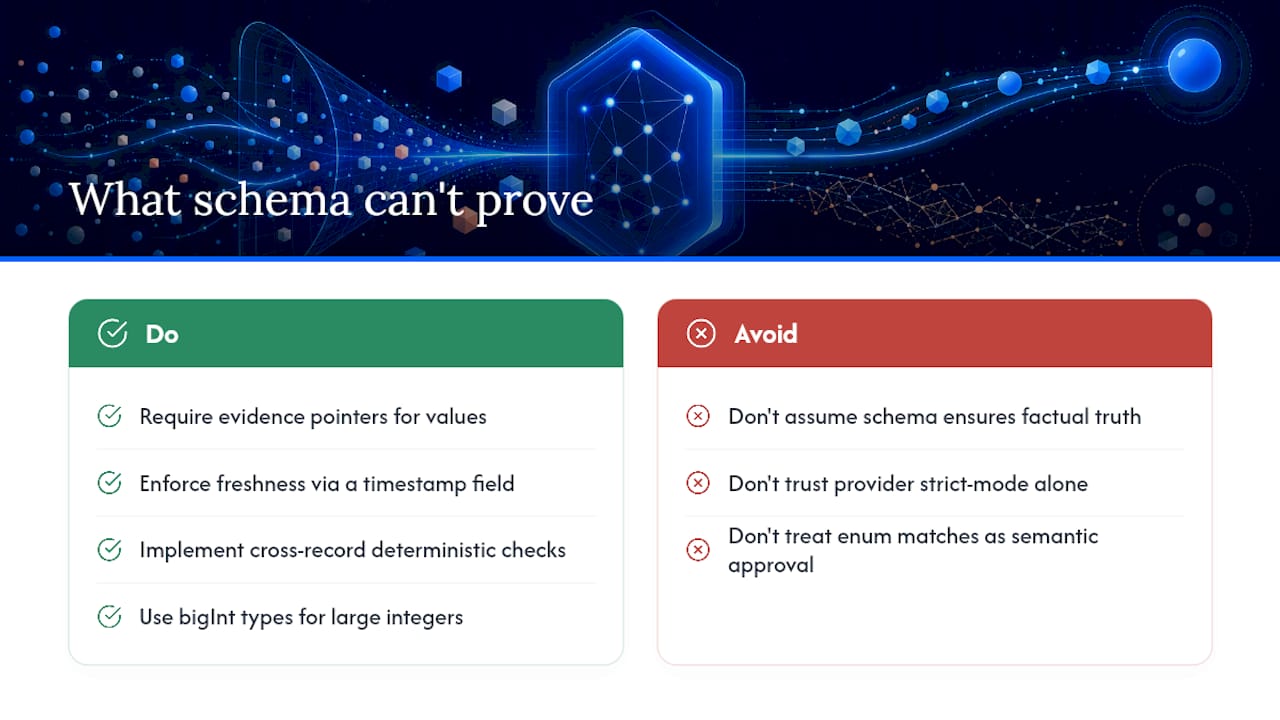
What JSON Schema validators can't prove
Schema validation gives you structural confidence. It does not give you factual confidence. These are the gaps you must close with additional checks.
Factual truth. A response where company_name is "Acme Corp" and revenue is 4200000 passes every schema check. If the model hallucinated both values, your validator will never know. Add evidence pointers — require the model to return a source_url or document_id alongside extracted values, then verify that source exists and contains the claimed value.
Provenance and freshness. A schema cannot tell you whether the data is current. A price field that was accurate six months ago passes validation today. Add a retrieved_at timestamp field and enforce freshness checks outside the validator.
Cross-record constraints. JSON Schema cannot express "the sum of all line_item.amount fields must equal invoice.total." That constraint requires a separate deterministic check in your application code.
Large integer precision. JavaScript's JSON.parse silently corrupts integers larger than Number.MAX_SAFE_INTEGER (9,007,199,254,740,991). If your pipeline handles large IDs or financial values, enforce string types for those fields in your schema. A number that looks valid in the schema can be silently wrong after parsing.
Semantic correctness. A status field that is "approved" is valid if "approved" is in your enum. Whether the approval was legitimate is outside the schema's scope. Use an LLM-as-judge layer or deterministic business-rule checks for semantic validation.
Blind reliance on provider strict-mode is a deployment risk. Strict mode enforces the provider's interpretation of your schema, not your application validator's interpretation. Test both against the same payloads before you ship. A schema that passes strict-mode validation on the provider side can still fail your application-side validator if the provider's subset behavior differs from the spec.
For a fuller picture of AI data pipeline integrity covering freshness, distribution, volume, and lineage alongside schema checks, that guide covers all five integrity pillars together.
Treat schemas as contracts, not suggestions
The engineers who get the most out of JSON validation are the ones who treat schemas the same way they treat API contracts: versioned, tested, and enforced in CI. The ones who struggle are the ones who add a schema as an afterthought and then wonder why their pipeline degrades silently over three model updates.
The practical priority order is: add a schema first, then add deterministic repair, then add one capped retry. That sequence handles the vast majority of structural failures without significant latency or cost overhead. Semantic failures — hallucinations, wrong values, missing evidence — need a separate layer. Don't conflate the two problems or you'll build a system that retries its way into confident nonsense.
Start with one high-impact extractor or agent step. Add a schema, wire in a repair library, cap retries at two, and log every failure with the raw output and schema version. Measure your validation error rate for a week before rolling out broadly. The data will tell you where to go next.
Datatool handles broken JSON and schema failures at scale
When your pipeline is producing malformed outputs faster than you can debug them, Datatool gives you a deterministic repair engine, schema validation, and failure logging in one place. Paste a broken LLM response and get a repaired, schema-validated object back. No guessing about what the repair changed — every transformation is logged.
Datatool is built for the exact failure classes this article covers: markdown-wrapped JSON, truncated objects, wrong types, missing required fields, and schema drift across provider updates. The repair engine runs before any LLM retry, which keeps token costs down and latency predictable. You can test a sample broken output and run a compatibility check against your provider's schema subset directly on Datatool. Free access is available to get started without a commitment.