

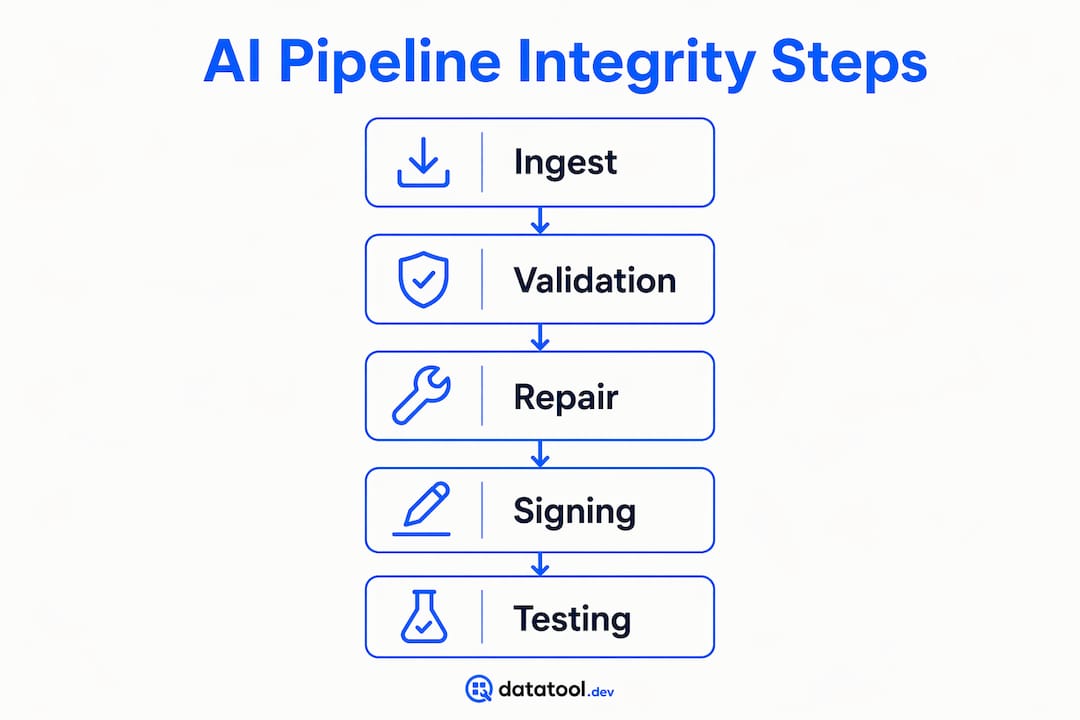
AI data pipeline integrity means guaranteeing that every record used to train, evaluate, or run an AI system has not been tampered with, corrupted, or semantically drifted since it was generated. The FBI defines it as ensuring data has not been altered in transit or at rest, covering both malicious manipulation and accidental anomalies. If you are debugging a broken pipeline right now, do three things first: run schema conformance on every ingest, sandbox suspect LLM outputs before they touch production indexes, and enforce cryptographic provenance signatures before ingestion.
A peer-reviewed review of ML production failures found that data quality issues are the primary cause of most model failures in production. The model is rarely the problem. The data feeding it is.
- Run schema conformance at every ingestion gate.
- Sandbox all LLM-generated structured data before promotion.
- Enforce provenance signatures; reject unsigned artifacts for high-sensitivity datasets.
Table of Contents
- What makes up AI data pipeline integrity?
- Common failure modes in LLM-generated structured data
- Why schema validation alone is not enough
- How Zero-Trust Data Pipelines use signing to detect tampering
- Sandbox-first testing and CI integration
- Repair strategies for malformed AI outputs
- Implementation checklist for AI data pipeline integrity
- Key Takeaways
- The seam is where pipelines actually fail
- Datatool fixes malformed LLM outputs before they reach your pipeline
- Useful sources for engineers going deeper
What makes up AI data pipeline integrity?
AI data pipeline reliability depends on layered controls, not a single check. Each layer enforces a different guarantee.
- Source signing: Sign data as close to generation as possible. A signed artifact at origin means any downstream mutation is detectable.
- Ingestion gates: Validate structure, types, and required fields before a record enters the pipeline. Fail fast here to avoid debugging corrupted features three stages later.
- Schema and semantic checks: Schema checks enforce structure. Semantic checks enforce meaning. Both are required (more on the difference in the next section).
- Lineage and metadata: Carry authority, freshness, and certification forward. Metadata failures at retrieval cause hallucinations and governance gaps in LLM agents.
- Sandbox staging: Promote outputs only after they pass deterministic repair and golden-dataset validation.
- Monitoring and alerting: Track distribution shifts, repair rates, and schema changes continuously.
- Incident response: Define who owns each layer and what triggers a rollback.
Pro Tip: Place your lightest, fastest checks at ingestion. A type mismatch caught at ingest costs microseconds. The same mismatch caught after model training costs hours.
Common failure modes in LLM-generated structured data
LLMs produce structured data that breaks in predictable ways. Knowing the pattern makes the fix straightforward.
Broken JSON. The model outputs a truncated object because it hit a token limit.

# Broken output from LLM
{"name": "Acme Corp", "revenue": 4200000, "employees":

# Fix: deterministic repair + schema validation
import json
from datatool_repair import repair_json

raw = '{"name": "Acme Corp", "revenue": 4200000, "employees":'
repaired = repair_json(raw)          # closes open objects/arrays
validated = schema.validate(repaired) # rejects if required fields missing
Wrapped responses. The model wraps JSON in markdown fences or prose: ```json {...} ```. Strip the wrapper before parsing, then validate.
Invalid escaping. A model outputs {"note": "He said \"hello} with an unmatched quote. Standard json.loads throws. A deterministic repair engine handles this without re-prompting the model.
Partial objects. A streaming response cuts mid-field. Buffer until a complete object boundary, then repair and validate.
Schema drift. An upstream ETL job changes a field from int to string. The model's feature input silently corrupts. This is the "seam" failure: ETL changes that look like model failures. To detect it fast, diff your ingestion schema against a pinned version in CI on every deploy.
To isolate whether a failure is upstream ETL, the model prompt, or the repair layer: check repair-rate telemetry first. A sudden spike in repair events almost always points to an upstream schema change, not a model regression.
Why schema validation alone is not enough
A column named customer_status can pass every JSON and schema check while its business meaning shifts from "account active" to "contract pending renewal" after a CRM workflow update. The structure is valid. The meaning is wrong. That is semantic drift, and no structural monitor catches it.
Structural checks verify shape: required fields present, correct types, valid JSON. Semantic checks verify meaning: Is the value still what the model was trained to expect?
Concrete semantic checks to add:
- Canonical value lists: Assert that
statusfields only contain known enum values. - Distributional assertions: Run Population Stability Index (PSI) or Kolmogorov-Smirnov checks on numeric features. Teams should track mean, standard deviation, and distinct value counts across ingestion, feature engineering, and inference.
- Authority and source certification: Flag records from uncertified sources before they reach training.
- Cross-field invariants: Assert that
end_dateis always afterstart_date, regardless of type validity. - Golden-dataset assertions: Run labeled reference records through the pipeline and assert expected outputs.
Semantic validation is what separates a pipeline that passes CI from one that actually works in production. Learn more about structural and semantic checks for AI-generated data.
How Zero-Trust Data Pipelines use signing to detect tampering
Chain-of-custody controls treat every data artifact as untrusted until cryptographically verified. The SEI at CMU recommends signing data near generation, tracking transfer signatures, and verifying at dataset creation and model training.
2026 research on Zero-Trust Data Pipelines using ECDSA-P384 signed tokens reported the following measured results:
| Metric | Result |
|---|---|
| Insider tampering detection | 100% detection in study |
| Behavioral anomaly detection | 96% detection |
| Throughput overhead | ~9.1% overhead |
| Per-stage latency | ~0.8 ms per-stage latency |
Those numbers mean you get near-complete tamper detection at a throughput cost most production pipelines can absorb. The DPP Grid AI transparency framework describes how this chain-of-custody model applies across pipeline stages in practice.
Pro Tip: Verify signatures at the ingestion gate and attach signature metadata to lineage records. If provenance verification fails for a high-sensitivity dataset, fail the ingestion entirely. Do not repair and promote an unsigned artifact.
Sandbox-first testing and CI integration
Sandbox-first means LLM outputs never touch production indexes until they have passed deterministic repair, schema validation, and golden-dataset checks in staging. This is the recommended workflow for teams that need safe automation testing without shipping bad data.
Staging workflow:
- Generate LLM output in a sandboxed environment.
- Run deterministic repair on all outputs.
- Validate repaired output against a pinned schema and golden dataset.
- Run semantic checks (PSI, canonical value lists, cross-field invariants).
- Promote to production only on full pass.
CI integration patterns:
- Unit tests: schema conformance and JSON validity on every pull request.
- Integration tests: end-to-end repair plus ingestion against a staging index.
- Nightly distribution checks: PSI on all numeric features against training baseline.
Deployment patterns: shadow runs (new pipeline runs in parallel, outputs compared but not served), canary ingestion (5–10% of traffic routed to new pipeline), and rollback triggers tied to validation failure thresholds.
When a validation gate fails, the on-call engineer for the pipeline owner gets paged. Not the model team. Ownership at the seam matters. See unit testing patterns for AI-generated data for CI-ready examples.
Repair strategies for malformed AI outputs
Four repair strategies cover most production cases:
- Deterministic JSON repair: Rule-based fixing of broken brackets, unmatched quotes, and truncation. No model call required. Predictable output. Datatool's deterministic repair engine is built for exactly this: broken JSON, wrapped responses, partial objects, and invalid escaping from LLM outputs.
- Schema-first transformation: Coerce types, strip unexpected fields, and fill optional defaults before validation.
- Context-aware re-generation: Re-prompt the model with the broken output and a repair instruction. Non-deterministic. Use only when deterministic repair fails and the record is high-value.
- Reject and queue: Route unfixable records to a human-review queue. Do not silently drop them.
When to reject vs. repair: if a record is missing required fields that cannot be inferred, reject it. If the structure is broken but the content is recoverable, repair it. Track both paths in telemetry.
Pro Tip: Instrument your repair layer to emit a repair_applied: true flag on every fixed record. A sudden increase in repair rate is an early signal of upstream schema drift, not a model problem.
Repair rate, rejection rate, and repair type (truncation vs. escaping vs. schema drift) are the three telemetry signals that tell you where the pipeline is breaking. For more on repair pipeline topology, see what is an AI output repair pipeline.
Implementation checklist for AI data pipeline integrity
Work through this in order. Each step builds on the previous one.
- Sign at source. Apply ECDSA or equivalent signatures to data artifacts at generation.
- Verify at ingestion. Check signatures before any processing. Fail ingestion on verification failure for sensitive datasets.
- Run schema validation. Enforce required fields, types, and structure at every ingestion gate.
- Add semantic checks. PSI on numeric features, canonical value lists on categoricals, cross-field invariants.
- Build a golden dataset. Label a reference set. Run it through the pipeline on every deploy.
- Wire CI gates. Schema tests on every PR. Integration tests on every merge. Nightly distribution checks.
- Capture lineage. Record source, transformation steps, and signature metadata for every artifact.
- Define incident response. Who owns each gate? What PSI threshold triggers a page? What triggers a rollback?
Monitoring signals to alert on:
- Schema change detected (column added, removed, or retyped).
- PSI above 0.2 on any feature used in training or inference.
- Repair rate increase of more than 20% over a 24-hour baseline.
- Provenance verification failure on any high-sensitivity artifact.
The DPP Grid product platform covers Zero-Trust pipeline frameworks that map directly to steps 1 and 2 above. For production monitoring patterns, see monitoring AI data quality in production.
Key Takeaways
AI data pipeline integrity requires signing at source, semantic validation above schema checks, sandbox-first testing with golden datasets, deterministic repair for malformed LLM outputs, and continuous distribution monitoring across both training and inference paths.
| Point | Details |
|---|---|
| Sign and verify at ingestion | Use ECDSA-P384 or equivalent; fail ingestion on provenance failure for sensitive data. |
| Semantic checks above schema | PSI, canonical value lists, and cross-field invariants catch drift that JSON validation misses. |
| Sandbox before production | Run deterministic repair and golden-dataset validation in staging before promoting any LLM output. |
| Instrument repair telemetry | Track repair rate and rejection rate; a spike signals upstream schema drift, not a model bug. |
| Datatool for LLM output repair | Datatool's deterministic repair engine handles broken JSON, truncation, and escaping failures in production pipelines. |
The seam is where pipelines actually fail
Most teams treat AI failures as model problems. They tune prompts, swap models, and adjust temperature. The root cause is usually an upstream schema change nobody noticed: an int became a string, a CRM workflow updated a status field, or a cron job started emitting nulls where it used to emit zeros. The model hallucinates because the features it receives no longer match what it was trained on.
The fix is not a better model. It is a validation gate that sits between your ETL and your AI consumers, owned by a named engineer with a defined SLA. Contract-driven ownership at that seam, combined with symmetric validation (the same checks on training data and inference data), is what actually prevents silent regressions. Datatool is built around that principle: deterministic repair, schema validation, and provenance capture as a production-grade toolset, not an afterthought.
Datatool fixes malformed LLM outputs before they reach your pipeline
Broken JSON from LLMs is not an edge case. It is the default. Datatool's deterministic repair engine handles the full range: truncated objects, wrapped responses, invalid escaping, partial arrays, and schema drift. Paste malformed output. Get valid, schema-conformant JSON back.
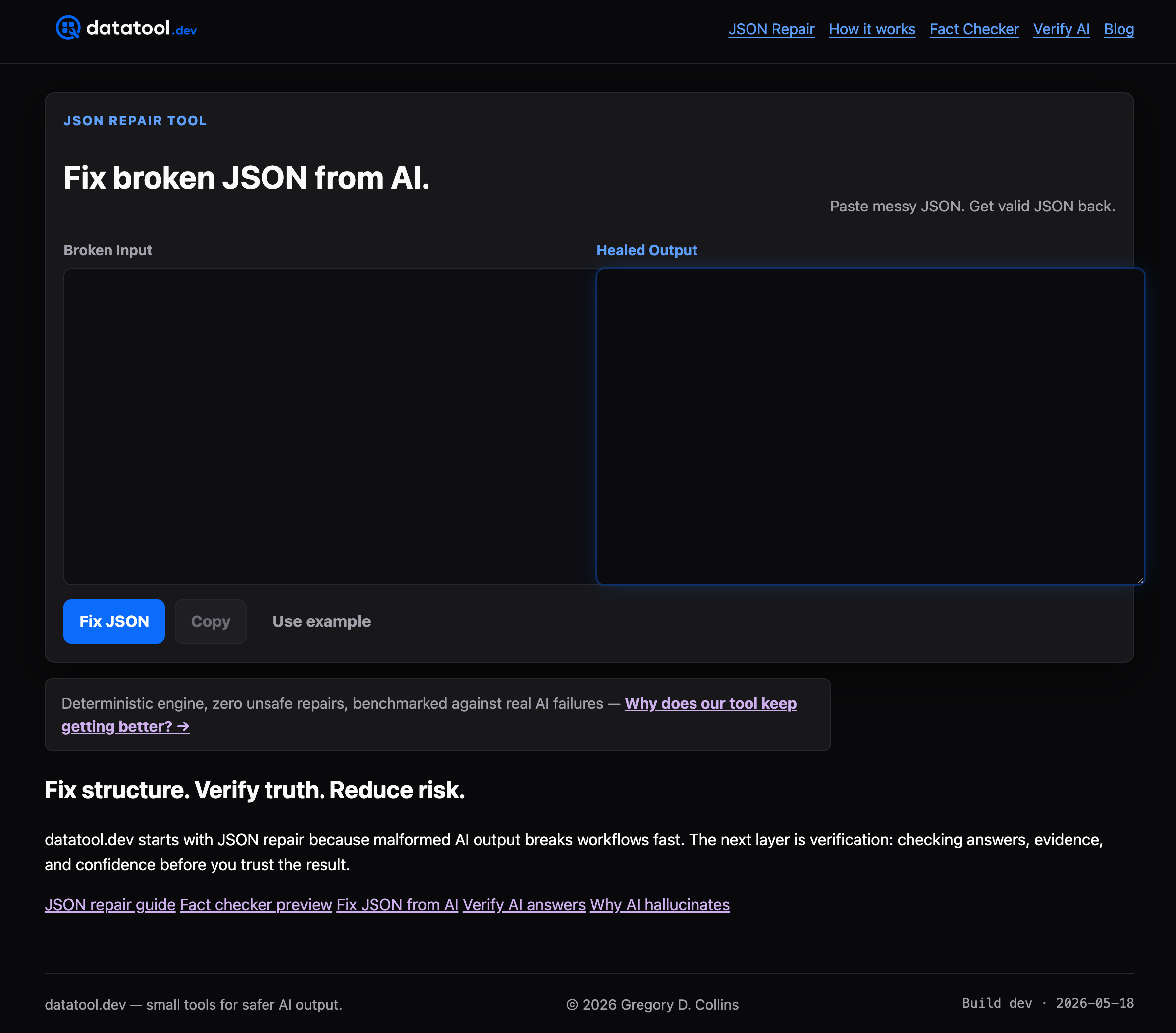
Datatool maps directly to the checklist above: deterministic JSON repair at the repair layer, schema-first validation at ingestion gates, provenance manifest capture for lineage, and CI-friendly tooling that integrates with your existing test suite. No re-prompting the model. No non-deterministic guessing. Just a reliable repair pass followed by strict validation.
Fix broken JSON from AI and see the repair engine on a real malformed output in under a minute.
Useful sources for engineers going deeper
- FBI AI Data Security Best Practices: Authoritative definition of AI data integrity, provenance tracking, and digital signature requirements across the AI lifecycle.
- SEI/CMU: Data Poisoning and Chain-of-Custody Controls: Justifies signing at source and manifest verification for training datasets.
- 2026 ZTDP Research: ECDSA-P384 Signed Tokens: Primary source for the detection rate and overhead metrics in the provenance section.
- Peer-reviewed review: Data quality as primary cause of ML failures: Supports the claim that upstream data, not model architecture, drives most production failures.
- VexData: Validation as the critical layer in AI pipelines: Practical checklist of distribution checks, join cardinality validation, and skew detection.
- Atlan: Data pipeline for AI and LLM-ready pipelines: Covers metadata, governance gates, and semantic integrity as the sixth observability pillar.
- Monte Carlo: Building AI data pipelines without shipping bad data: Recommends shadow mode, canary testing, and golden datasets for safe pipeline automation.
- tianpan.co: AI feature reliability bounded by upstream ETL: Field account of seam failures and why ETL ownership gaps cause AI regressions.