

Common AI deployment data failures are the primary reason 85% to 95% of AI projects never reach production, according to Gartner and MIT Sloan 2026 studies. These failures are not random. They follow predictable patterns: data freshness rot, schema drift, uncertified table selection, and infrastructure silos. Each one quietly degrades model accuracy or breaks pipelines entirely. This guide covers the specific failure modes AI practitioners and data engineers encounter in live systems, with concrete fixes for each.
1. What are common AI deployment data failures?
Common AI deployment data failures are systematic breakdowns in data quality, structure, or governance that cause AI models to produce wrong, unreliable, or erratic outputs after deployment. The industry term for this category is data quality failure in production AI. These failures differ from training errors. They emerge after launch, when real-world data drifts away from what the model was built on. 27% of AI agent production failures trace directly to data quality issues including freshness rot, uncertified tables, and schema drift. That makes data quality the second most common root cause behind AI agent failures, after scope creep.
2. Data freshness rot: when stale data breaks live models
Data freshness rot is the gradual degradation of model reliability as the data feeding a live system ages without refresh. The model does not know the data is stale. It keeps generating confident answers based on outdated facts. Freshness rot causes RAG systems to be confidently wrong a significant portion of the time after several months without a data refresh. That is a production failure hiding in plain sight.

The fix starts with metadata timestamps on every dataset entering a pipeline. Add automated freshness checks that fire alerts when data exceeds a defined age threshold.
import datetime

def check_data_freshness(last_updated: datetime.datetime, max_age_hours: int = 24):
    age = datetime.datetime.utcnow() - last_updated
    if age.total_seconds() > max_age_hours * 3600:
        raise ValueError(
            f"Data is stale: {age}. Refresh required before model inference."
        )
    return True

# Example usage
last_updated = datetime.datetime(2026, 6, 1, 8, 0, 0)
check_data_freshness(last_updated, max_age_hours=24)
Continuous freshness checks with metadata timestamps are non-negotiable for production-grade AI systems. Without them, you are flying blind.
Pro Tip: Automate freshness validation as a gate in your production pipeline. Block inference calls when data age exceeds your defined threshold, not just log a warning.
3. How uncertified table selection causes AI agent failures
Uncertified table selection happens when an AI agent queries a dataset that is deprecated, broken, or no longer maintained. The agent has no way to know the table is unreliable. It treats the output as valid and propagates bad data downstream. Poor data governance lets AI agents query deprecated or broken data assets, causing wrong decisions, hallucinations, and erratic tool behavior.
Symptoms of this failure include:
- Agents returning results that contradict known ground truth
- Downstream pipeline breaks with no obvious error source
- Inconsistent outputs across identical queries run at different times
- Hallucinated values that match the schema but not reality
The fix requires governance layers that are visible to agent logic, not just to human data teams. Tag every data asset with a certification status field. Agents must check that field before querying.
Pro Tip: Add a certified: true/false metadata flag to every table in your data catalog. Build agent query logic to reject uncertified sources at runtime, not at review time.
4. Why schema drift silently kills AI pipeline accuracy
Schema drift is the gradual, often unannounced change in data field names, types, or semantics that breaks model assumptions without triggering an obvious error. A field called user_id becomes userId. A float becomes a string. The model keeps running. The accuracy drops. Schema changes can reduce production accuracy by 8% or more if they go unnoticed. That is a meaningful degradation that compounds over time.
The table below maps common drift indicators to detection methods:
| Drift indicator | Detection method |
|---|---|
| Field renamed across pipeline versions | Cross-system schema diff on each deployment |
| Type change (float to string) | Automated type validation in ingestion layer |
| Semantic shift (same name, different meaning) | Data lineage tracking with version annotations |
| Missing fields in new data batches | Schema completeness checks with alert thresholds |
| New fields added without model retraining | Impact analysis linking schema versions to model versions |
Cross-system impact analysis that links feature pipeline schema versions directly to deployed model versions is the most reliable way to catch drift before it reaches inference. Build this into your CI/CD process, not as an afterthought.
5. Organizational misalignments that worsen data failures
Organizational failures compound technical ones. Data infrastructure silos scatter data meaning across systems, making reconciliation difficult without context-aware metadata management. No single team owns the full picture. Models get fed data that no one has verified end to end.
Common organizational pitfalls include:
- No clear owner for a dataset once it enters production
- ML engineering and data engineering teams operating without shared definitions
- Legacy systems exporting data in formats incompatible with model inputs
- Life-cycle planning that stops at training and ignores post-deployment monitoring
The fix for data infrastructure silos is not centralization. Architectures enabling context-aware metadata management to reconcile conflicting definitions across systems are what actually work. Centralization creates a single point of failure. Metadata-aware federation creates resilience.
Pro Tip: Assign a named data owner to every dataset used in production AI. That person is accountable for freshness, certification status, and schema change notifications.
6. How to prevent and fix AI deployment data failures
Prevention requires treating data as a live system, not a static input. Organizations with continuous data observability, governance, and testing experience significantly lower AI project failure rates. The difference is operational discipline applied consistently.
Start with these concrete steps:
- Implement data observability. Monitor data pipelines for volume drops, null rate spikes, and type changes. Tools like Great Expectations or Monte Carlo provide automated anomaly detection.
- Version-couple data and models. Every model deployment must record the exact schema version of its input data. Use this to run AI output testing before promoting a new model version.
- Build governance gates. Require certification sign-off before any dataset enters a production pipeline. Automate the check so agents cannot bypass it.
- Test AI-generated data. LLMs produce malformed JSON, truncated objects, and schema-violating outputs. Validate every structured output before it touches downstream systems.
import json

def validate_schema(output: str, required_keys: list):
    try:
        data = json.loads(output)
    except json.JSONDecodeError as e:
        raise ValueError(f"Malformed JSON output: {e}")
    missing = [k for k in required_keys if k not in data]
    if missing:
        raise ValueError(f"Schema drift detected. Missing fields: {missing}")
    return data

# Example: catch a broken LLM response before it enters the pipeline
raw_output = '{"user_id": 42, "score": 0.91}'
validate_schema(raw_output, required_keys=["user_id", "score", "timestamp"])
Pro Tip: Run schema validation on every LLM output in your pipeline. A missing field caught at ingestion costs nothing. The same field missing at inference costs a production incident.
Poor data quality can reduce AI model accuracy by up to 40%, and poisoning just 0.01% of a dataset can induce systematic output errors. Prevention is always cheaper than recovery.
Key takeaways
Preventing AI deployment data failures requires continuous observability, governance gates, and schema version coupling applied consistently across every production pipeline.
| Point | Details |
|---|---|
| Data freshness rot | Automate freshness checks with metadata timestamps to block stale data from reaching inference. |
| Uncertified table selection | Tag every dataset with a certification status and enforce it in agent query logic. |
| Schema drift detection | Link schema versions to model versions and run diffs on every deployment. |
| Organizational ownership | Assign a named owner to every production dataset and require sign-off before changes. |
| Continuous observability | Treat data pipelines as live systems and monitor for anomalies, not just errors. |
What I have learned from watching AI pipelines break
The failures I see most often are not exotic. They are boring. A table gets renamed during a migration. Nobody tells the ML team. The model keeps running. Accuracy drops 8%. Three weeks later, someone notices the recommendations look off. By then, the root cause is buried under two sprint cycles of unrelated changes.
The real problem is not technical. It is communication. Data engineers and ML engineers operate on different timelines with different definitions of "done." Data engineers ship a migration and move on. ML engineers assume the schema is stable. Neither team is wrong. They just never agreed on a shared contract.
The teams I have seen succeed treat schema changes like API breaking changes. They version them, announce them, and block model deployments that depend on deprecated versions. That discipline is not glamorous. It does not require new tooling. It requires a shared agreement that data is a dependency, not a background service.
Early detection matters more than perfect prevention. You will not catch every drift before it hits production. Build your systems to detect failures fast and recover faster. Monitor AI output observability at the output layer, not just the input layer. By the time bad data reaches your model, you want an alert firing in seconds, not days.
— Gregory
Datatool: fix broken AI data output before it breaks your pipeline
AI models produce malformed JSON, truncated objects, invalid escaping, and schema-violating responses. These are not edge cases. They are routine outputs from production LLMs under real load.
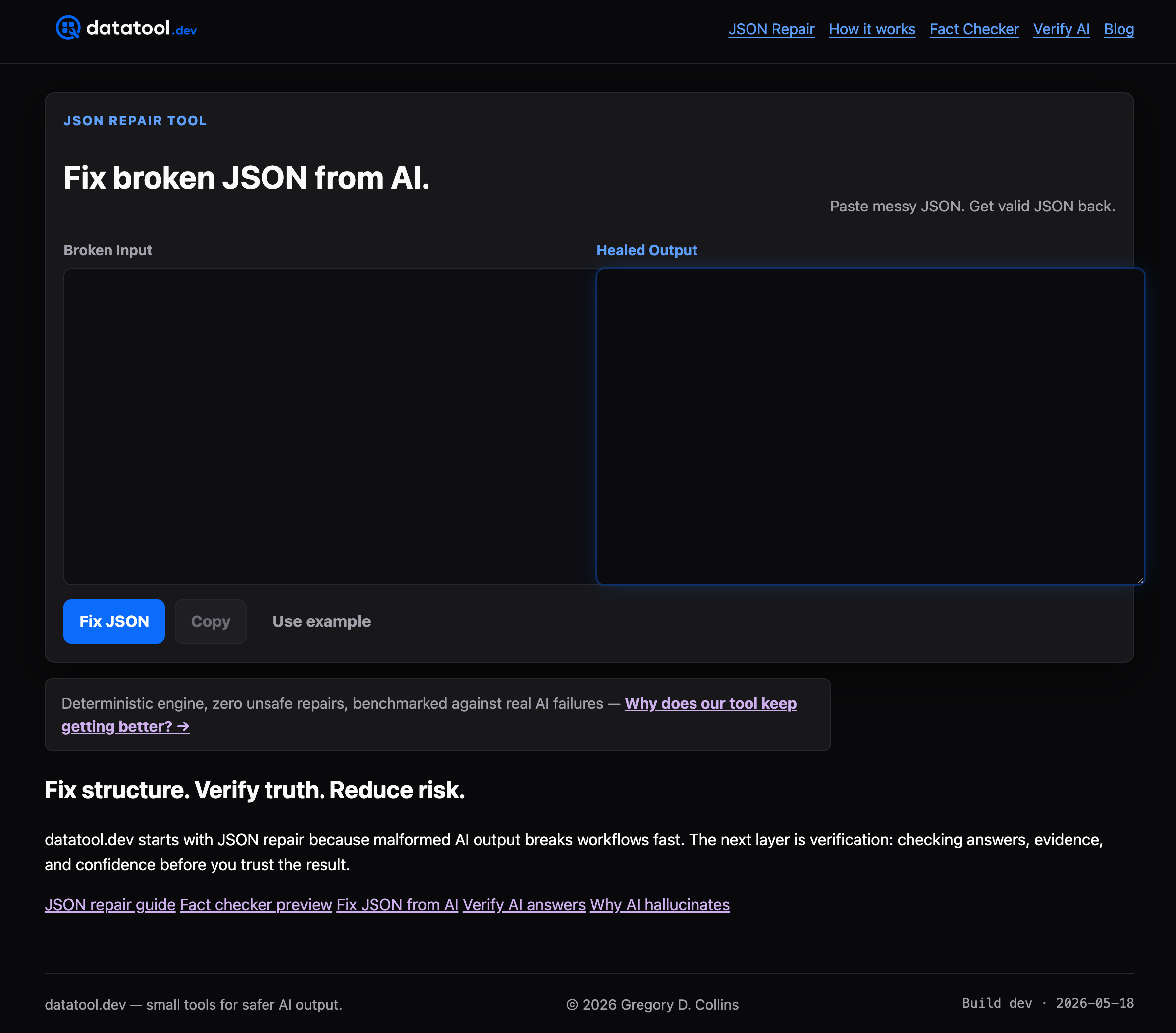
Datatool is built for exactly this problem. It repairs broken JSON, validates structured outputs against your schema, and catches the malformed responses that slip past basic error handling. Data engineers use Datatool to fix broken JSON from AI before it reaches downstream systems. The result is fewer production incidents and more trust in your AI pipeline outputs. If your pipeline ingests LLM-generated structured data, Datatool belongs in your validation layer.
FAQ
What causes most AI deployment failures?
85% to 95% of AI projects fail due to poor data quality or lack of relevant data, according to Gartner and MIT Sloan 2026 studies. Data issues outrank model architecture problems as the primary failure cause.
What is schema drift in AI pipelines?
Schema drift is when field names, types, or semantics change in a data pipeline without updating the model that depends on them. Undetected schema drift can reduce production accuracy by 8% or more.
How do I detect data freshness rot in production?
Add metadata timestamps to every dataset and run automated checks that alert when data exceeds a defined age threshold. Block inference calls on stale data rather than logging warnings that get ignored.
Why do AI agents query deprecated tables?
AI agents query deprecated tables when governance metadata is not visible to agent logic. The fix is a certification status field on every data asset that agents check before querying.
How does poor data quality affect AI model accuracy?
Poor data quality reduces AI model accuracy by up to 40%. Even poisoning 0.01% of a training dataset can cause systematic output errors across the full model.