

When AI systems underperform, engineers often blame the model. The real culprit is usually the data. Examples of AI data inconsistencies show up across every production ML pipeline: mislabeled training records, schema fields that silently change type, training features computed differently at serving time, and entity records that contradict each other. These are not edge cases. They are routine causes of degraded accuracy, broken pipelines, and debugging sessions that consume days. This guide covers the most damaging patterns with concrete examples so you can identify, diagnose, and fix them before they compound into serious technical debt.
Table of Contents
- Key takeaways
- 1. Labeling inconsistencies in training data
- 2. Schema and type drift in AI data pipelines
- 3. Training-serving skew and timing mismatches
- 4. Entity resolution and semantic inconsistencies
- My take on diagnosing AI data inconsistencies
- Fix AI data inconsistencies with Datatool
- FAQ
Key takeaways
| Point | Details |
|---|---|
| Label noise is systematic | Annotation boundary shifts and negation conflicts create learned contradictions, not just random noise. |
| Schema drift fails silently | Type changes and null rate spikes degrade pipelines without throwing errors or alerts. |
| Training-serving skew is common | Feature timing mismatches produce "same code" bugs that are hard to reproduce and costly to fix. |
| Entity resolution errors compound | Ghost records and duplicate IDs corrupt downstream joins and aggregations at scale. |
| Detection requires automation | Manual inspection misses subtle drift; schema fingerprinting and EMA baselines catch issues early. |
1. Labeling inconsistencies in training data
In the ML community, what practitioners informally call "label noise" is more formally described as annotation inconsistency. The distinction matters. Noise implies random scatter. Inconsistency implies systematic contradictions that teach models conflicting rules and produce ambiguous, unstable outputs.
Three patterns cause the most damage in practice:
- Annotation boundary shifts. Two annotators label the same named entity differently over time. One marks "New York City" as a single span; another splits it at the borough level. Models trained on both conventions learn neither reliably.
- Negation conflicts. One annotator marks "patient denies chest pain" as a negative sentiment signal. Another marks it positive for the "chest pain" entity. The model sees conflicting supervision for identical text.
- Undefined multi-label precedence. When a record qualifies for two labels and no guideline specifies priority, annotators choose differently. The result is systematic model behavior errors that persist long after the annotation batch closes.
Re-certifying annotators every four to six weeks catches guideline drift before it contaminates production data. Maintaining an anchor set of stable labeled cases lets you regrade control samples across batches and detect rubric drift early. Model-assisted review can boost audit throughput by two to four times by surfacing suspicious labels for human adjudication.
Pro Tip: When inter-annotator agreement drops below your baseline on anchor set examples, stop the labeling batch. The issue is almost always a guideline ambiguity, not annotator fatigue.
2. Schema and type drift in AI data pipelines
Schema drift is a category of machine learning data flaws that rarely announces itself. Pipelines keep running. No exceptions are thrown. Downstream models quietly receive corrupted inputs.
A concrete example: a numeric revenue field starts returning strings like ""$1,204.50"after an upstream API change. Aggregation queries that expectFLOATnow receiveVARCHAR. The revenue calculation silently outputs null` or errors depending on the engine. The issue went undetected for two full days in a real incident before anyone noticed model predictions had shifted.

| Drift type | Symptom | Fix |
|---|---|---|
| Field added | Downstream schema mismatch, ignored or crashing | Add schema version checks at ingestion |
| Type drift | Silent cast failures, nulls, or wrong aggregations | Enforce strict type contracts with alerts |
| Null rate drift | Gradual accuracy drop, no obvious error | Monitor null rates with EMA baselines |
| Cardinality drift | New categories treated as OOV or merged incorrectly | Track vocabulary size per categorical field |
Null rate spikes are often the first detectable signal. A field moving from 2% null to 60% null triggers an EMA-based alert long before the pipeline crashes. TFX workflows address this by inferring frozen schemas from training statistics and validating all incoming serving data against those contracts.
Pro Tip: Run schema fingerprint comparisons on every data batch. A hash over field names, types, and null rates takes milliseconds and catches drift before it reaches your feature store.
3. Training-serving skew and timing mismatches
Training-serving skew is one of the most deceptive causes of AI data discrepancies. The code is identical. The schema looks correct. But predictions differ systematically between training evaluation and production.
The root cause is almost always data timing or null handling. Consider this example:
# Training pipeline reads overnight snapshot (T-24h)
user_features = snapshot_store.read(timestamp=yesterday)

# Serving pipeline reads near-real-time store (T-45min lag)
user_features = online_store.read(timestamp=now)

# Same feature name, same code path, 45-minute data gap.
# Model trained on stale aggregations sees live values it never learned from.
That 45-minute lag causes systematic prediction differences because aggregation windows computed at training time do not match what arrives at inference time. Common skew types that data scientists encounter include:
- Lookup freshness mismatch. Batch training reads a daily join; serving reads a real-time lookup with different freshness guarantees.
- Null handling divergence. Batch pipelines fill nulls with median imputation; online pipelines return raw nulls. The model input distribution shifts on a subset of records.
- Out-of-vocabulary categoricals. New enum values appear in production that were absent from training data. The model receives OOV inputs and defaults to degraded behavior.
- Aggregation window mismatch. A "rolling 7-day" feature is computed from complete days in training but from a partial current day in serving.
Catching these requires explicit data contract validation between your feature engineering code and your serving path. Log training-time feature distributions and compare them against serving distributions weekly.
4. Entity resolution and semantic inconsistencies
Entity resolution failures produce a specific type of AI data error called ghost records: records with different unique IDs but matching or near-matching core attributes. At scale, these corrupt joins, inflate user counts, and poison any model that relies on individual-level history.
A well-documented instance involved 14.35 lakh suspect duplicates in a Bihar voter dataset caused by inconsistent transliteration of names across data entry systems. The same person appeared under multiple spellings, each assigned a unique ID. No single normalization rule resolved all cases.
Beyond transliteration, semantic inconsistency in schema fields causes its own category of failures. A relationship field that sometimes stores "father" and sometimes "husband" depending on the data entry form is not just dirty. It is semantically ambiguous at the schema level, and no downstream cleaner can reliably resolve it without knowing the original intent.
Failure modes practitioners should watch for:
- False-positive merges. Two distinct entities with similar attributes get collapsed into one record. Downstream models see a single entity with contradictory behavioral history.
- False-negative merges. One real entity persists as multiple records. Aggregations double-count activity, and training examples for that entity carry inconsistent labels.
- Free-text address drift. Addresses entered in different formats across time periods generate multiple distinct keys for the same physical location.
- Relationship field repurposing. Schema fields change meaning over time without version tracking. Old records and new records use the same field name for different concepts.
Schema version tracking and normalization at ingestion prevent most of these. Log schema lineage so you can trace exactly when a field's semantics changed and which records are affected.
My take on diagnosing AI data inconsistencies
I've spent a lot of time watching teams burn debugging cycles on model architecture changes when their actual problem was in the data. The model was not broken. The training signal was.
What I've learned is that most practitioners have a strong bias toward blaming the model because it feels more tractable. You can retrain. You can adjust hyperparameters. Fixing annotation guidelines or schema contracts requires convincing multiple teams to change their workflows, which is harder. So the model gets blamed, and the data problem grows.
The teams that recover fastest share one habit: they treat data inconsistency examples as first-class bugs. Not data quality issues to clean later, but reproducible failures with a root cause, an owner, and a fix. When I've seen annotation audits run consistently, schema fingerprints checked on every batch, and training-serving feature logs compared weekly, the number of "mysterious" model regressions drops to near zero.
The uncomfortable truth is that label quality matters more than model architecture in most real-world pipelines. A cleaner dataset almost always outperforms a fancier model trained on noisy data. Building that discipline early pays off across every model iteration that follows.
— Gregory
Fix AI data inconsistencies with Datatool
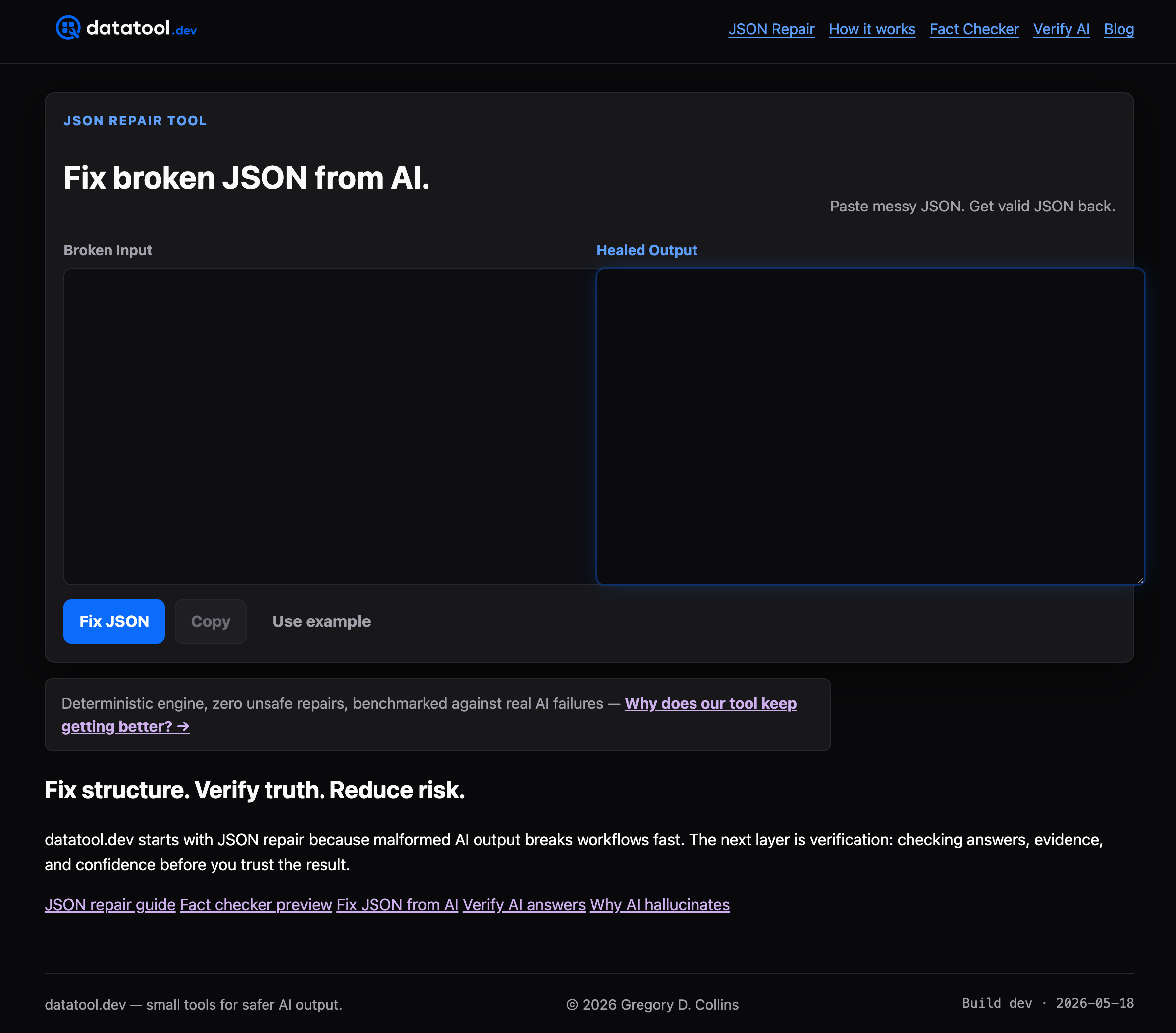
Datatool is built for the exact failures described in this article. It validates structured data from AI outputs, catches schema drift, and repairs malformed output from LLMs including broken JSON, type mismatches, partial objects, and null rate anomalies. You paste the output. Datatool flags what is wrong and returns valid, schema-conformant data. No guessing. No silent failures downstream. Visit datatool.dev to fix broken AI output and enforce data contracts across your ML pipeline. For teams building testing rigor into their workflows, the unit testing guide for AI data covers practical validation patterns worth implementing today.
FAQ
What causes AI data inconsistencies in production pipelines?
The most common causes are annotation disagreements in training data, schema drift in upstream data sources, and training-serving feature timing mismatches. Each introduces a different failure mode and requires a different detection strategy.
How do you detect schema drift before it breaks a model?
Monitor null rates using exponential moving average baselines and run schema fingerprint comparisons on every incoming batch. A null rate moving from 2% to 60% is a reliable early signal of a silent schema violation.
What is training-serving skew and why does it matter?
Training-serving skew occurs when features computed at training time differ from those computed at inference time, often due to data timing lags or null handling differences. It produces systematic prediction errors that are difficult to reproduce in development.
How do ghost records affect machine learning models?
Ghost records are duplicate entities with different IDs. They inflate record counts, introduce contradictory training labels for the same real-world entity, and corrupt any model relying on individual-level aggregations or history.
How often should annotation guidelines be reviewed?
Re-certify annotators and review guidelines every four to six weeks. Use an anchor set of stable labeled examples to detect rubric drift across batches before inconsistencies reach production training data.