

Your pipeline looks healthy. Status codes are green. Then a downstream service starts writing garbage to your database because an AI agent returned JSON with a missing required field three hours ago. That is the real cost of failing to detect malformed output AI agents produce. It is not a crash. It is a silent drift. This guide gives you a practical, layered approach to classifying, catching, and fixing malformed structured data from AI agents before it causes business incidents you cannot easily reverse.
Table of Contents
- Detecting malformed AI agent outputs: understanding the error types
- Preparation: setting up strict validation and gating mechanisms
- Execution: detecting malformed outputs during AI agent runtime
- Verification and remediation: automated repair and quality improvement strategies
- Why strict validation and early divergence detection matter more than you think
- Improve your AI output reliability with datatool.dev
- Frequently asked questions
Key Takeaways
| Point | Details |
|---|---|
| Three error categories | AI output failures split into format, quality, and consistency errors, each needing tailored detection and fixes. |
| Strict validation gates | Enforce content-type gates, strict parsing, schema, and business invariants before any data use to catch corruption early. |
| Runtime monitoring metrics | Track invalid payload and schema mismatch rates alongside tracing to detect silent malformed outputs in production. |
| Error-specific remediation | Use auto-retry for format errors, agent self-checking for quality, and consensus voting for consistency improvements. |
| Early divergence detection | Identify first tool or step divergence to prevent cascading silent failures and enable targeted fixes. |
Detecting malformed AI agent outputs: understanding the error types
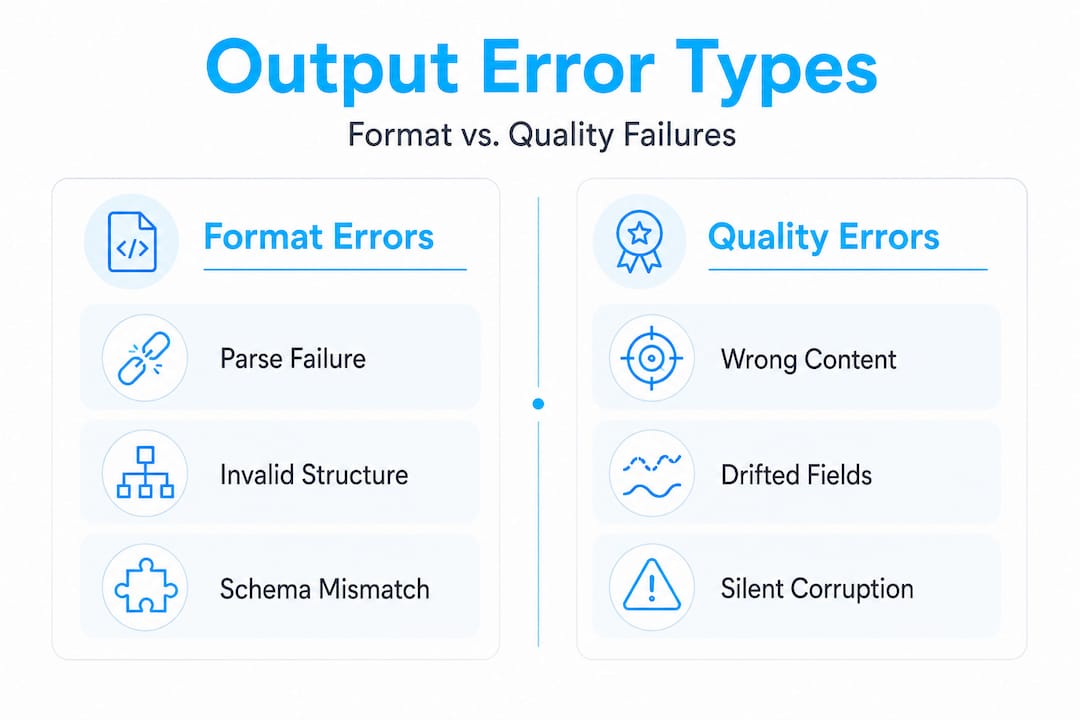
To effectively detect malformed AI agent outputs, first understand their different error categories. Treating all failures as a single class leads to brittle handling and inconsistent fixes. Agent output validation errors fall into three distinct categories: format errors, quality errors, and consistency errors, and each requires a different remediation strategy.
Format errors are the most visible. The agent returns a response that fails to parse, contains an invalid JSON structure, is missing required fields, or uses the wrong data type for a field. A classic example: an agent returns a "pricefield as a string"12.99"instead of a float. Your schema expectsnumber`. Parse succeeds, but strict validation fails.
Quality errors are subtler and more dangerous. The JSON parses correctly and passes schema validation, but the content is wrong. An agent might return a summary field that is factually incomplete or a confidence_score of 0.99 for a conclusion it essentially hallucinated. You can detect AI output errors in this category only by applying content-level checks, not just structural ones.

Consistency errors occur across runs or across agents in a multi-agent workflow. Two agents process the same input and return contradictory classifications. Neither response is technically wrong in isolation. But together they break any downstream logic that expects deterministic output.
Understanding these categories matters for automation logic. Here is how they map to detection priority:
- Format errors: detect at parse and schema validation stage
- Quality errors: detect via business rule checks and content evaluation
- Consistency errors: detect by comparing outputs across runs or agent instances
Common signals that point to each error type:
- Unparseable or truncated JSON (format)
- Correct structure, missing semantic meaning (quality)
- Same input producing divergent outputs on repeat runs (consistency)
- Schema drift after a model update (format or quality)
- Extra or unexpected fields appearing in production (format)
Preparation: setting up strict validation and gating mechanisms
With error categories clear, you must prepare your system with validation gates to detect malformed outputs early. Validation after the fact is too late. You need gates that block bad data before it touches any downstream system.
Follow this sequence to build a reliable validation layer:
-
Gate on content-type and payload size first. Before attempting any parse, confirm the response has the right
Content-Typeheader and is within expected size bounds. An empty body or a 5MB response when you expect 2KB is an immediate rejection signal. -
Use strict parse mode only. Reject responses that do not parse cleanly. You should use strict parse without best-effort JSON repair at this gate, validate schema and business invariants before using data, and block writes when validation is violated. Best-effort parsing masks format errors and lets corrupted data flow silently.
-
Enforce JSON schema with zero tolerance for extra keys. Use
additionalProperties: falsein your schema definition. An agent that starts returning unexpected fields is signaling model drift. You want to catch that immediately. -
Validate business invariants after schema validation. Schema tells you the structure is correct. Invariants tell you the values make sense. Examples:
end_datemust be afterstart_date.quantitymust be a positive integer.statusmust be one of a known enum. Schema cannot catch these. You need a separate invariant check layer. -
Fail closed by default. If any gate fails, block all downstream writes and side effects. Log the raw payload, tag the error category, and route to your error queue. Do not attempt to recover at the point of failure.
You should also consider using server-enforced structured outputs when available. Strict mode in the OpenAI API, for example, guarantees JSON schema conformance at the model output level, which reduces the volume of format errors before they even reach your validation layer. It does not eliminate quality or consistency errors.
Pro Tip: Before you add any retry logic, build a validation test suite using known-bad AI responses. Feed truncated JSON, type-mismatched fields, and schema-violating payloads through your gates. If they pass, your gates are not strict enough. Pair this with unit testing AI-generated data practices for full coverage.
Want an independent audit of your structured output quality? A structured data LLM audit can surface schema drift and quality issues you may not be tracking yet.
Execution: detecting malformed outputs during AI agent runtime
Once validation gates are in place, you need to detect malformed outputs actively during AI agent execution using runtime signals and tracing. Static validation at ingestion is not enough for multi-step agent workflows where a single corrupted step can propagate errors through every subsequent action.
Track these runtime metrics to surface malformed AI response detection signals:
| Metric | What it signals |
|---|---|
tool_output_invalid_rate | Percentage of tool calls returning invalid payloads |
tool_2xx_with_invalid_payload_rate | Success codes hiding bad content |
schema_mismatch_rate | Structural drift from expected schema |
step_divergence_count | Workflow steps that deviate from expected path |
retry_triggered_rate | Frequency of validation-triggered retries |
Response corruption is visible through metrics such as tool_output_invalid_rate and schema_mismatch_rate and requires precise classification to route to the right fix.
For tracing, attach a unique trace ID to each agent run. Log the raw input and output at every tool call. This is the only reliable way to detect tool or step divergence early, because a single corrupted step can silently corrupt all subsequent steps in a pipeline.
Key runtime detection practices:
- Set automated alerts when
tool_2xx_with_invalid_payload_rateexceeds 1% over a rolling 5-minute window - Tag each validation failure with its error category (format, quality, consistency) at the point of detection
- Log the first failing field path in the payload, not just a generic "validation failed" message
- Block all downstream writes when any validation gate fails, even when the HTTP transport status is 2xx
- Replay failed payloads against your schema in a staging environment to verify your detection logic catches the same errors
Pro Tip: Do not wait for human-visible failures to investigate. Alert on schema_mismatch_rate increases of more than 10% over a 24-hour baseline. Model updates often cause silent schema drift that only becomes obvious in aggregate metrics.
For additional visibility across your AI tooling, an AI overview checker can help you surface output quality issues across different AI systems quickly.
For a deeper look at testing these signals in practice, the AI output testing best practices guide covers metric-driven test design for production agent workflows.
Verification and remediation: automated repair and quality improvement strategies
After detecting malformed outputs, apply tailored remediation strategies to improve AI output reliability and correctness. A single retry-everything loop is fragile. Your remediation logic should branch on error category from the moment detection fires.
Here is how to structure your remediation workflow by error type:
-
Format errors: Trigger a retry with a stricter prompt that explicitly specifies the required JSON structure. If the retry still fails parsing, attempt JSON auto-repair only as a secondary measure. Log both the original and repaired payload for audit. If two retries fail, quarantine the request.
-
Quality errors: Do not retry with the same prompt. Instead, route to a self-checking step where a verifier agent or a separate quality gate evaluates the output against your defined quality criteria. If it fails, request a revision with explicit feedback about what was incomplete or inaccurate.
-
Consistency errors: Run the same input through three independent agent calls. Apply a voting mechanism. If two of three agree, use that output. If all three diverge, escalate to a human review queue or quarantine.
-
Unrecoverable errors: Check the stop reason returned by the model. A
max_tokensstop reason signals truncation, which is a known format error cause. Acontent_filterstop reason signals a different class of failure entirely. Route each stop reason to its own handling path. -
Quarantine strategy: Any payload that fails after retries and self-checking should be quarantined with its full trace, raw output, error classification, and stop reason. Never discard it. These payloads are your most valuable debugging data.
Here is a comparison of remediation approaches by error category:
| Error type | Trigger | Primary fix | Fallback |
|---|---|---|---|
| Format | Parse or schema failure | Retry with stricter prompt | Auto-repair then quarantine |
| Quality | Business invariant failure | Verifier agent review | Human review queue |
| Consistency | Output divergence across runs | Consensus voting | Escalate or quarantine |
| Truncation | max_tokens stop reason | Retry with adjusted token budget | Split prompt, retry |
For developers building instruction following AI systems, investing in prompt engineering that explicitly specifies output structure reduces format error rates significantly before remediation logic even fires.
Pro Tip: Automate the remediation branch selection based on the error category tag you assigned at detection. If detection produces a tagged error type, remediation can route immediately without manual diagnosis. This makes fixing AI output issues fast and predictable at scale.
Why strict validation and early divergence detection matter more than you think
Most teams underestimate AI production failures because they do not look like failures. There is no 500 error. No stack trace. The agent returns a 200, the payload parses, and the data writes to your database. Three days later, a report shows anomalous numbers. By then, the root cause is buried.
This is the fundamental problem: corrupted payloads often sneak past as formally successful tool calls, which is why detectors must validate content-type, schema, and business invariants, not just HTTP status codes. Monitoring 2xx codes tells you the transport worked. It tells you nothing about the content.
The fix is a layered detection boundary. Strict parse plus schema validation plus business invariants forms a strong wall. Each layer catches a different class of failure. Format errors die at parse. Schema drift dies at schema validation. Semantic errors die at invariant checks. Nothing meaningful gets through all three.
Step-level tracing is equally important. Detecting the first tool or step divergence early prevents cascading corruption in multi-step agent pipelines. In a 10-step workflow, if step 3 produces a corrupted output that steps 4 through 10 blindly consume, you are not debugging one error. You are debugging 8.
The operational discipline here is the real differentiator. Teams that invest in fail-closed gates and step-level tracing do not just debug faster. They prevent entire classes of incidents from reaching production. They also build trust in their AI systems faster, because they can detect AI output errors and verify correctness proactively rather than reactively.
The uncomfortable truth: most AI integration failures are not model failures. They are validation failures. The model returned something imperfect. The system accepted it anyway. That is the gap worth closing.
Improve your AI output reliability with datatool.dev
Detecting malformed outputs is only half the work. Fixing them consistently, at scale, without rebuilding your validation logic from scratch is where most teams lose time.
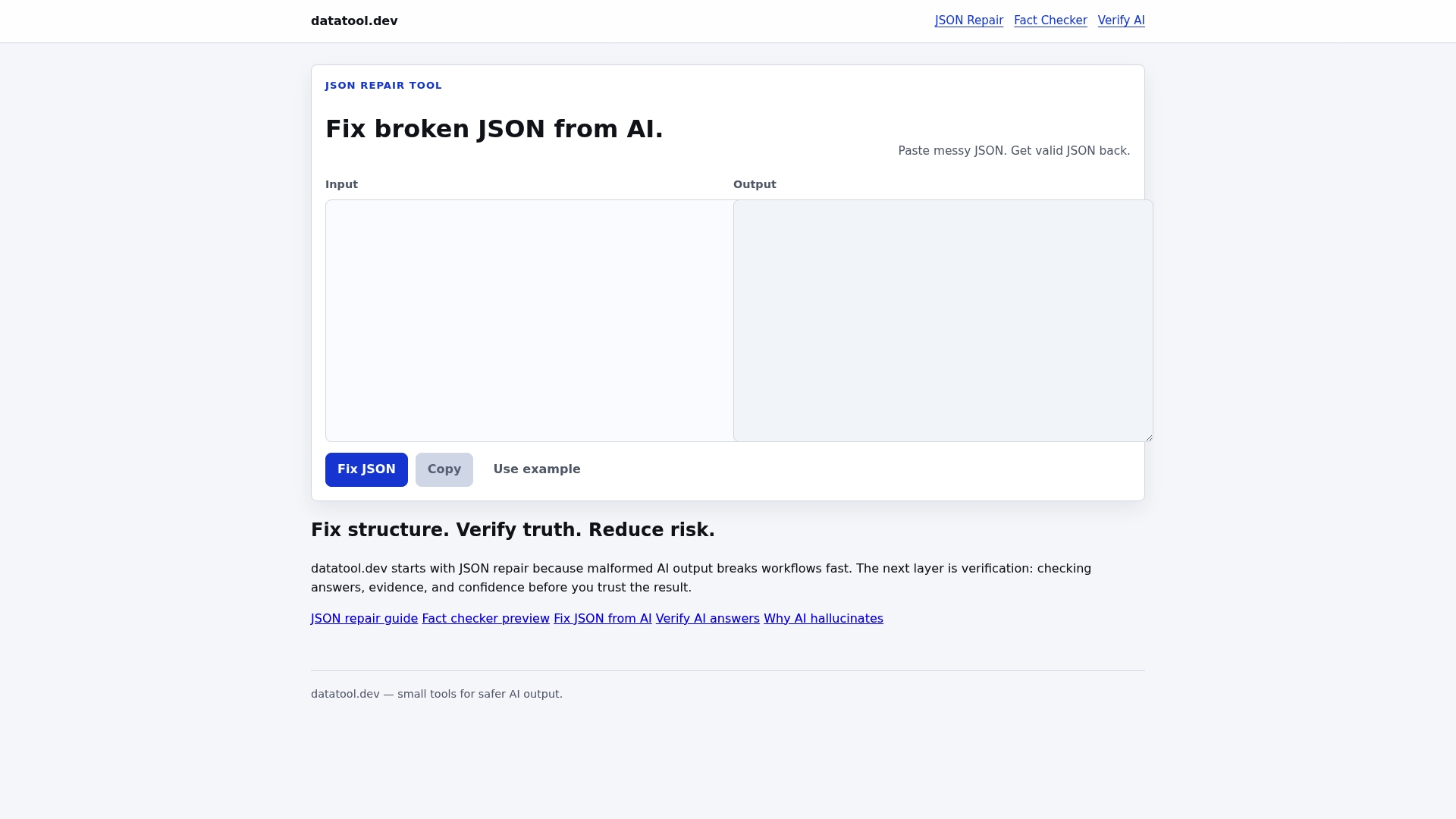
datatool.dev is built for exactly this problem. It gives AI developers and data engineers pre-built schema validation, contract enforcement, and fail-closed pipeline tools designed for real-world LLM output. Broken JSON, truncated responses, wrapped objects, schema drift: datatool.dev handles the full range of malformed AI outputs you encounter in production. It integrates into multi-step agent workflows and provides monitoring for invalid payload rates and schema mismatches so you can catch problems before they propagate. Stop patching validation logic manually. Start with tooling that is purpose-built for AI-generated structured data.
Frequently asked questions
How can I distinguish between malformed JSON and semantically incorrect AI output?
Malformed JSON fails to parse or breaks schema rules, while semantically incorrect output conforms structurally but contains inaccurate or incomplete content. You should separate malformed JSON from semantically wrong but parseable outputs and handle each with a distinct remediation path.
Why shouldn't I rely solely on HTTP 2xx status codes to judge AI tool output correctness?
A tool can return a 2xx status while delivering a payload that fails parse or schema validation, silently corrupting downstream data. Response corruption often presents as formally successful calls, so you must validate content-type, schema, and business invariants independently.
What is the best approach to handle inconsistent outputs across multiple AI agent runs?
Use consensus or voting mechanisms across multiple runs or agents to aggregate results and reduce output variance. Consistency errors are best handled via voting across runs or multiple agents to stabilize the final output.
How can early detection of step divergence improve AI agent reliability?
Catching the first step where execution diverges isolates the root cause before it corrupts every subsequent step. Detecting tool divergence early is critical because a single corrupted output can silently propagate through all later steps in a multi-step workflow.
Is strict JSON schema enforcement enough to ensure correct AI output?
No. Schema enforcement improves structural correctness but cannot prevent semantic errors or business rule violations. Structured outputs reduce malformed JSON but do not guarantee truth, so you must apply additional validation layers covering quality and business logic.