

Most AI pipeline failures don't come from bad models. They come from bad data that nobody caught. Your schema looked fine. Your tests passed. Then an upstream team renamed a column, changed a timestamp format, or dropped a field with no notice. The model degraded silently for days. Understanding what is a data contract in AI systems is how you stop that from happening. Data contracts formalize the expectations your pipelines depend on, and this guide covers exactly how they work, how to enforce them, and where teams get it wrong.
Table of Contents
- Key takeaways
- What is a data contract in AI systems
- Enforcement in AI pipelines
- Service-level agreements in data contracts
- Data contracts for governance and compliance
- Agentic enforcement: from reactive to self-healing
- My take on where teams actually fail
- Fix broken data pipelines with Datatool
- FAQ
Key takeaways
| Point | Details |
|---|---|
| Data contracts go beyond schemas | They include semantics, SLAs, ownership, quality rules, and versioning, not just structure. |
| Enforcement belongs in CI/CD | Producer and consumer validation gates catch violations before broken data reaches your models. |
| SLAs make reliability measurable | Freshness, completeness, and accuracy thresholds give you concrete breach detection targets. |
| Governance is built in | Contracts encode masking, retention, and usage rules that block non-compliant data automatically. |
| Start in observe mode | Calibrate thresholds by logging violations before enabling automated remediation. |
What is a data contract in AI systems
A data contract is a versioned, machine-readable agreement specifying schema, semantics, data quality expectations, and freshness SLAs. Think of it the same way you think about an API contract. The API contract tells your service what it can send and receive. A data contract tells your pipeline what it can trust about the data flowing through it.
Schema registries only track physical structure. Data contracts extend beyond a schema registry by adding quality expectations, SLAs, ownership metadata, versioning history, and business context. That distinction matters. A schema tells you a field named "order_status` exists and holds a string. A data contract tells you it must only contain specific enum values, must be populated on every record, and must be produced within 30 minutes of an order event.
Here is a comparison of the three concepts most teams confuse:
| Artifact | What it defines | What it misses |
|---|---|---|
| Schema registry | Field names, types, nullable flags | Quality rules, SLAs, ownership, semantics |
| API spec | Request/response structure, auth | Data freshness, completeness, downstream trust |
| Data contract | Schema + semantics + SLAs + quality + ownership + versioning | Nothing at this layer |
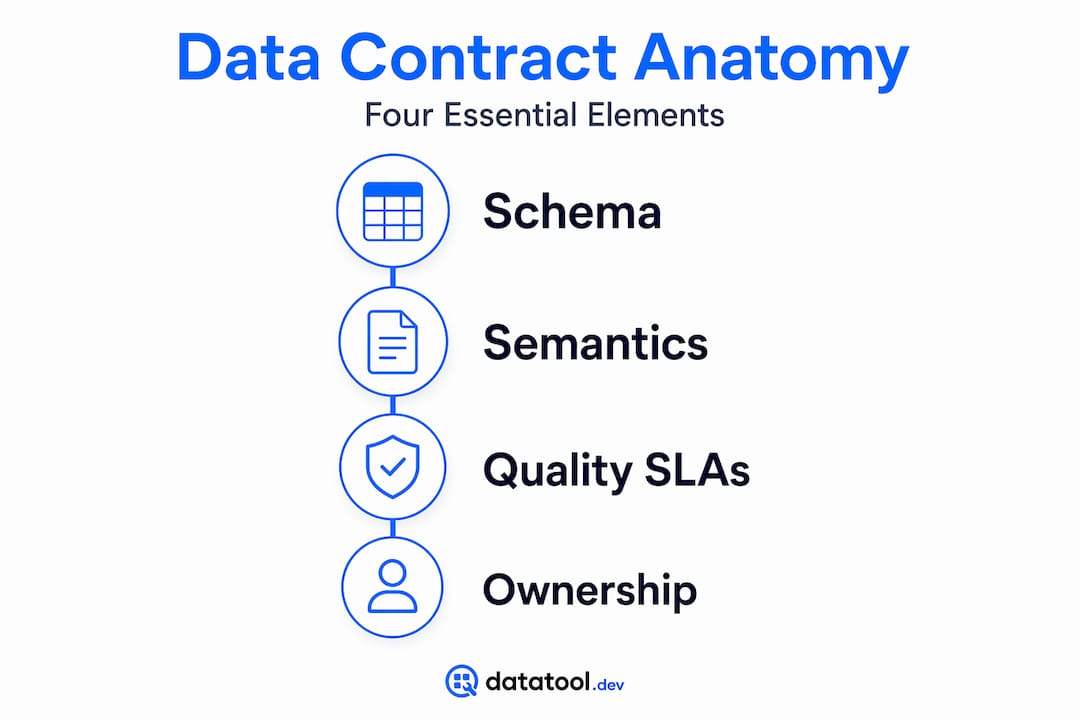
A contract file typically bundles four components together. First, the schema definition with field names and types. Second, semantic rules covering value ranges, enum memberships, and business meaning. Third, SLA thresholds for freshness and completeness. Fourth, ownership metadata identifying the producing team and version history.
Enforcement in AI pipelines
Enforcement follows a five-step flow: contract registration, consumer subscription, producer-side validation, consumer-side assurance, and version evolution. Each step has a job.
- Register the contract in a central store before any data moves.
- Subscribe consumers to a specific contract version so breaking changes never land silently.
- Validate on the producer side before writing data. Fail the write if the contract is violated.
- Validate on the consumer side after ingestion as a second safety net.
- Evolve with backward compatibility checks, treating contract changes exactly like API versioning.
A CI/CD gate makes this concrete. Consider a contract requiring event_type to be non-null:
# contract_check.py — fails the pipeline on violation
import json, sys

record = {"user_id": 42, "event_type": None, "timestamp": "2026-01-15T10:00:00Z"}
contract_rules = {"event_type": {"nullable": False}}

for field, rules in contract_rules.items():
    if not rules.get("nullable") and record.get(field) is None:
        print(f"CONTRACT VIOLATION: '{field}' must not be null")
        sys.exit(1)  # Fails the CI/CD step, blocking deployment
The fix is straightforward: the producer patches the upstream job to populate event_type before writing. The pipeline gate catches it in staging, not production.
Embedding enforcement into CI/CD pipelines moves validation left. Breaking data changes never deploy if your gate rejects them.

Pro Tip: Most teams validate structure and call it done. That is not enough. A common pitfall is missing semantic invariants: a field can be the right type with the wrong value, and your model will degrade without a single schema error appearing in your logs.
Service-level agreements in data contracts
SLAs turn vague reliability goals into measurable breach conditions. Freshness, completeness, and accuracy SLAs define maximum data staleness, minimum expected record counts, and acceptable error rates. Every one of these is continuously monitored and alertable.
| SLA Type | Example threshold | What a breach means |
|---|---|---|
| Freshness | Revenue data no older than 1 hour | Stale data enters model training |
| Completeness | 99.5% of daily orders present by 6 AM | Feature store missing records silently |
| Accuracy | Error rate under 0.01% | Model fed corrupt or invalid values |
Monitoring alone is not enough. You need automated alerting tied to each SLA so breaches surface before model inference starts. The best setups use agent-driven enforcement that can auto-remediate: if freshness is breached, trigger a backfill job. If completeness drops, hold the training run until data catches up.
Pro Tip: Set your completeness SLA thresholds based on historical baselines, not intuition. Pull 90 days of pipeline run data and use the 5th percentile as your minimum before you write the contract.
Data contracts for governance and compliance
Contract lifecycle management systems enforce AI training data governance by translating legal contract terms into automatable data rules. This is where the engineering work connects directly to regulatory obligations.
Contracts encode the following compliance controls:
- Permitted fields: Only approved fields from a data subject flow into training. Non-permitted fields are blocked at ingestion.
- Data masking: PII fields are masked or tokenized before reaching model training jobs, enforced by the contract, not by developer memory.
- Processing location constraints: Data from EU users stays in EU infrastructure. Contracts specify the allowed processing regions and reject violations automatically.
- Retention limits: Contracts carry a maximum retention window. Data older than the specified period is purged from training sets.
Automating data governance via contract control planes operationalizes compliance from the time a contract is drafted through to model outputs. Every enforcement decision produces an audit trail. That trail links contracts, data runs, and model versions, which is exactly what you need when a regulator asks how a training decision was made.
Human oversight still matters. Automated validation handles clear-cut rules. Edge cases with ambiguous data usage, particularly in high-risk categories like health or financial data, require a human review step built into the workflow. Read more about AI output observability to understand how this fits into broader monitoring.
Agentic enforcement: from reactive to self-healing
Modern enforcement architectures use autonomous agents that watch every pipeline run in real time. These agents do not just detect. They classify, respond, and propose fixes.
Here is the recommended rollout sequence:
- Observe mode first. Log every violation without blocking anything. Run this for two to four weeks to calibrate thresholds and eliminate false positives.
- Enable alerting. Route severity-classified violations to the right teams based on breach type and downstream impact.
- Activate blocking gates. Turn on hard failures for critical violations. Let low-severity issues continue with logged warnings.
- Deploy self-healing. For common violations like column renames or type widening, let agents apply the fix automatically and propose a contract update.
Starting enforcement in observation mode helps calibrate thresholds and avoids false positives before you enable active remediation. Skip this step and you will block valid data on day one, which kills team trust in the entire system. Agentic enforcement includes proactive monitoring with severity classification and optional self-healing, reducing mean time to detect and fix from hours to minutes.
My take on where teams actually fail
I've seen data contract initiatives fail not because the technology was wrong, but because teams scoped them too narrowly. They write a contract that's basically a schema with a freshness field and call it done. Then three months later a semantic change slips through and a model starts making wrong predictions. Nobody connects it to the data.
What I've learned: the contracts themselves are the easy part. The hard part is getting the producing team to treat them as binding. Without explicit data contracts, AI systems rely on handshake agreements that cause silent schema changes and cascading failures. I've watched a missed enum value take down a fraud detection model for 36 hours before anyone traced it back to the upstream change.
Agentic enforcement changed how I think about incident response. When violations are auto-classified and routed in real time, you stop spending hours debugging data lineage. My advice: start with one critical pipeline, write a contract that covers schema, semantics, and one SLA, run it in observe mode for two weeks, then turn on the gates. Build the habit before you scale.
— Gregory
Fix broken data pipelines with Datatool
Data contracts catch what your schema validation misses. But even with contracts in place, AI systems generate malformed structured data that needs repair before it can be validated at all. Datatool is built for exactly that. It handles broken JSON, schema drift, truncated objects, and invalid escaping from LLM output, so you have clean data to validate against your contracts in the first place. Explore AI output testing practices and see how Datatool fits into your enforcement workflow. Less broken data. More trust in your models.
FAQ
What is a data contract in an AI system?
A data contract is a versioned, machine-readable agreement between data producers and consumers that defines schema, semantic rules, quality expectations, and SLAs. It prevents silent failures in AI pipelines by making data expectations explicit and enforceable.
How does a data contract differ from a schema?
A schema only defines field names and types. A data contract adds quality rules, freshness SLAs, ownership metadata, semantic constraints, and versioning, covering the full set of expectations a pipeline needs to trust its data.
How are data contracts enforced in AI pipelines?
Enforcement runs at two points: producer-side validation before data is written, and consumer-side validation after ingestion. CI/CD gates fail the pipeline if a contract violation is detected, blocking broken data before it reaches model training.
What SLAs belong in a data contract?
Freshness SLAs set a maximum data age, completeness SLAs define the minimum percentage of expected records, and accuracy SLAs cap the acceptable error rate. All three are monitored continuously and trigger alerts or automated remediation on breach.
What is agentic data contract enforcement?
Agentic enforcement uses autonomous agents to monitor every pipeline run, classify violations by severity, and apply self-healing fixes for common issues like column renames. Start in observation mode before enabling active blocking to avoid false positives.