

AI models confidently produce wrong answers. That's the core problem with ungrounded AI. Understanding what is AI data grounding is now a foundational skill for any developer or data engineer building production systems on top of large language models (LLMs). Grounding connects AI output to real, verified external data at inference time, cutting hallucination rates and making structured data outputs trustworthy enough to actually use. This guide covers the concept, the key techniques, verification practices, and practical implementation patterns you need to build reliable grounded AI systems.
Table of Contents
- Understanding AI data grounding and its significance
- Key techniques and architectural patterns for effective grounding
- Verifying grounded AI outputs: preventing hallucinations and fake citations
- Best practices for implementing AI data grounding in production
- Comparison of grounding approaches: RAG vs tool use vs knowledge base grounding
- Why grounding is the next essential frontier for reliable AI outputs
- Explore datatool.dev to enhance your AI data grounding strategy
- Frequently asked questions
Key Takeaways
| Point | Details |
|---|---|
| Grounding defined | AI data grounding means linking AI outputs to real data sources at runtime to reduce hallucinations. |
| Multiple grounding methods | RAG, tool use, and knowledge base access are primary techniques to implement grounding. |
| Verification matters | Verifying claims against sources prevents citation-shaped hallucinations and builds trust. |
| Production best practices | Use typed APIs, modular tools, and error handling for reliable, maintainable grounding. |
| Architectural foundation | Grounding is essential infrastructure for moving AI from pattern matching to fact-based reasoning. |
Understanding AI data grounding and its significance
AI data grounding explained simply: it's the practice of anchoring what an AI generates to factual, external sources rather than relying solely on patterns baked into model weights during training. Without grounding, an LLM draws on statistical associations it learned from training data, which may be outdated, incomplete, or just wrong.

This produces hallucinations. The model doesn't signal uncertainty. It generates a confident, well-formatted answer that may have no factual basis at all. In production, that's not a theoretical risk. It's a recurring failure mode.
Grounding solves this at the architectural level. It is not a prompt engineering workaround. You're not just telling the model to "be accurate." You're changing what information the model has access to when it generates a response, giving it verified context before it writes a single token.
Key reasons grounding matters for AI developers and data engineers:
- Reduces hallucinations. Grounded AI models reduce hallucinations by 40 to 60 percent compared to ungrounded equivalents.
- Provides transparency. Grounded outputs can cite specific sources, enabling downstream verification.
- Supports instruction following AI use cases where factual precision is required, not just coherent text.
- Builds E-E-A-T aligned systems. Source-backed outputs demonstrate expertise and trustworthiness, critical for any AI system interacting with real users or downstream processes.
- Enables auditability. When something goes wrong, grounded systems let you trace exactly which source drove a given output.
Grounding is not about making a model smarter. It's about making its outputs verifiable. That distinction matters enormously in production.
Without grounding, AI accountability is impossible to enforce at any meaningful scale. You can't audit what you can't trace.
Key techniques and architectural patterns for effective grounding
How does AI data grounding work in practice? There are three main methods, each with distinct trade-offs. Most production systems combine at least two.
The three core grounding techniques:
-
Retrieval-Augmented Generation (RAG). The system retrieves relevant documents from a corpus before the LLM generates a response. Those documents are injected into the prompt context. The model uses them as its primary source of truth for that query. RAG works well for unstructured knowledge bases like documentation, reports, and research material.
-
Tool use (function calling). The model calls external APIs, databases, or calculation tools at runtime to fetch exact, live data. This is the right approach when you need real-time figures, current records, or precise computations that no static document can reliably provide.
-
Knowledge base grounding. The system queries curated, structured sources like knowledge graphs, company wikis, or product catalogs. This is ideal for consistent domain-specific facts where data freshness and precision both matter.
Grounding in production systems typically combines RAG, tool use, and structured knowledge retrieval depending on query type.
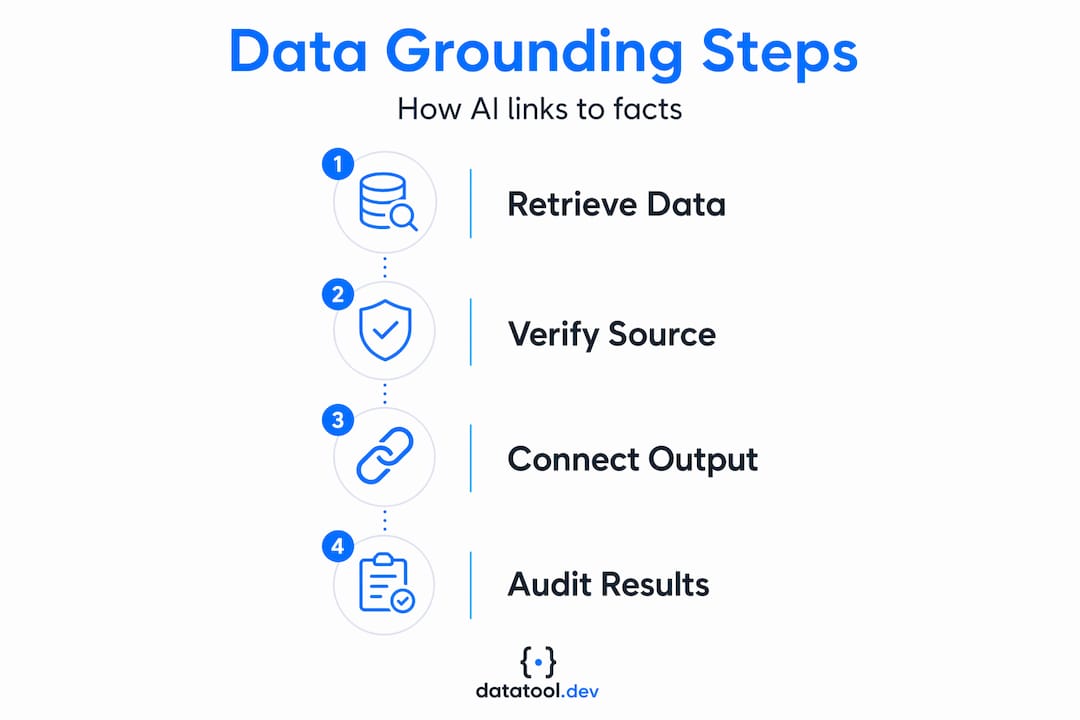
A well-designed grounding pipeline includes:
- Query intent detection: determine what type of fact is needed
- Source routing: select the right retrieval method for that fact type
- Retrieval: fetch relevant documents, API results, or knowledge graph nodes
- Context injection: insert retrieved data into the model's context window
- Generation: produce output grounded in the retrieved context
- Verification (optional but recommended): validate claims against sources
The architectural layers should be clearly separated. Data providers sit in one layer. Tools and functions in another. Agent reasoning in a third. This separation makes each layer independently testable and reduces debugging complexity significantly when something breaks.
| Concern | Monolithic approach | Layered approach |
|---|---|---|
| Fault isolation | Difficult | Clear per layer |
| Testability | Low | High |
| Scalability | Limited | Independent scaling |
| Debugging | Expensive | Targeted |
Pro Tip: Use typed, stable APIs with predictable response schemas for your tool integrations. Unstructured text returns from tools force the LLM to parse the data itself, which reintroduces the hallucination risk you were trying to eliminate. Integrate detecting AI output errors into your pipeline to catch issues before they reach downstream consumers.
Verifying grounded AI outputs: preventing hallucinations and fake citations
Grounding reduces hallucinations. It doesn't eliminate them. The next line of defense is verification.
The most effective verification approach decomposes an AI-generated answer into atomic claims, meaning individual, independently verifiable statements, then checks each one against its retrieved source. This is different from checking whether a citation appears. It checks whether the citation actually supports the specific claim.
This distinction matters because of a failure mode called citation-shaped hallucination. The model produces a plausible-looking citation. The citation may even be a real document. But the document doesn't say what the model claims it says. Without claim-level verification, this slips through.
Common failure modes in grounded outputs:
- Fabricated citations. Real-sounding source titles attached to nonexistent documents.
- Misattributed claims. Real sources that don't support the specific claim being made.
- Out-of-domain retrieval. Retrieved documents that are topically adjacent but factually irrelevant to the query.
- Stale data without labeling. Grounded responses using cached or outdated sources presented as current.
- Partial support. A source supports part of a claim but not all of it, and the model treats it as full support.
Modern RAG evaluation targets atomic claim verification with LLM judges at sub-sentence granularity, which is the current standard for faithfulness assessment.
Multi-level citation enhances traceability. Source-level attribution says "this answer came from document X." Sentence-level attribution ties each sentence to a source. Token-level attribution goes further, mapping specific phrases to specific source spans. The deeper the attribution, the more auditable the output.
| Verification level | Granularity | Implementation cost | Trust level |
|---|---|---|---|
| Source-level | Full document | Low | Low |
| Sentence-level | Per sentence | Medium | Medium |
| Claim-level (atomic) | Sub-sentence | High | High |
| Token-level | Per phrase | Very high | Very high |
Citation verification depends entirely on the quality of the verification model. A weak judge produces false confidence, which is worse than no verification at all.
Pro Tip: Don't treat your verification step as a solved problem once you deploy it. Evaluate the verifier's own accuracy on a labeled test set. Build unit testing for AI data into your pipeline and run AI output testing practices regularly. A verifier that passes bad outputs silently undermines the entire grounding effort.
Best practices for implementing AI data grounding in production
Deploying grounded AI in production requires more than getting the happy path working. Here's what separates systems that hold up from systems that quietly degrade.
Core implementation practices:
-
Match data sources to query types. A single generic search tool is not enough. Map specific factual query categories to purpose-built APIs or structured sources designed for that data type. Product queries go to the product catalog API. Financial figures go to the finance data API. Mixing them leads to imprecise retrieval and confused context.
-
Keep tool integrations narrow and composable. One tool that does one thing reliably beats one monolithic search function that tries to cover everything. Composable tools are easier to test, easier to replace, and easier to monitor.
-
Test failure scenarios explicitly. What does your pipeline do when an API returns a 429 rate limit error? What about an empty result set? Graceful degradation needs to be designed in, not discovered in production.
-
Label data freshness clearly. If retrieved data is cached from six hours ago, the agent needs to know that. Live data and cached data require different confidence signals in the output.
-
Build for modularity with protocols like MCP. The Model Context Protocol (MCP) provides typed, stable APIs returning predictable, machine-readable responses, which is exactly what production-grade grounding requires. Designing around open protocols also reduces vendor lock-in as your backend needs evolve.
Pro Tip: Keep retrieval logic and verification logic completely separate from generation. When an output is wrong, you need to know immediately whether retrieval returned bad data, verification missed a false claim, or generation drifted from the context. You can't diagnose that in a monolithic pipeline. Use structured detection methods and pair them with data validation practices to keep each layer accountable.
Comparison of grounding approaches: RAG vs tool use vs knowledge base grounding
Understanding data grounding in AI means knowing which technique fits which problem. Each approach has a profile of strengths and costs that makes it better suited to certain use cases.
Grounding is a design goal achievable through multiple methods, with RAG being one among tool use and knowledge traversal, not a synonym for grounding itself.
| Approach | Best for | Latency | Complexity | Data freshness |
|---|---|---|---|---|
| RAG | Unstructured textual knowledge | Medium | Medium | Depends on index |
| Tool use | Real-time data, calculations | Low to medium | Higher | Live |
| Knowledge base | Curated domain facts | Low | Medium | Controlled |
| Hybrid | Broad coverage | Variable | High | Mixed |
Key trade-offs at a glance:
- RAG excels at breadth but can retrieve marginally relevant documents that confuse rather than ground the model.
- Tool use provides exact, live data but requires stable APIs and introduces network dependency into your inference path.
- Knowledge base grounding offers consistency and control but needs active maintenance to stay accurate.
- Hybrid approaches deliver the best overall coverage. They also require the most careful architectural design to avoid compounding failure modes across retrieval paths.
AI data grounding examples from production: a customer support agent might use tool use to fetch live account status, RAG to pull from a knowledge base of support articles, and knowledge base grounding to confirm product specifications. All three run together in a routing layer that detects query type and dispatches accordingly.
Why grounding is the next essential frontier for reliable AI outputs
Here's the uncomfortable reality most teams avoid: you cannot scale AI reliability by scaling model size. Larger models hallucinate with greater confidence. They don't hallucinate less.
Grounding is the architectural investment that actually moves the needle. It shifts an AI system from statistical pattern-matching toward evidence-backed, traceable reasoning. That's not an incremental improvement. That's a different class of system.
Most AI projects underinvest in data layers and verification pipelines. They spend heavily on model selection and prompt engineering, then discover late in development that their outputs can't be trusted at the claim level. Fixing that retroactively is far more expensive than building it right initially.
Leading researchers emphasize that grounded world models combined with reasoning and planning are the path to advancing AI beyond correlation toward causation. That framing should shape how you think about building these systems today.
The future of AI development runs through grounding combined with memory, planning, and causal reasoning. The foundation for all of that is a reliable data layer. If your grounding architecture is weak, every capability you build on top of it inherits that weakness.
Your instruction following AI guide already tells you that model behavior is shaped by context. Grounding is how you control what that context contains.
Pro Tip: Prioritize your grounding pipeline in the early system design phase, not as an afterthought. The cost of retrofitting retrieval architecture, verification logic, and source attribution into a deployed system is high. Build it in from the start.
Explore datatool.dev to enhance your AI data grounding strategy
Grounding improves the factual basis of AI outputs. But grounded AI still produces structured data that can be malformed, schema-invalid, or truncated by the time it reaches your application layer. That's where datatool.dev fits in.
datatool.dev is built for developers who need AI-generated JSON to be valid, complete, and schema-conformant in production. It handles broken JSON, wrapped responses, partial objects, invalid escaping, and schema drift. These are the real-world output failures that grounding alone doesn't prevent. Combine a solid grounding pipeline with rigorous output validation and you get structured data you can actually trust end to end. Fix broken AI output faster. Validate against your schema. Reduce the debugging time that comes from unpredictable LLM responses.
Frequently asked questions
What is AI data grounding and why does it matter?
AI data grounding connects AI-generated outputs to real, verified external data sources to reduce hallucinations and improve accuracy. It matters because grounding reduces hallucinations by 40 to 60 percent, making AI outputs reliable enough to use in production systems.
How does retrieval-augmented generation (RAG) relate to grounding?
RAG is one technique for achieving grounding by retrieving relevant documents and injecting them into the AI's context before generation. RAG is a popular grounding approach that bases outputs on retrieved data instead of model memory alone, but it is one method among several.
Can grounding alone guarantee factually correct AI outputs?
No. Grounding reduces hallucination risk but still requires robust verification and reliable data sources. Verification is critical to prevent citation-shaped hallucinations where sources appear cited but don't actually support the claims being made.
What are common challenges in implementing AI grounding?
Common challenges include designing stable data layers, handling API failure modes like empty responses and rate limits, ensuring retrieval precision, and integrating multi-level verification. Production grounding requires typed APIs with error handling and clear separation of pipeline concerns.
How can I improve the trustworthiness of AI citations?
Verify each atomic claim against its source chunk rather than checking citation presence alone. Use multi-level citation ranging from source-level to sentence-level or claim-level attribution, and implement multi-stage verification with out-of-domain detection to catch unsupported claims before they reach production.