

AI systems hallucinate, produce broken JSON, drift from their schemas, and return structurally valid but semantically wrong data. These failures land in your pipelines, corrupt downstream systems, and create compliance exposure you did not plan for. Improving AI data output reliability is not a model tuning problem. It is a data engineering problem, and treating it that way changes every decision you make. This guide covers preparation, execution, and verification from a data-centric perspective built for production environments.
Table of Contents
- Key takeaways
- Improving AI data output reliability: preparation first
- Data engineering steps that reduce output errors
- Grounding, schema validation, and output execution
- Verification and monitoring after deployment
- Why model fixes alone will not solve this
- Fix broken AI output with Datatool
- FAQ
Key takeaways
| Point | Details |
|---|---|
| Data quality drives reliability | Data-Centric AI treats curation and validation as the primary levers, not model tweaks. |
| Schema enforcement is a floor, not a ceiling | Valid structure does not guarantee correct semantics. Add business rule validation after schema checks. |
| Retrieval coverage is measurable | Hallucination probability has a provable upper bound tied to retrieval coverage and generator calibration. |
| Monitoring must be continuous | Drift detection and provenance tracking prevent silent degradation after deployment. |
| Distinguish failure levels | Parsing errors, semantic errors, and factual errors require different fixes at different pipeline stages. |
Improving AI data output reliability: preparation first
Before you write a single validation rule, you need a data governance framework that defines what good output actually looks like. Without it, you are measuring noise.
Data quality has four dimensions that matter here: accuracy, completeness, consistency, and relevance. Each one can fail independently. An output can be syntactically complete and consistently formatted but factually wrong. Relevance failures are particularly common in retrieval-augmented systems where retrieved chunks do not match the query scope.
The table below compares the core techniques and where they apply.
| Technique | What it addresses | When to apply |
|---|---|---|
| Dataset curation and filtering | Noise, bias, and irrelevant training signal | Before fine-tuning or RAG index construction |
| Schema design and versioning | Structural drift and parsing failures | At pipeline design and after model updates |
| Annotation consistency audits | Label noise and semantic ambiguity | During dataset creation and periodic review |
| Distribution monitoring | Silent drift in live data | Post-deployment, on a scheduled basis |
| Retrieval coverage measurement | Hallucination rate upper bounds | During RAG system design and benchmarking |
Start with dataset construction practices before addressing runtime fixes. Infrastructure built on weak data produces weak outputs, regardless of the model you use.
Data engineering steps that reduce output errors
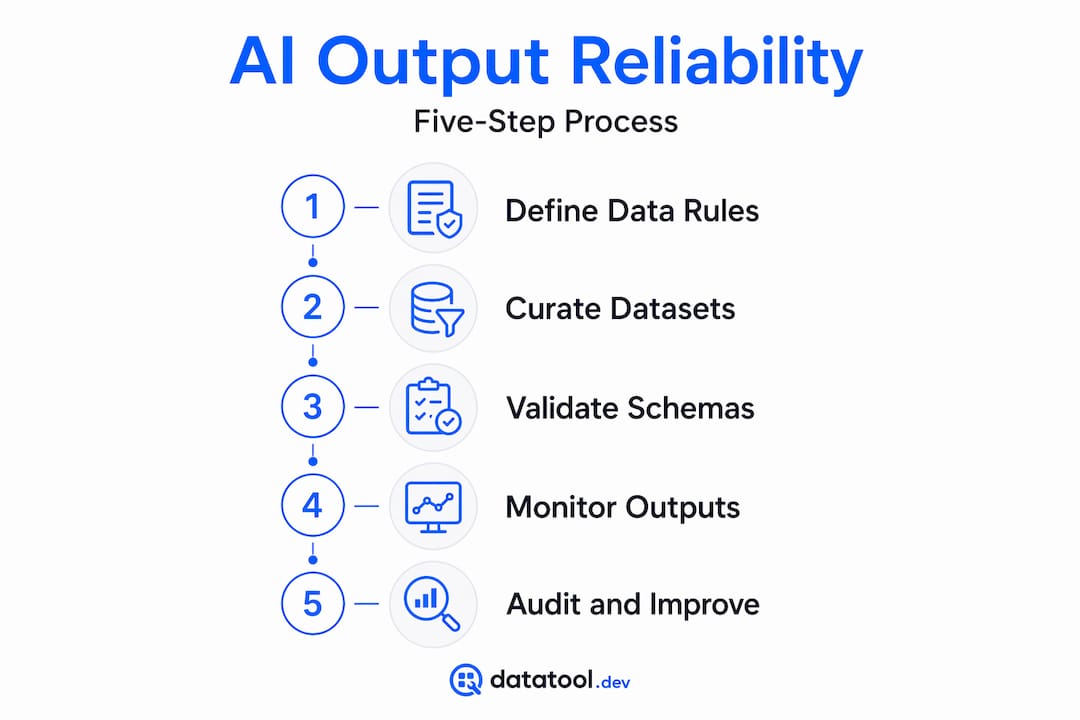
Reliable outputs start with clean, well-structured data at every stage of the pipeline. Here is a concrete sequence that works in production.
-
Filter and enrich your dataset systematically. Remove duplicates, near-duplicates, and low-quality samples before training or indexing. Enrichment means adding structured metadata, source provenance, and confidence signals that downstream validation can use.
-
Apply the RefineLab approach to token budget constraints. The RefineLab framework improves domain coverage, factual fidelity, and difficulty alignment under fixed resource limits. It treats dataset quality as an optimization problem with measurable targets, not a manual curation exercise.
-
Minimize label noise before it compounds. Label noise does not average out. It creates systematic errors in model behavior. Audit annotation consistency using inter-annotator agreement scores. Flag and re-label samples where agreement falls below your threshold.
-
Enforce semantic consistency across your corpus. The same concept should be described the same way across all training or retrieval documents. Inconsistent terminology causes the model to produce inconsistent outputs. A controlled vocabulary or entity normalization step pays off here.
-
Set up continuous data validation before deployment. Track distribution shifts in your input data using statistical tests such as KL divergence or Population Stability Index. A shift in input distribution predicts a shift in output reliability before it becomes visible in user-facing metrics.
Pro Tip: The most common labeling noise pitfall is assuming that majority vote among annotators is enough. It is not. Track disagreement patterns. If the same samples generate disagreement repeatedly, they are either ambiguous by definition or mislabeled at the source. Fix the source.
Grounding, schema validation, and output execution
This is where the data engineering work from the previous section pays off. Execution phase reliability depends on three controls working together: grounded generation, schema enforcement, and retry logic with feedback.

Grounded generation and out-of-domain detection. When your retrieval system cannot find supporting evidence for a query, the model should abstain rather than generate an unsupported response. Retrieval score thresholds make this measurable. Set a minimum relevance score below which your system routes to a fallback response. Abstaining on low coverage prevents the model from filling knowledge gaps with plausible-sounding fabrications.
Hallucination rate has a provable structure: Pr[hallucinate] ≤ 1 minus retrieval coverage plus generator leakage. When coverage is low, fix retrieval first. When coverage is adequate but hallucinations persist, the problem is generator calibration. These are different root causes that require different interventions.
Schema-constrained generation. JSON Schema enforcement at the token level, as implemented by major LLM providers, pushes valid structured output rates close to 100%. Use it. But know its limits. Schema enforcement guarantees structure. It does not guarantee that a "pricefield contains a sensible number or that adate` field reflects the actual event date.
Here is a real failure pattern and its fix:
# Failure: Schema-valid but semantically broken
{
  "order_date": "2024-02-30",
  "total_price": -450.00,
  "status": "shipped"
}

# Fix: Add post-generation semantic validation
def validate_order(output: dict) -> bool:
    from datetime import datetime
    try:
        datetime.strptime(output["order_date"], "%Y-%m-%d")
    except ValueError:
        return False
    if output["total_price"] < 0:
        return False
    return True
The schema accepted 2024-02-30 as a string. The semantic validator caught the impossible date.
Retry logic with validation feedback. When an output fails schema or semantic validation, retry with the error message appended to the prompt. This closes the loop and reduces malformed outputs without human intervention. Cap retries at three attempts. Beyond that, route to a human review queue.
Pro Tip: Grounding and multi-step verification add latency. Self-RAG can multiply generation time. Set explicit latency budgets per pipeline stage and measure the reliability-versus-latency trade-off empirically. Do not assume the default is acceptable for your use case.
Verification and monitoring after deployment
Deployment is not the finish line. Output reliability degrades over time as input distributions shift, knowledge bases go stale, and model updates introduce unexpected behavior changes.
The core monitoring stack you need in production:
- Claim-level coverage tracking. Measure the ratio of supported claims to total claims in each output batch. Practitioner pipelines that track supported versus unverifiable claims can gate releases and flag degradation before it reaches end users.
- Semantic consistency scoring. Track whether outputs for semantically equivalent inputs remain consistent over time. Divergence signals either data drift or model drift.
- Decision significance ranking. This differs from semantic relevance. In regulated workflows, decision significance identifies which outputs carry material consequences. Flag those for tighter review thresholds.
- Provenance and lineage tracking. Know where every training or retrieval document came from. AI-generated data used as training input creates recursive contamination loops that are difficult to detect after the fact.
For unit testing, treat AI outputs the same way you treat function outputs. Define expected behavior for a fixed set of inputs, run on each deployment, and alert on regression. The production monitoring guide from Datatool covers specific metric thresholds and alerting patterns worth reviewing.
Why model fixes alone will not solve this
I have worked with production AI pipelines where the team's default response to every reliability failure was to request a model upgrade or adjust temperature settings. It almost never worked. The outputs got slightly different but not measurably more reliable.
What actually moved the needle was treating data as a first-class engineering concern. Cleaning the retrieval index. Fixing annotation inconsistencies. Adding semantic validation on top of schema enforcement. These changes produced measurable gains. Model changes produced hope.
The uncomfortable truth is that reliability in regulated workflows requires encoding constraints architecturally, not relying on the model to learn them from examples. Compliance boundaries, domain rules, and output constraints belong in your pipeline as enforceable checks, not in your system prompt as polite instructions.
I have also seen teams skip provenance tracking because it felt like overhead. Then they discovered their retrieval index had been partially populated with AI-generated summaries of AI-generated documents. The model was retrieving its own hallucinations as evidence. That is not a model problem. It is a data governance failure.
Start with the data. Fix the data. Then look at the model.
— Gregory
Fix broken AI output with Datatool
If your pipelines are producing malformed JSON, truncated responses, invalid escaping, or schema drift, Datatool is built for exactly that.
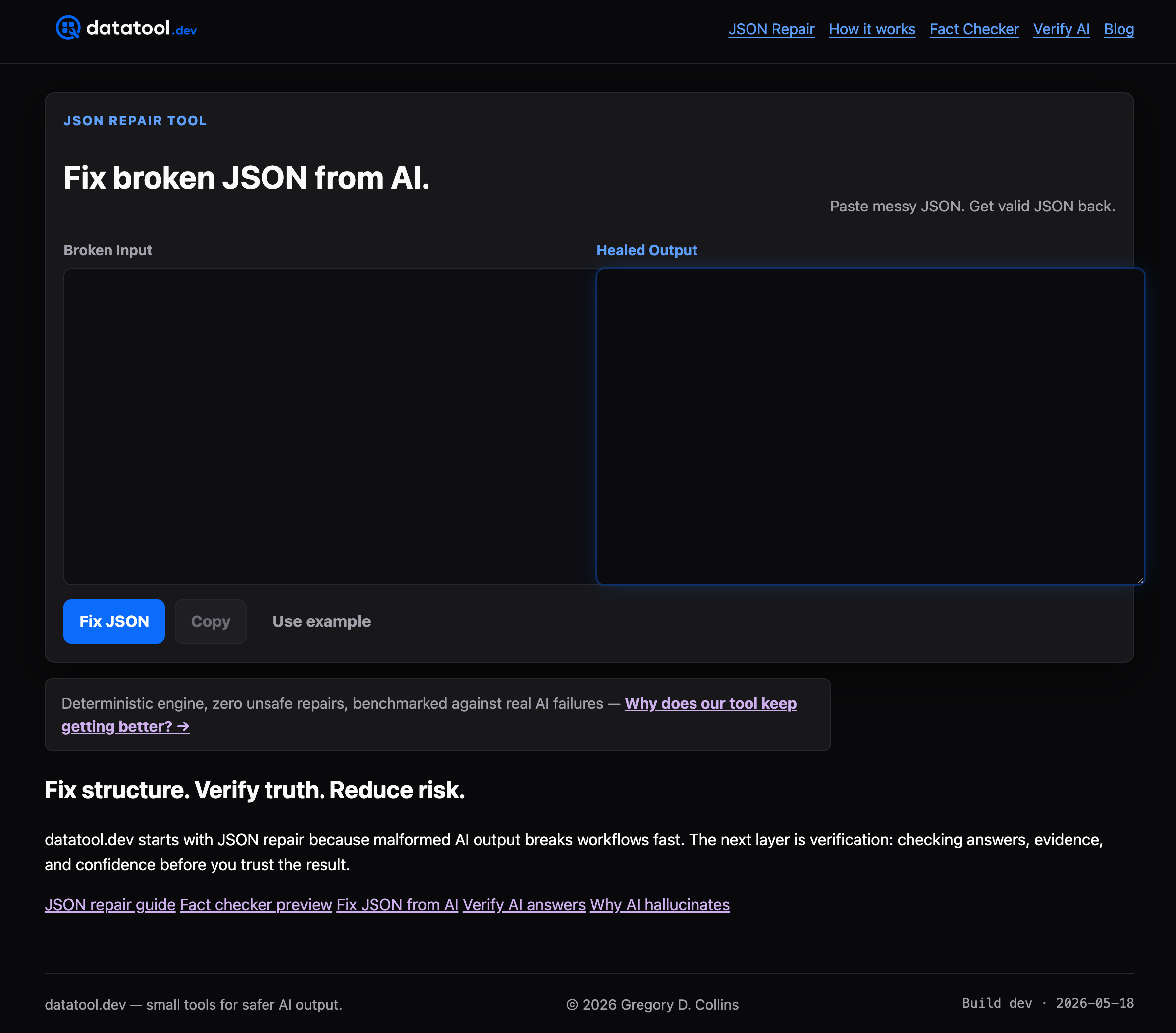
Datatool repairs broken AI-generated structured data in real time. It handles the full range of LLM output failures: broken JSON, wrapped responses, partial objects, and token-truncated structures. Paste malformed output. Get valid, parseable JSON back. Use it inline in your validation pipeline or as a standalone repair step before downstream processing. For teams working on AI reliability improvement, it removes the manual debugging that slows down iteration. Combine it with the schema validation and retry patterns described above to build a production-grade output pipeline that actually holds up.
FAQ
What is the main cause of unreliable AI data outputs?
The primary causes are label noise in training data, insufficient retrieval coverage in RAG systems, and missing semantic validation after schema enforcement. Each requires a different fix at a different pipeline stage.
How do you measure AI output reliability?
Track claim-level support coverage, semantic consistency scores across equivalent inputs, schema validation pass rates, and hallucination rates derived from retrieval coverage metrics. These give you a measurable baseline.
Does schema-constrained generation prevent all output errors?
No. Schema enforcement guarantees structural validity but not semantic correctness. An output can pass schema validation while containing impossible dates, negative prices, or factually wrong values. Post-generation business rule validation is required.
How often should you run drift detection on AI pipelines?
Run distribution monitoring on every deployment and on a scheduled daily or weekly basis in production. Track both input data distribution and output semantic consistency to catch silent degradation early.
What is the fastest way to fix broken JSON from an AI model?
Use a dedicated repair tool such as Datatool to parse and fix malformed output automatically, then add retry logic that passes validation error messages back to the model as prompt context for self-correction.