

An AI output repair pipeline is a structured sequence of automated processes that detects, corrects, and refines AI-generated outputs, particularly malformed structured data, before it reaches downstream systems. LLMs regularly produce broken JSON, truncated objects, invalid escape sequences, and schema-drifted responses. Without a repair pipeline, those failures propagate silently into your application logic. A single structured correction cycle improves factual accuracy by 31 percentage points and reduces omission errors below 10%, which makes automated repair one of the highest-return investments in any AI-driven workflow.
What is an AI output repair pipeline and why does it matter?
An AI output repair pipeline is the layer between raw LLM output and your application. It catches what the model gets wrong and fixes it without requiring a full retry. The pipeline typically includes validation, format correction, content repair, and structured critique, applied in sequence with defined exit conditions.
LLMs hold latent knowledge they do not always surface on the first pass. Recursive correction activates different reasoning pathways, which is why a second structured pass often produces dramatically better output than the original. This is not a workaround. It is a core design pattern for production AI systems.

The AI output correction process matters most when your system consumes structured data. A missing closing brace in a JSON response does not degrade gracefully. It throws a parse error, fails silently, or corrupts a downstream record. Repair pipelines prevent all three outcomes.
What are the common failure modes repair pipelines address?
AI-generated outputs fail in predictable, classifiable ways. Knowing the failure taxonomy lets you build targeted fixes instead of brute-force retries.
The most frequent failure modes in structured output are:
- Malformed JSON: Missing brackets, unquoted keys, trailing commas, and invalid Unicode escapes. These are the most common errors Datatool sees in production LLM output.
- Truncated responses: The model hits a token limit mid-object. You receive a partial JSON structure with no closing delimiter.
- Markdown fence wrapping: The model wraps valid JSON in triple backticks or adds a "json` language tag, breaking direct parsing.
- Tokenization artifacts: Byte-pair encoding at the boundary of a generation window produces garbled characters or split tokens.
- Over-correction during iteration: The model rewrites already-correct sections when given vague feedback, introducing new errors.
Here is a concrete example of a malformed response and a minimal fix:
// Raw LLM output (broken)
{
  "name": "sensor_batch_42",
  "readings": [12.4, 15.1, 9.8
  "status": "ok"
}

// After fence stripping + truncation recovery
{
  "name": "sensor_batch_42",
  "readings": [12.4, 15.1, 9.8],
  "status": "ok"
}
The fix here is not an LLM retry. It is a deterministic parser that detects the unclosed array, inserts the missing bracket, and re-validates. Fast, cheap, and reliable.
Pro Tip: Classify every failure before choosing a repair strategy. A truncated output needs truncation recovery. A fence-wrapped output needs stripping. Sending both to the same LLM retry wastes tokens and introduces new failure modes.
How does a typical AI output repair pipeline work?
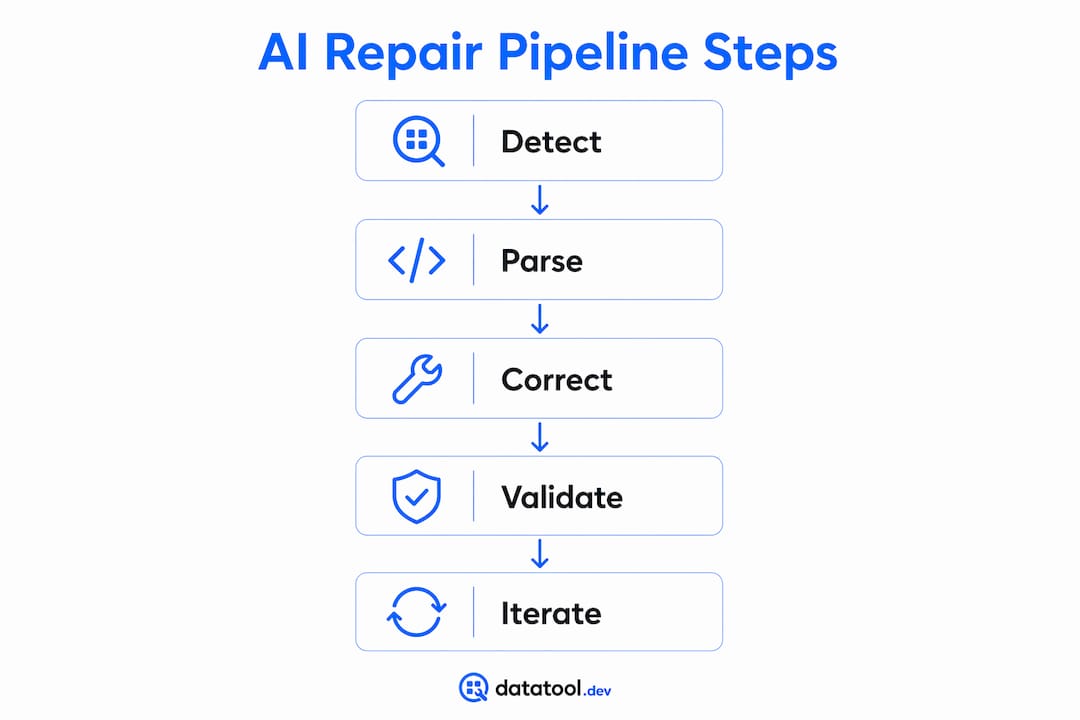
A production-grade pipeline for fixing AI results runs repair strategies in a cost-ordered sequence. Start cheap. Escalate only when cheaper methods fail.
| Strategy | Method | Cost | Success rate |
|---|---|---|---|
| Direct parse | Attempt JSON.parse or equivalent | Near zero | ~60% of outputs |
| Fence stripping | Remove markdown code fences | Minimal | Adds ~15% coverage |
| Truncation recovery | Detect and close open structures | Low | Adds ~10% coverage |
| Extraction | Regex or heuristic JSON extraction | Low | Adds ~5% coverage |
| LLM retry with schema | Structured prompt with Pydantic model | High | Handles remaining cases |
Output recovery steps like token healing and truncation repair should be prioritized over full LLM retries because they are cheaper and faster. The heuristic is clear: fix format issues first, and only retry when semantic content is missing or wrong.
When an LLM retry is necessary, constrain it. Pydantic-based schemas for critiques prevent over-correction by limiting revisions to flagged spans only. Structured reviews produce a 20% quality lift and avoid rewriting already-correct parts of the output. Free-form critique prompts cause the model to hallucinate new problems and rewrite sections that were fine.
Pro Tip: Set a maximum of two to three repair iterations. Beyond three cycles, quality gains diminish and token costs rise without meaningful improvement.
The pipeline exit conditions matter as much as the repair logic. Define explicit stop reasons: no_issues, max_iterations, schema_valid, and unrecoverable. Without them, the pipeline loops indefinitely or exits silently on partial fixes.
What best practices improve AI output repair pipeline effectiveness?
Effective pipelines share four design properties: observability, hierarchy, structured critique, and prompt discipline.
-
Log every repair action. Observable repair pipelines detect consistent failure points and enable proactive upstream fixes. Treat repair triggers as telemetry, not just error handling. If fence stripping fires on 40% of outputs from a specific model, that is a prompt engineering signal, not a runtime anomaly.
-
Apply hierarchical repair. Run deterministic fixes before LLM-based fixes. Deterministic methods are fast, free of hallucination risk, and auditable. Reserve LLM retries for cases where the content itself is wrong, not just the format.
-
Use structured critique schemas. Vague feedback like "fix the errors in this JSON" causes unstable results. A Pydantic model that specifies exactly which fields failed validation and why produces consistent, targeted corrections. Treat the prompt as code and the output as a test result. Classify the failure mode before writing the correction prompt.
-
Set hard limits on tokens, iterations, and time. Repair pipelines without budget constraints become runaway cost centers. Define a maximum token budget per repair attempt and a wall-clock timeout. If the pipeline cannot fix the output within those bounds, escalate to a fallback.
For AI output testing best practices, the same discipline applies: every repair attempt should be logged, reproducible, and tied to a specific failure classification.
How to integrate AI output repair pipelines in real-world workflows
Integration points vary by architecture, but the core monitoring metrics stay consistent across agentic pipelines, multi-model ensembles, and single-model APIs.
Track these metrics in production:
- Constraint violation rate: The percentage of outputs that fail schema validation before repair. A rising rate signals model drift or prompt regression.
- Stop-reason distribution: Logging stop reasons like
no_issuesormax_iterationsprovides early signals of quality control problems. A spike inmax_iterationsmeans the pipeline is hitting its ceiling on a new failure class. - LLM-as-judge win rate: For content quality, use a separate judge model to score repaired outputs against a rubric. This catches semantic degradation that schema validation misses.
- Repair latency by strategy: Measure how long each repair stage takes. Truncation recovery should be milliseconds. LLM retries will be seconds. Latency spikes indicate infrastructure or prompt issues.
For streaming outputs, apply incremental validation at chunk boundaries rather than waiting for the full response. This reduces time-to-first-valid-token and catches truncation earlier. When auto-repair fails entirely, the fallback options are human review queues, graceful degradation with a null or default value, or a hard error with a structured error payload. The right choice depends on whether your downstream system can tolerate missing data or requires a complete record.
For teams building AI output observability into their pipelines, the repair layer is the richest source of diagnostic signal in the entire system. Do not discard it.
Key takeaways
An AI output repair pipeline works by applying cost-ordered, deterministic fixes first, then structured LLM-based correction, with strict iteration limits and full telemetry at every stage.
| Point | Details |
|---|---|
| Define failure modes first | Classify errors as format, truncation, or semantic before choosing a repair strategy. |
| Prioritize cheap fixes | Run fence stripping and truncation recovery before any LLM retry to control costs. |
| Use structured schemas | Pydantic-based critique models prevent over-correction and produce a 20% quality lift. |
| Cap iteration depth | Limit repair cycles to two or three passes to avoid diminishing returns and token waste. |
| Log everything | Repair telemetry reveals model drift and prompt regressions before they reach production. |
Why vague critique is the silent killer of repair pipelines
I have reviewed a lot of repair pipeline implementations, and the most common failure is not a missing validation step or a bad regex. It is vague critique. Engineers write a correction prompt that says something like "review this output and fix any issues," then wonder why the repaired output is worse than the original.
The model does not know what "issues" means without a schema. It rewrites confidently. It fixes things that were not broken. It introduces new errors in sections it should have left alone. I have seen this pattern destroy a pipeline that was otherwise well-designed.
The fix is structural, not prompt-level. Use a Pydantic model or equivalent schema to define exactly what the critique should flag. Constrain the revision to those flagged spans only. The Critic-Refiner pattern with severity thresholds is the right architecture here, not a free-form "please fix this" prompt.
The other thing I would emphasize: treat your repair pipeline as a first-class system, not an afterthought. It deserves its own tests, its own monitoring, and its own budget. If you are running AI output preprocessing without a repair layer downstream, you are catching problems too early and missing the ones that matter most.
— Gregory
Fix broken AI outputs with Datatool
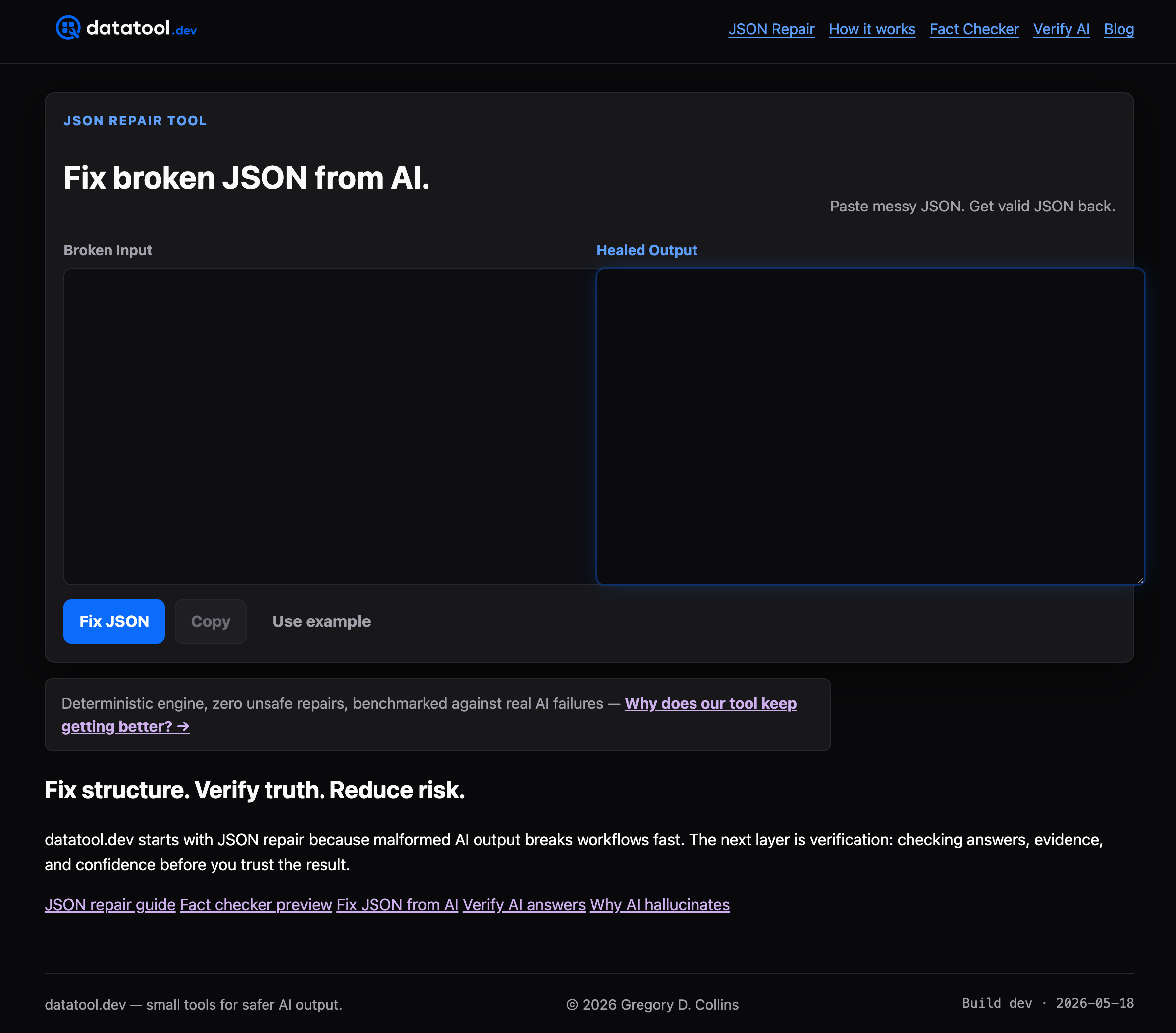
Datatool is built for exactly the failure modes described in this article. Broken JSON, wrapped responses, partial objects, invalid escaping, truncation, and schema drift. All handled automatically, without an LLM retry.
Paste malformed AI output. Get valid, schema-conformant JSON back. Datatool runs deterministic repair first, validates against your schema, and flags anything that requires human review. It fits directly into your existing pipeline as a validation and repair layer, with no model calls required for format-level errors.
If you are building or maintaining an AI output repair pipeline, fix broken JSON with Datatool and stop writing one-off parsers for every new failure mode your models produce.
FAQ
What is an AI output repair pipeline?
An AI output repair pipeline is an automated sequence of validation, correction, and refinement steps applied to LLM-generated outputs to fix errors like malformed JSON, truncation, and schema violations before they reach downstream systems.
How many repair iterations should a pipeline run?
Two to three iterations is the recommended limit. Beyond that, quality gains diminish and token costs rise without meaningful improvement to output accuracy.
Why use Pydantic schemas in a repair pipeline?
Pydantic schemas constrain LLM-based corrections to specific flagged fields, preventing the model from rewriting correct sections. This produces a 20% quality lift compared to free-form critique prompts.
What metrics should I monitor in a repair pipeline?
Track constraint violation rates, stop-reason distributions, LLM-as-judge win rates, and per-strategy repair latency. Stop-reason data in particular provides early warning of model drift and prompt regression.
When should a repair pipeline escalate to human review?
Escalate when the pipeline reaches its maximum iteration limit without producing a schema-valid output, or when semantic content is missing and cannot be recovered from the original response.