

AI output post-processing is defined as the transformation and validation layer applied to raw model outputs after inference, converting probabilities, tokens, and classifications into application-ready results. Raw outputs from models like GPT-4o, Whisper, or a custom classifier are not production-ready by default. They contain formatting gaps, hallucinated claims, schema mismatches, and probabilistic noise that downstream systems cannot safely consume. Understanding what is AI output post-processing means understanding that model inference is not the final step. It is the second-to-last step. Post-processing is what makes the output trustworthy.
What techniques are used in AI output post-processing?
Post-processing converts raw output into usable results using decoding strategies, business rules, and validation filters. Each technique targets a different failure mode.
The core techniques are:
- Decoding strategies. Greedy decoding picks the highest-probability token at each step. Beam search evaluates multiple candidate sequences and selects the best. These choices directly affect output coherence and factual consistency in language models.
- Thresholding. Classification outputs return a probability score. Thresholding converts that score into a label by applying a cutoff. A score of 0.72 means nothing to a billing system. "approved" or "flagged" does.
- Business rule filters. Rules enforce domain constraints the model was never trained to respect. A model generating a product price field has no concept of your pricing floor. A filter does.
- Guardrails and verifiers. Post-LLM guardrails run after generation to catch hallucinations, PII leakage, and unsupported claims before they reach users. Actions include retry, redact, or block.
- Schema validation. The output is checked against a defined schema. Malformed JSON, missing required fields, and type mismatches are caught here before they crash a downstream service.
Pro Tip: Design your guardrails to be stateless and independently testable. A guardrail that depends on session context is a guardrail that fails silently in production.
Speech-to-text pipelines show how product-specific this gets. Microsoft Azure Speech applies post-processing through the Speech SDK's "SpeechServiceResponse_PostProcessingOption` property, adding punctuation and capitalization to raw transcripts. This is not a generic wrapper. It is a tightly coupled SDK feature that must be enabled at the correct integration point.

How does post-processing fit into production AI pipelines?
Post-processing sits between model inference and delivery to downstream systems. It is not optional in production. It is the contract between what the model produces and what your application expects.
A production pipeline typically runs in this order:
- Inference. The model generates raw output: tokens, probabilities, or embeddings.
- Schema gate. The output is validated against the expected structure. Broken JSON, missing fields, and type errors are caught and either repaired or rejected.
- Safety gate. Guardrails scan for PII, hallucinated facts, and policy violations. Outputs that fail are retried or blocked.
- Grounding gate. For RAG systems, outputs are checked against source documents to verify factual support.
- Format transformation. The validated output is converted into the format the downstream system expects: a database record, an API response, a rendered UI component.
- Logging and audit. Every decision point is recorded. This is what makes the pipeline auditable rather than a black box.
"Multi-layered post-processing with explicit decision points creates auditable pipelines rather than probabilistic outputs." — AI Signals
The challenge is complexity. Each gate adds latency and a new failure mode. A pipeline with six layers is harder to debug than one with two. The answer is not to skip layers. It is to add them incrementally and measure the impact of each one independently before moving to the next.
What are specific examples of post-processing across AI applications?
Post-processing looks different depending on the modality and use case. The table below compares four common scenarios.
| Application | Post-processing technique | What it fixes |
|---|---|---|
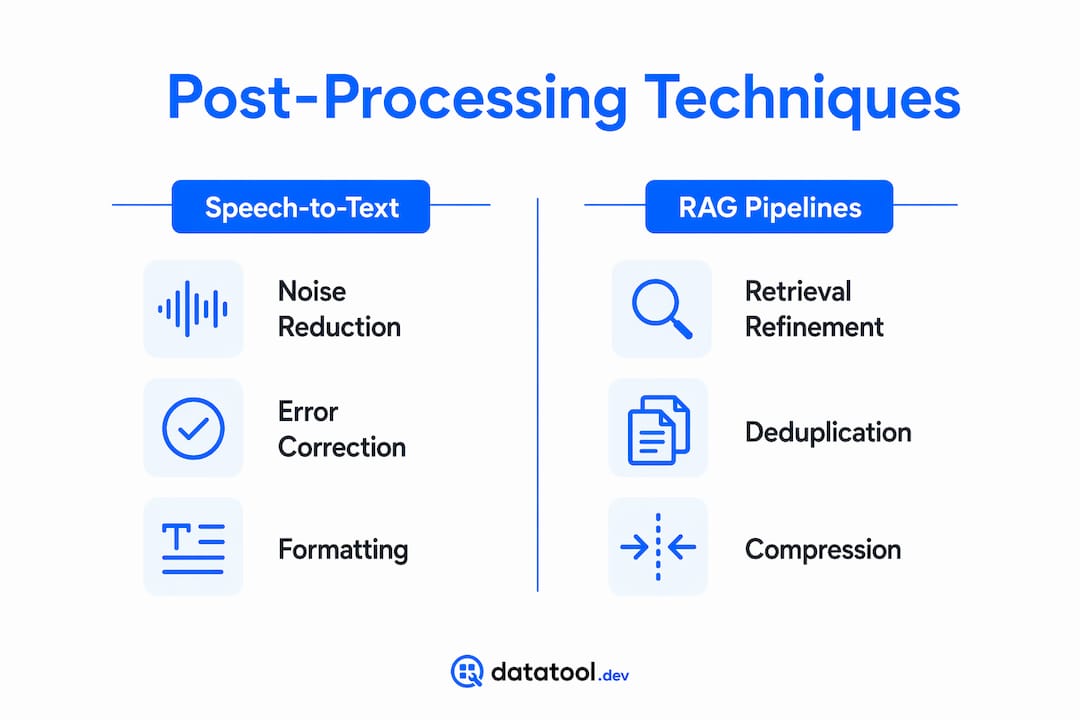
| Speech-to-text (Azure Speech / Whisper) | TrueText formatting, punctuation injection | Raw transcripts with no punctuation or casing |
| RAG pipelines | Reranking, deduplication, chunk compression | Noisy or redundant context passed to the LLM |
| LLM text generation | Guardrails, PII redaction, hallucination detection | Fabricated claims and sensitive data leaks |
| AI-generated video | Trimming, audio normalization, captioning | Unusable raw media not fit for platform delivery |
RAG pipelines show how aggressive this refinement gets. Retrieval refinement reranks 20 to 50 chunks down to 3 to 5 and compresses chunk tokens from 500 to roughly 80 before passing context to the LLM. That is a 90% reduction in noise. The model receives a tighter, more relevant context window, and output quality improves as a direct result.
AI-generated media follows the same logic. AI-generated videos still require post-production steps including trimming, audio normalization, and captioning before they are usable on any platform. The model output is a draft. Post-processing is what turns it into a deliverable.
Speech post-processing is the most tightly coupled example. Speech post-processing is product-specific and must be enabled through the SDK, not the REST API. Treating it as a generic text filter will produce incorrect results. The lesson applies broadly: post-processing is not a universal layer you bolt on. It must be designed for the specific model and output type.
How to implement effective post-processing pipelines
Treat raw AI outputs as intermediate artifacts, not final results. This single principle changes how you design every layer that follows.
Here is a practical implementation sequence:
- Define the output contract first. Specify the exact schema, types, and constraints your downstream system requires before writing any post-processing logic.
- Add a schema validation gate. Parse and validate the raw output against your contract. Log every failure with the raw input attached.
- Add a safety gate. Scan for PII, policy violations, and hallucinated claims. Use a dedicated verifier, not a regex string.
- Add business rule filters. Enforce domain constraints the model cannot know: price floors, valid status codes, required field combinations.
- Measure each gate independently. Track pass rate, failure rate, and latency per gate. A gate that catches nothing is either redundant or misconfigured.
Here is a concrete example from Datatool testing. An LLM returns this malformed JSON:
{"status": "approved", "amount": 142.5, "user_id": 9021
The closing brace is missing. The field amount should be an integer per the schema. A downstream service parsing this will throw an exception. Post-processing catches both issues:
import json
from datatool import repair_json, validate_schema

raw = '{"status": "approved", "amount": 142.5, "user_id": 9021'
repaired = repair_json(raw)
# Result: {"status": "approved", "amount": 142, "user_id": 9021}

validated = validate_schema(repaired, schema=ORDER_SCHEMA)
# Passes: amount coerced to int, structure complete
The repair step closes the broken structure. The schema gate coerces the type. The downstream service receives a valid, contract-compliant object. For AI output testing practices that cover business logic enforcement at scale, the pattern extends to unit tests that run against a fixture library of known-bad outputs.
Pro Tip: Build a fixture library of real malformed outputs from your production logs. Run your post-processing pipeline against it on every deploy. This catches regressions before they reach users.
Key takeaways
AI output post-processing is the required layer between model inference and production delivery, using schema validation, guardrails, and format transformation to convert raw outputs into reliable, application-ready results.
| Point | Details |
|---|---|
| Raw outputs are intermediate artifacts | Never pass model output directly to downstream systems without validation and transformation. |
| Guardrails catch what prompts cannot | Post-LLM verifiers detect hallucinations and PII leaks that prompt design alone will miss. |
| RAG pipelines need aggressive refinement | Reranking and compression reduce context noise by up to 90%, directly improving output quality. |
| Gates must be independently measurable | Track pass rate and latency per gate to identify redundant or misconfigured layers. |
| Post-processing is modality-specific | Speech, text, and media each require different techniques tied to their specific output format. |
Why post-processing is the part most teams get wrong
I have reviewed a lot of production AI integrations. The most common failure pattern is not a bad model. It is a missing post-processing layer. The team ships inference, the output looks reasonable in testing, and then production surfaces edge cases the model handles badly: truncated JSON, a hallucinated field value, a PII string in a response that should never contain one.
The second failure pattern is treating post-processing as an afterthought. Teams add it reactively, after an incident, rather than designing it into the pipeline from the start. The result is a patchwork of filters with no clear ownership and no test coverage. When something breaks, nobody knows which layer failed.
My recommendation: design your output validation setup before you write inference code. Define the output contract, build the schema gate, and add guardrails in order of risk. A pipeline with three well-tested gates is more reliable than one with eight untested ones. Complexity is not quality. Measured, incremental gates are.
The teams that get this right treat AI output reliability as a first-class engineering concern, not a cleanup task. That shift in framing changes everything about how the pipeline gets built and maintained.
— Gregory
Fix malformed AI outputs with Datatool

Datatool is built for the exact failures that post-processing is designed to catch: broken JSON from LLMs, truncated objects, invalid escaping, schema drift, and wrapped responses that downstream parsers reject. If your pipeline is receiving malformed AI output, Datatool repairs and validates it before it reaches your application. Paste broken output, get a valid, schema-compliant result back. No configuration required for basic repair. For teams running structured data pipelines at scale, Datatool provides validation, testing, and repair in one place. Fix broken AI JSON and stop debugging malformed output by hand.
FAQ
What is AI output post-processing?
AI output post-processing is the transformation and validation step applied to raw model outputs after inference, converting probabilities, tokens, and unstructured data into application-ready results using decoding, filtering, and schema validation.
Why do AI outputs need post-processing?
Raw model outputs contain formatting errors, hallucinated claims, PII, and schema mismatches that downstream systems cannot safely consume. Post-processing catches and corrects these issues before delivery.
What is the difference between pre-LLM and post-LLM guardrails?
Pre-LLM guardrails filter inputs before the model sees them. Post-LLM guardrails run after generation to catch hallucinations, sensitive data leaks, and policy violations in the output before it reaches users.
How does retrieval refinement work in RAG pipelines?
Retrieval refinement reranks, deduplicates, and compresses retrieved context chunks before passing them to the LLM, reducing noise and fitting token budgets to improve output relevance and accuracy.
How do I test my post-processing pipeline?
Build a fixture library of real malformed outputs from production logs and run your full post-processing pipeline against it on every deploy. Track pass rate and latency per gate to catch regressions early.