

AI output fuzzing is the automated process of injecting semantically valid but adversarial inputs into AI systems to expose vulnerabilities, logic flaws, and silent failure modes in models, middleware, and downstream parsers. Unlike traditional fuzz testing, which floods a system with random bytes, AI output fuzzing uses frameworks like FuzzyAI, NeuroFuzz, and AdvJudge-Zero to generate linguistically plausible payloads that probe the actual decision boundaries of large language models and their surrounding pipelines. The goal is to catch failures that unit tests miss entirely: policy bypasses, malformed structured output, incorrect tool calls, and guardrail evasion.
What is AI output fuzzing and how does it work?
AI output fuzzing applies the core principle of fuzz testing to AI systems: generate a large volume of structured, adversarial inputs, inject them, observe the outputs, and classify failures. The industry term for this practice is adversarial input fuzzing, though "AI output fuzzing" accurately describes the focus on what the model produces rather than just what it receives.
The fuzzing loop has four stages:
- Payload generation. A fuzzer creates inputs using semantic mutation, natural language token manipulation, or stealth attack tokens. FuzzyAI supports multiple attack modes including default jailbreak, ManyShot, taxonomy-based, and art prompt attacks. Each mode targets a different failure surface.
- Injection. Payloads are sent to the full system endpoint, not just the raw model. This means requests pass through system prompts, middleware, guardrails, and output parsers, exactly as they would in production.
- Output classification. An AI classifier acts as the decision oracle. Classifier effectiveness depends on checking for specific failure modes, not just whether a response was returned. A non-empty response is not a pass.
- Feedback and iteration. Results feed back into payload generation. NeuroFuzz uses reinforcement learning and semantic risk quantification to prioritize the next round of inputs, which is why it finds 40% more crashes with 26% less power than traditional fuzzers like AFL++.
Fuzzing AI systems requires semantically valid inputs to bypass initial filters and reach the logic boundaries where real failures live. Random noise gets blocked at the gate. Plausible, well-formed adversarial inputs do not.
Pro Tip: Monitor logit-gap values during fuzzing runs. Logit-gap measurement identifies the minimal input change that causes the largest shift in model decision probability, which lets you tune payloads for maximum bypass efficiency.

What vulnerabilities does AI output fuzzing detect?
The failure categories that AI output fuzzing surfaces are distinct from what static analysis or standard unit testing catches. Here are the most common:
- Policy bypass via formatting tokens. Stealth tokens like markdown syntax, newlines, or invisible Unicode characters manipulate AI judges into approving content that violates their own safety rules. AdvJudge-Zero specifically targets this class of logic flaw.
- Silent tool misrouting. AI agents call incorrect tools plausibly and without throwing errors. The model returns a confident, well-formatted response. The wrong function ran. Only structured test cases that assert the specific tool called will catch this.
- Malformed output and parser crashes. Partial JSON, truncated objects, and invalid escape sequences crash downstream parsers silently. Testing the full pipeline, including parsers and middleware, reveals failure modes that testing the model endpoint alone misses entirely.
- State-dependent API bugs. SGAFuzzer discovered 227 new GraphQL bugs by using schema-aware dependency mapping and state caching. These bugs only appear when requests arrive in a specific sequence, which random testing never reaches.
- Hallucination and gating failures. Models hallucinate tool parameters, misclassify inputs at routing gates, or return structurally valid but factually wrong data that passes schema validation.
"Testing full pipelines including parsers and middleware reveals hidden failure modes missed by testing model endpoints alone." — Pipeline-level AI testing research
The practical implication: if your fuzzing setup only sends prompts to a model and checks the text response, you are testing a fraction of your actual attack surface.
How do leading AI fuzzing frameworks compare?
| Framework | Primary target | Key technique | Notable result |
|---|---|---|---|
| FuzzyAI | LLM endpoints and guardrails | Multi-mode jailbreak automation | Systematic jailbreak discovery at scale |
| NeuroFuzz | Binary and AI model pipelines | Reinforcement learning + semantic risk | 40% more crashes, 26% less power vs. AFL++ |
| AdvJudge-Zero | AI judges and safety classifiers | Logit-gap stealth token fuzzing | Exposes formatting-based policy bypass |
| SGAFuzzer | GraphQL APIs | Schema-aware state dependency mapping | 227 new state-dependent bugs found |
| MHFuzzer | Web application firewalls | Adaptive optimization framework | 67% more effective payloads vs. RL baselines |
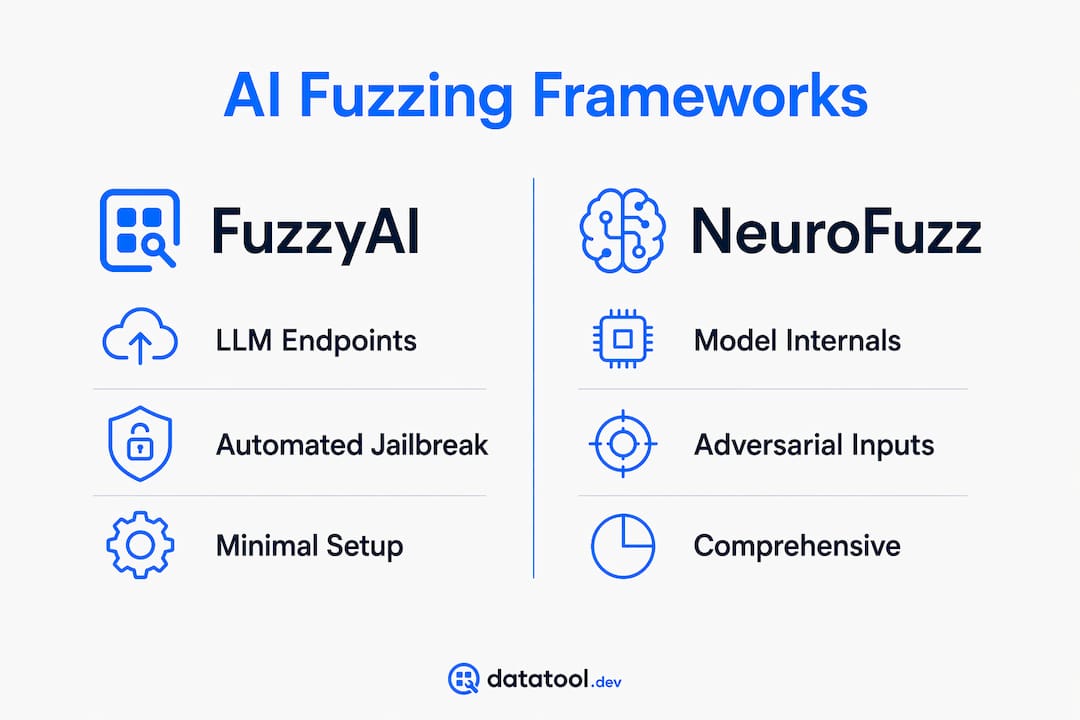
FuzzyAI fits teams that need automated jailbreak testing across LLM API endpoints with minimal configuration. NeuroFuzz is the right choice when you need maximum crash coverage with constrained compute. AdvJudge-Zero is purpose-built for security teams auditing AI judges and content moderation systems. SGAFuzzer and MHFuzzer address stateful API and WAF scenarios respectively. None of these tools are interchangeable. Pick based on your target surface, not general reputation.
How to implement AI output fuzzing in your pipeline
Embedding AI output fuzzing into a real development workflow requires more than running a tool against a staging endpoint. Follow these steps to build a repeatable process:
- Define test inputs and expected behaviors. Write explicit pass/fail criteria before you fuzz. Specify which tools an agent should call, what schema the output must conform to, and which content categories are prohibited. Vague success criteria produce unactionable results.
- Target the full API endpoint. Send fuzzing payloads through the complete request path: system prompt, middleware, guardrails, and output parser. This is where AI output testing best practices diverge from simple prompt testing.
- Configure your classifier oracle precisely. The classifier must check for specific harmful behaviors and structural failures, not just response presence. An empty response and a policy-violating response are both failures, but they require different remediation.
- Add human review to the triage workflow. Automated testing combined with human curation removes duplicates, reduces false positives, and surfaces the bugs worth fixing. Teams that skip this step drown in noise.
- Integrate into CI/CD for regression testing. Run a baseline fuzzing suite on every model update or prompt change. AI models degrade silently when prompts shift. Continuous fuzzing catches regressions before they reach production.
Pro Tip: When validating structured output from LLMs, use unit testing methods that assert schema correctness, field presence, and tool call identity separately. A single assertion on the full response object misses partial failures.
Key takeaways
AI output fuzzing tests the full pipeline, not just the model, and the difference determines whether you catch real production failures or miss them entirely.
| Point | Details |
|---|---|
| Fuzz the full pipeline | Test parsers, middleware, and guardrails, not just the raw model endpoint. |
| Use semantic payloads | Random inputs get filtered; linguistically plausible adversarial inputs reach logic boundaries. |
| Configure classifiers precisely | Oracles must check for specific failure modes, not just response presence. |
| Add human triage | Automated fuzzing generates noise; human review separates real bugs from false positives. |
| Integrate into CI/CD | Run fuzzing on every model or prompt change to catch silent regressions early. |
Why fuzzing the output layer changed how I think about AI safety
I spent years treating AI model testing as a prompt-in, text-out problem. The assumption was that if the response looked right, the system worked. That assumption is wrong, and fuzzing is what proved it to me.
The failures that matter most are not the ones that throw exceptions. They are the ones that return a confident, well-formatted response while the wrong tool ran, the JSON truncated at byte 4,096, or a stealth newline character flipped a safety gate. None of those show up in logs. None of them trigger alerts. They just silently corrupt downstream data or expose a policy bypass that no one notices until it matters.
What I tell teams now: fuzz the parser before you fuzz the model. The parser is where malformed AI output actually kills your pipeline. A broken JSON object from a truncated LLM response will crash your data layer faster than any jailbreak attempt. Tools like AI output observability give you the metrics to see this in production, but fuzzing is what surfaces it in testing before it costs you.
The future of AI fuzzing is adaptive. As models become better at detecting adversarial inputs, fuzzers will use logit-gap monitoring and reinforcement learning to stay ahead. The teams that build fuzzing into their development workflow now will have the regression baselines to detect model drift when it happens. The teams that wait will be debugging production incidents instead.
— Gregory
Fix malformed AI output before it breaks your pipeline
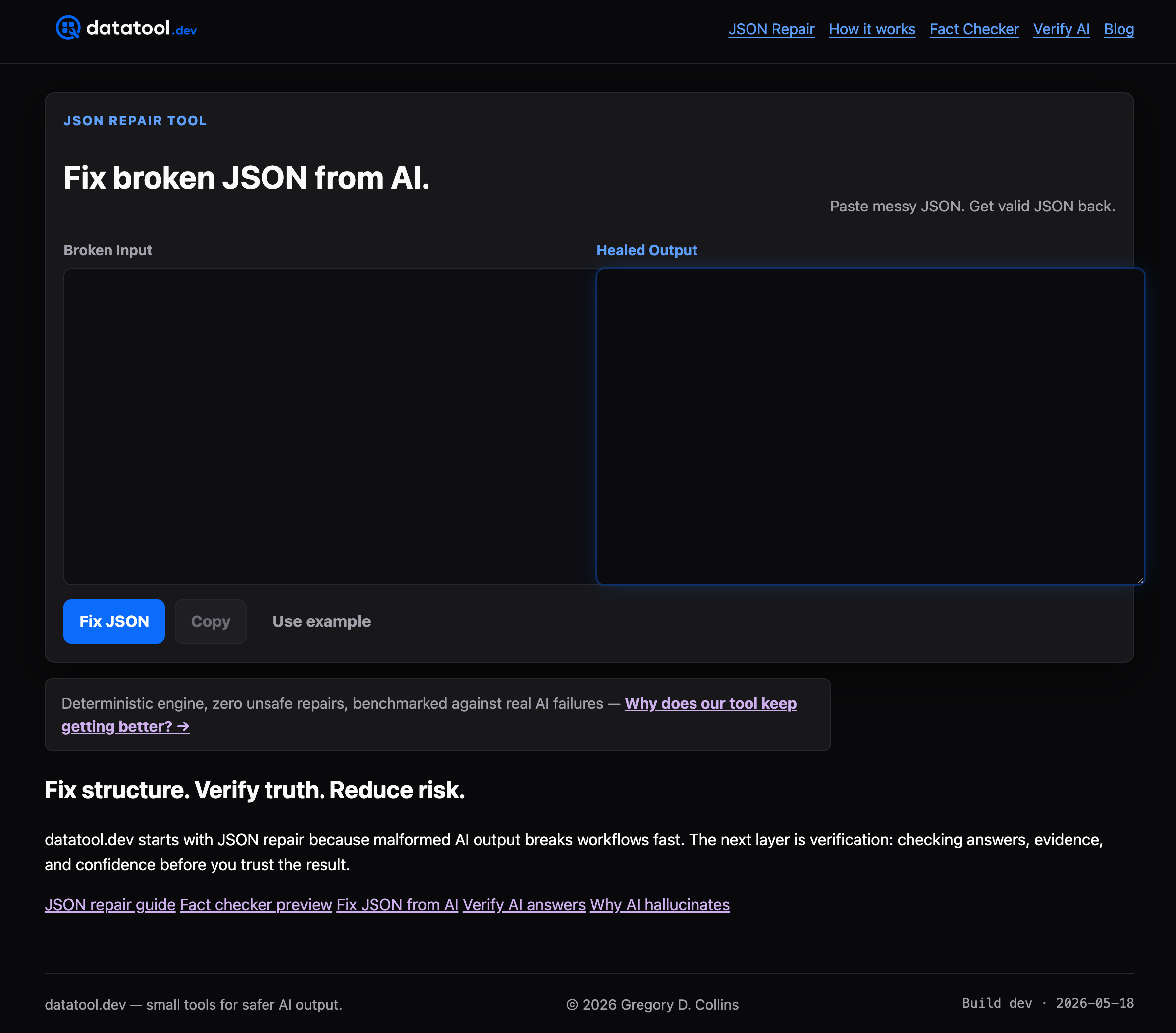
Fuzzing reveals where your AI pipeline breaks. Datatool fixes what it finds. When your LLM returns broken JSON, truncated objects, partial arrays, or invalid escape sequences, Datatool repairs the output and validates it against your schema before it reaches your data layer. Paste malformed AI output. Get valid, schema-conformant JSON back. Datatool integrates directly into CI/CD workflows, so every fuzzing run that surfaces a structural failure has an automated repair path. No manual patching. No silent data corruption. Fix broken JSON from AI at datatool.dev.
FAQ
What is AI output fuzzing in simple terms?
AI output fuzzing is the automated process of sending adversarial inputs to an AI system to find vulnerabilities, logic flaws, and failure modes in the model and its surrounding pipeline.
How is AI fuzzing different from traditional fuzz testing?
Traditional fuzz testing sends random or malformed data to find crashes. AI fuzzing uses semantically valid, linguistically plausible payloads to probe logic boundaries and safety controls that random noise never reaches.
What tools are used for AI output fuzzing?
FuzzyAI, NeuroFuzz, AdvJudge-Zero, SGAFuzzer, and MHFuzzer are the leading frameworks, each targeting different surfaces from LLM endpoints to GraphQL APIs and web application firewalls.
Can AI output fuzzing detect broken JSON from LLMs?
Yes. Fuzzing the full pipeline, including output parsers, surfaces truncated objects, invalid escaping, and schema drift that crash downstream systems without throwing visible errors.
How do I start AI output fuzzing in my CI/CD pipeline?
Define explicit pass/fail criteria, target the full API endpoint including middleware and guardrails, configure a classifier oracle for specific failure modes, and run a baseline fuzzing suite on every model or prompt change.