

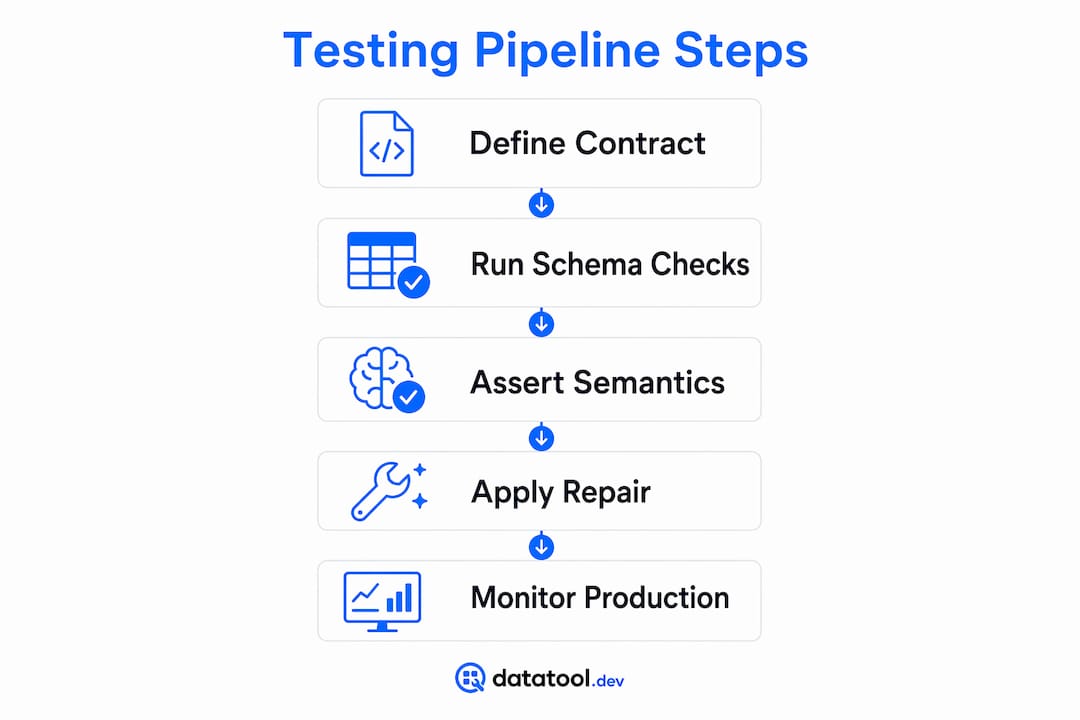
Run schema validation, probabilistic assertion checks, deterministic repair hooks, CI gating, and production monitoring on every LLM-driven pipeline. That five-layer workflow is the minimum to stop malformed AI output from corrupting downstream systems. The artifacts you need before your first test run: a JSON Schema contract, an assertion set, a repair function, an offline evaluation dataset, and a CI job. Three anchors back this approach: the SPaDE framework (ArXiv 2024), TestGrid's guidance on statistical validation, and Datatool as the recommended tool for deterministic repair and schema validation.
Table of Contents
- What silent failure modes do you need to test for first?
- What are the core principles for testing AI data pipelines?
- How do you detect, validate, and repair broken JSON in practice?
- Which repair techniques actually work for malformed AI output?
- What should you measure in production, and how do you set alert thresholds?
- When should a human gate an AI pipeline decision?
- How do you wire these tests into a CI/CD pipeline?
- Actionable checklist you can run this afternoon
- Key Takeaways
- Why the standard advice on AI testing still misses the real problem
- Datatool handles the repair and validation layer for you
- Useful sources and further reading
What silent failure modes do you need to test for first?
Standard unit tests pass. The pipeline still ships garbage. That gap is where LLM pipelines fail teams most often.
The SilentFail auditor documents four common failure classes: schema drift, confident wrong answers, silent truncation, and hallucinated structure. Add to those: wrong data types, wrapped or double-encoded responses, and missing or empty fields. None of these necessarily raise a parse error.
Here is why happy-path tests miss them. LLM outputs are probabilistic. The same prompt returns different shapes across runs. A unit test that asserts response["status"] == "ok" tells you nothing about whether response["items"] is a truncated list or a hallucinated one.
Two examples that show the problem:
# Looks valid. Parses fine. But "items" was cut off at 95% context fill.
raw = '{"status": "ok", "items": "a", "b"'  # truncated — no closing bracket

# Parses after repair, but "price" is a string, not a float.
raw = '{"product": "Widget", "price": "free"}'
The first causes a json.JSONDecodeError downstream. The second silently passes validation and corrupts your database. [SilentFail's context-padding tests show that truncation becomes frequent at 95%+ context fill, producing short or missing fields compared to outputs at lower fill ratios. Always include high-context adversarial inputs in your test suite.
What are the core principles for testing AI data pipelines?
Use three validation layers in sequence: contract checks, assertion-based checks, and statistical thresholds. Each layer catches a different class of failure.
- Contract/schema layer: JSON Schema validation catches structural violations. Run this first. It is fast and deterministic.
- Assertion layer: Boolean assertions check semantic correctness — field presence, value ranges, type coercion, and cross-field consistency. SPaDE reduced assertions by 14% and cut false failures by 21% across nine real-world LLM pipelines by synthesizing a minimal, effective assertion set from prompt-version deltas.
- Statistical threshold layer: Track distributions and acceptable ranges across many outputs, not just one. TestGrid recommends moving away from binary pass/fail and instead monitoring confidence scores and performance metrics over time.
Start with offline evaluation against a static baseline dataset. It is reproducible, fast to iterate, and catches regressions before deployment. Structured offline evaluation pipelines let you run repeatable experiments and compare model versions without touching production traffic. Once offline baselines are stable, add production monitoring for real-time drift detection.
Contract testing scales this further. Define the expected output shape as a versioned contract. Any output that violates the contract fails immediately, before assertions even run.
How do you detect, validate, and repair broken JSON in practice?
Test code should fail fast on contract violations and attempt deterministic repair only when the fix is safe to apply without human review.

Here is a realistic broken LLM response — wrapped in prose, trailing comma, truncated:
raw_llm_output = """
Sure! Here is the JSON you requested:
```json
{"name": "Acme", "score": 0.91, "tags": ["ai", "data",],
"""
A deterministic repair function handles this:
import json, re

SENTINEL = "__MISSING__"

def repair_llm_json(raw: str) -> dict:
    # 1. Strip code fences and surrounding prose
    match = re.search(r"```(?:json)?\s*([\s\S]*?)```", raw)
    text = match.group(1) if match else raw

    # 2. Remove trailing commas before ] or }
    text = re.sub(r",\s*([}\]])", r"\1", text)

    # 3. Attempt to close truncated objects
    open_b = text.count("{") - text.count("}")
    open_sq = text.count("[") - text.count("]")
    text = text.rstrip() + ("]" * open_sq) + ("}" * open_b)

    try:
        return json.loads(text)
    except json.JSONDecodeError:
        return {SENTINEL: raw}  # signal for re-request
Wire this into pytest to assert each failure mode is caught:
import pytest

def test_detects_truncation():
    result = repair_llm_json('{"name": "Acme", "tags": ["ai"')
    assert "name" in result

def test_strips_code_fence():
    result = repair_llm_json("```json
{\"x\": 1}
```")
    assert result["x"] == 1

def test_schema_contract(repaired_output, json_schema):
    from jsonschema import validate
    validate(instance=repaired_output, schema=json_schema)
When repair produces a sentinel value, trigger a re-request with a tighter prompt and exponential backoff:
if SENTINEL in repaired:
    time.sleep(2 ** attempt)
    repaired = call_llm(prompt + "
Respond with valid JSON only.")
Statistic: SPaDE's assertion synthesis approach reduced the number of data-quality assertions required by about 14% and cut false failures by about 21% across nine pipelines — a strong case for structured assertions over one-off conditionals.
Datatool's repair API fits as a drop-in at the repair_llm_json call site, handling escaping, type normalization, and partial-object completion deterministically. See AI output preprocessing techniques for preprocessing patterns that pair with repair hooks.
Pro Tip: Use unit testing patterns for AI-generated data to build a small adversarial fixture set — five to ten broken inputs covering each failure class — before writing any assertion logic.
Which repair techniques actually work for malformed AI output?
Prefer deterministic repair for syntactic problems, guarded completion for partial objects, and re-requests or human review for semantic ambiguity.
Deterministic tactics, in order of application:
- Unwrap: strip code fences, markdown formatting, and explanatory prose before parsing.
- Fix syntax: remove trailing commas, normalize smart quotes to straight quotes, fix unescaped backslashes.
- Type coercion: cast
"true"toTrue, numeric strings tofloatorintwhere the schema specifies. - Partial-object completion: close unclosed brackets and fill missing required fields with sentinel values.
- Re-request: when the repaired object still fails schema validation, re-prompt with explicit format constraints.
A Datatool repair hook call looks like this in CI:
import requests

def datatool_repair(raw: str, schema: dict) -> dict:
    resp = requests.post(
        "https://datatool.dev/api/repair",
        json={"input": raw, "schema": schema}
    )
    return resp.json()  # {"repaired": {...}, "valid": true, "actions": [...]}
Pro Tip: Use confidence score plus schema field coverage as the decision gate. If coverage is below 80% of required fields after repair, reject and re-request rather than auto-accepting a partial object.
What should you measure in production, and how do you set alert thresholds?
Track these five metrics. Each catches a different failure class.
| Metric | Why it matters | Example alert rule |
|---|---|---|
| Assertion failure rate | Detects semantic drift before schema breaks | Alert if >5% of outputs fail any assertion in a 1-hour window |
| False-failure rate | Catches over-aggressive assertions | Alert if FFR rises above your calibrated baseline |
| Defect escape rate | Measures what AI tests miss vs. human tests | Review monthly; recalibrate if gap does not narrow in 3–6 months |
| Context-fill ratio | Predicts truncation risk | Alert if average fill exceeds 90% |
| Schema validation pass rate | Structural health signal | Alert if pass rate drops below baseline in any monitoring window |
Log raw LLM responses, the schema-validated payload, assertion results, and repair actions together. That bundle makes debugging reproducible. Production monitoring patterns for AI pipelines recommend daily and weekly aggregates for trend detection, with monthly calibration reviews of assertion thresholds.
Real-time alerting workflows pair well with this metric model. Route threshold breaches to your incident channel immediately, not in a batch report.
TestGrid's guidance reinforces this: track performance metrics and acceptable ranges continuously, not just at release time.
When should a human gate an AI pipeline decision?
Gate three specific decisions. Not every output. Katalon's guidance is explicit: human review should cover decisions that materially change product or release outcomes, not routine AI actions.
The three mandatory gates:
- Publishing a new schema version to production.
- Approving a release based on AI-only test coverage.
- Closing a high-severity defect flagged by an AI assertion.
For confidence-threshold routing: outputs that fall below your calibrated confidence threshold go to a review queue automatically. Repair attempts that produce sentinel values require human sign-off before auto-accept.
Triage rules for reviewer batches: sort by assertion failure count first, then confidence score, then production impact. Keep batches small — ten to twenty samples per reviewer session keeps accuracy high. If the defect escape rate gap between AI and human tests does not narrow over three to six months, recalibrate your assertion thresholds or retrain the model.
How do you wire these tests into a CI/CD pipeline?
Run offline evaluation and schema checks on every pull request. Reserve larger assertion suites and longer experiments for nightly or merge-to-main jobs.
# .github/workflows/llm-pipeline-tests.yml
jobs:
  pr-checks:
    steps:
      - name: Schema validation
        run: pytest tests/test_schema.py -x

      - name: Unit tests (repair + detection)
        run: pytest tests/test_repair.py tests/test_assertions.py

  nightly:
    steps:
      - name: Full assertion suite
        run: pytest tests/test_assertions_full.py --tb=short

      - name: Repair simulation
        run: python scripts/repair_simulation.py --dataset data/adversarial_fixtures.jsonl
Failure handling:
- PRs fail on any contract violation.
- PRs warn on borderline statistical regressions (log, do not block).
- Merges to main are blocked on high-severity assertion failures.
Retain raw outputs and assertion reports as build artifacts. You need them for triage when a nightly run regresses. See the pre-production validation setup guide for offline baseline configuration and regression testing patterns for version comparison across model updates.
Actionable checklist you can run this afternoon
- Write a JSON Schema contract for your LLM output shape.
- Create five to ten adversarial fixture inputs covering: truncation, wrapped response, trailing comma, wrong type, and missing required field.
- Write pytest unit tests asserting detection and repair for each fixture.
- Add a repair hook (deterministic function or Datatool API call) that runs before schema validation.
- Add a CI step that runs schema checks and unit tests on every PR.
- Run offline evaluation against your fixture set. Inspect assertion failures and repair logs.
- Set a weekly calendar reminder to review assertion failure rate and context-fill ratio.
- Schedule a monthly calibration session to adjust assertion thresholds based on defect escape rate trends.
Key Takeaways
Reliable LLM pipelines require contract validation, probabilistic assertions, deterministic repair hooks, CI gating, and production monitoring working together — no single layer is sufficient alone.
| Point | Details |
|---|---|
| Layer your validation | Run schema checks first, then assertions, then statistical thresholds — each layer catches what the previous misses. |
| Use assertion synthesis | SPaDE reduced the number of data-quality assertions required by about 14% and cut false failures by about 21% across nine pipelines; structured assertions outperform ad-hoc conditionals. |
| Repair deterministically | Strip wrappers, fix syntax, coerce types, and complete partial objects before falling back to re-requests. |
| Gate high-risk decisions | Block schema publishing, release approvals, and high-severity defect closures behind human review. |
| Datatool fits as a repair hook | Datatool's deterministic JSON repair and schema validation drop into CI and production monitoring as a single API call. |
Why the standard advice on AI testing still misses the real problem
Most AI testing guides focus on model accuracy. That is the wrong layer for pipeline engineers. By the time a bad output reaches your accuracy metric, it has already broken your schema, corrupted a downstream record, or silently filled a required field with a hallucinated value.
The pattern that actually holds up in production is: validate the contract first, assert the semantics second, repair what is safe to repair, and block everything else for human review. That order matters. Teams that skip straight to statistical monitoring without a contract layer spend weeks debugging failures that a two-line JSON Schema would have caught in milliseconds.
Developers should own the contract definition, the assertion set, and the repair logic. The platform should automate execution, logging, and threshold alerting. That division keeps the team in control of what "correct" means while removing the operational burden of running checks at scale. Datatool's AI output testing best practices guide covers this division in more detail.
Datatool handles the repair and validation layer for you
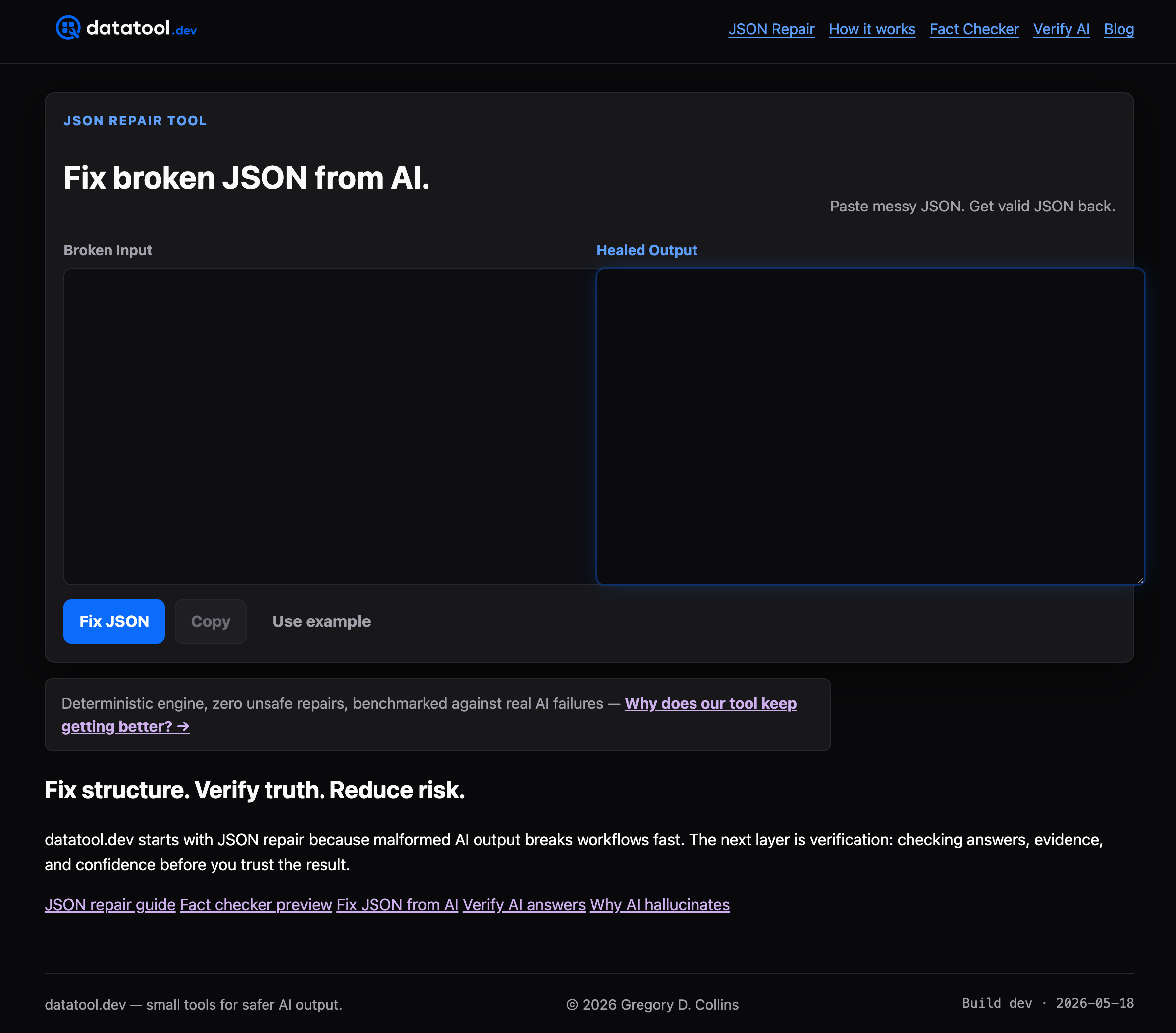
Broken JSON from LLMs is not an edge case. It is the default. Datatool provides deterministic JSON repair, schema validation, and assertion orchestration as a single integrated hook for CI and production monitoring.
# Drop this into your test suite or CI job
resp = requests.post("https://datatool.dev/api/repair", json={
    "input": raw_llm_output,
    "schema": your_json_schema
})
# Returns: {"repaired": {...}, "valid": true, "actions": ["stripped_fence", "closed_bracket"]}
No custom repair logic to maintain. No false failures from over-aggressive assertions. Paste broken JSON, get a valid, schema-checked object back. Start your free trial at datatool.dev and wire the repair hook into your pipeline today.
Useful sources and further reading
- SPaDE: Synthesizing Data Quality Assertions for LLM Pipelines — The core paper behind assertion synthesis; shows about 14% fewer data-quality assertions required and about 21% fewer false failures across nine pipelines.
- SilentFail v0.1.0 — Documents four silent failure classes and provides an auditor for adversarial context-padding tests.
- Structured evaluation pipelines (Heltweg) — Practical guide to offline evaluation pipeline design and reproducible experiments.
- Testing AI Applications: Strategy, Tools & Best Practices (TestGrid) — Covers statistical validation, confidence scoring, and moving beyond binary pass/fail.
- AI Testing Best Practices (Katalon) — Defines human-in-the-loop gating rules for high-risk decisions.
- Datatool.dev — Fix Broken JSON From AI — Deterministic repair, schema validation, and assertion orchestration for LLM pipelines.
- AI Output Observability Explained (Datatool blog) — Trace retention, log formats, and observability patterns for production AI pipelines.