

AI output regression testing is defined as the practice of verifying that changes to prompts, models, or agent logic do not degrade previously validated output behaviors. Unlike traditional software regression testing, which checks exact input-to-output equality, AI regression testing uses probabilistic rubrics and behavioral gates to handle the non-deterministic nature of large language models. This distinction matters because LLMs produce different outputs on every call, even with identical inputs. Treating AI outputs like deterministic function returns causes flaky tests, false failures, and missed regressions. This guide covers what AI output regression testing is, how to build a working pipeline, and how to write assertions that actually catch real problems.
What is AI output regression testing and why does it differ from traditional testing?
Traditional regression testing works on a simple premise: same input, same output. That assumption breaks completely with LLMs. A model can return a valid, well-formed response on one call and a subtly wrong one on the next, with no error thrown and no stack trace to follow.
The core failure mode is the silent regression. Your CI pipeline goes green. Your JSON parses. Your downstream application receives data. But the model started selecting the wrong function, omitting a required field, or drifting toward a policy violation. Silent downstream failures like these are the primary reason exact-match snapshot tests fail AI systems.
AI output regression testing replaces boolean assertions with behavioral gates. Instead of asserting output == "expected string", you assert that the output contains required keys, passes a format check, satisfies a content constraint, and clears a safety filter. These checks accommodate variability while still catching meaningful regressions.

The other critical difference is scope. Traditional regression tests cover code paths. AI regression tests must cover prompt versions, model versions, and agent logic versions as distinct artifacts. Each of those is a change vector that can break behavior without touching a single line of application code.
What challenges does AI output regression testing address?
The challenges fall into two categories: test fragility and coverage gaps.
Test fragility comes from exact-match assertions. Exact string snapshots cause frequent false failures because LLMs rephrase outputs across calls. A test that fails every third run trains engineers to ignore failures. That is the worst possible outcome for a quality gate.
Coverage gaps come from relying on UI or system tests to catch semantic changes. A UI test confirms a page renders. It does not confirm the model stopped hallucinating a price, dropped a required disclaimer, or started returning malformed JSON. Those regressions live below the surface of any end-to-end test.
The specific problems AI output regression testing addresses include:
- Non-deterministic output drift: The model returns correct outputs in testing but drifts in production as traffic patterns shift.
- Prompt sensitivity: A one-word change in a system prompt can alter output structure, tone, or completeness across thousands of calls.
- Model swap regressions: Upgrading a base model version changes behavior even when prompts stay identical.
- Agent logic failures: Multi-step agents can pass individual step checks but fail on composed behavior.
- Integration breaks: Valid JSON output does not guarantee the downstream parser receives the right fields with the right values.
Probabilistic behavioral gates solve these problems by checking intent rather than literal content. The test asks "does this output satisfy the behavioral contract?" not "does this output match a stored string?"
What are the essential components of an effective AI output regression pipeline?
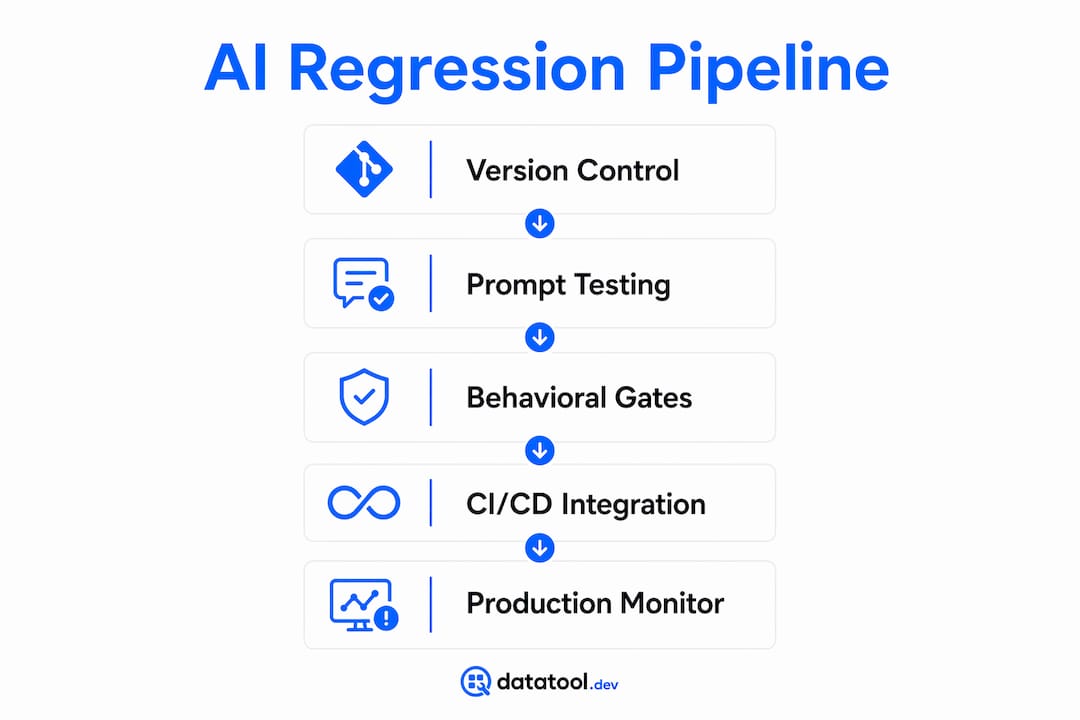
A working pipeline has three layers. Each layer catches a different class of regression.
-
Offline evaluation on fixed test sets. Run a curated set of high-risk prompts against the model before any merge. This is your CI gate. The test set uses fixed inputs and behavioral assertions, not golden output strings. Failures block the merge. This layer catches prompt and model regressions before they reach production.
-
Reference-free checks on live traffic. Once deployed, sample production requests and run format, schema, and policy checks against real outputs. These checks require no ground truth. They catch regressions that only appear under real user inputs, which hand-written test cases rarely cover. Building test datasets from real traffic traces rather than synthetic examples alone is the most reliable way to catch production-specific failures.
-
LLM-as-a-judge sampled scoring. Use a separate model to score output quality on a calibrated rubric. GPT-4 as a judge achieves over 80% agreement with human raters, making this approach viable for production monitoring at scale. Keep rubrics narrow: test one or two quality dimensions per call. Use zero temperature for the judge model to get reproducible scores.
Prompt version control sits underneath all three layers. Every prompt is a versioned artifact. Every change goes through peer review. Every merge requires the regression suite to pass. Microsoft and SDET practitioners treat this as standard practice in 2026. If your team does not version prompts as code, you cannot reliably reproduce a regression or roll back a bad change.
Pro Tip: Use LLM-as-a-judge rubrics with narrow scopes and zero temperature sampling. Broad rubrics produce inconsistent scores. Narrow rubrics produce consistent, actionable signals.
How do you design test cases and assertions for AI output regression?
Start with risk. The prompts that touch security, money, or user-facing features give you the highest return on test investment. High-risk prompts related to finance, safety, or customer reliability should be the first cases in any regression suite.
Here is a concrete example of what breaks and what fixes it.
Broken assertion (exact match):
assert response["summary"] == "The account balance is $1,200."
This fails on every paraphrase. The model returns "Your balance is $1,200" and the test fails, even though the output is correct.
Fixed assertion (behavioral):
import re

assert "balance" in response["summary"].lower()
assert re.search(r"\$1[,.]?200", response["summary"])
assert len(response["summary"]) < 300
assert response.get("account_id") is not None
This checks intent. The test passes on any correct paraphrase and fails on genuine regressions like a missing account ID or a wrong dollar amount.
Effective assertions cover multiple dimensions per test case:
- Format compliance: Is the output valid JSON? Does it match the expected schema?
- Required field presence: Are all mandatory keys present with non-null values?
- Content constraints: Does the output contain required phrases or avoid prohibited ones?
- Safety checks: Does the output clear content policy filters?
- Completeness: Is the response truncated or fully formed?
Avoid brittle string snapshots. Semantic assertions that check logical output properties are the industry standard because they survive model updates and prompt rewrites without constant maintenance.
How to integrate AI output regression testing into CI/CD workflows
Every pull request that touches a prompt file, model config, or agent logic file should trigger the regression suite automatically. This is not optional. Prompt edits are code changes. They get the same gating as application code.
The CI pipeline runs offline evaluation first. If assertions fail, the merge is blocked. If assertions pass, the change moves to a staging environment where reference-free checks run against sampled traffic. Production deployment follows only after both layers clear.
Production monitoring runs continuously. Set up AI output observability to track schema compliance rates, judge scores, and anomaly signals over time. When a metric drops, the system alerts before users report problems.
Managing the test data lifecycle is as important as writing the tests. When a production failure occurs, add the triggering input to the regression set immediately. Review and refresh the full test set quarterly to remove cases that no longer reflect real traffic patterns. This keeps the suite lean and high-signal.
Pro Tip: Do not ignore downstream parsers. Verifying full integration including API consumers and parsers catches silent breaks that output-only checks miss entirely.
The pre-production validation setup for AI pipelines follows the same principle as traditional integration testing: verify the full chain, not just the component in isolation.
Key takeaways
AI output regression testing requires behavioral gates, version control, and layered evaluation to reliably catch regressions that exact-match tests miss entirely.
| Point | Details |
|---|---|
| Behavioral gates over exact match | Assert logical properties like field presence and format compliance, not literal string equality. |
| Three-layer pipeline | Combine offline CI evaluation, reference-free live checks, and LLM-as-a-judge scoring for full coverage. |
| Prompts are versioned code | Every prompt change requires peer review and a passing regression suite before merge. |
| Risk-based test selection | Prioritize security, finance, and user-facing prompts first for the highest regression ROI. |
| Full integration testing | Verify downstream parsers and API consumers, not just raw LLM output validity. |
Why I think most teams are testing AI outputs wrong
Most teams I see treat AI output testing as an afterthought. They write a handful of snapshot tests, watch them go flaky within a week, and then quietly disable them. The root cause is always the same: they applied deterministic testing logic to a probabilistic system.
The shift that actually works is treating prompts with the same discipline as application code. That means version control, peer review, and hard CI gates. AI automation practices in 2026 increasingly reflect this standard, but adoption is still uneven. Teams that skip this step ship regressions they cannot reproduce or roll back.
The other mistake I see constantly is ignoring the downstream parser. A team will spend weeks building a judge-based evaluation pipeline and then ship a prompt change that breaks the JSON structure their parser expects. The LLM output looks fine. The integration is broken. Automation reduces manual QA effort only when it covers the full chain.
Start small. Pick five high-risk prompts. Write behavioral assertions for each. Add them to CI. Grow the suite from real production failures, not hypothetical cases. That approach builds a regression suite that actually catches problems instead of one that engineers learn to ignore.
— Gregory
Datatool makes AI output validation practical
Broken JSON from LLMs is one of the most common silent regression failures in production AI pipelines. Datatool is built specifically for this problem.
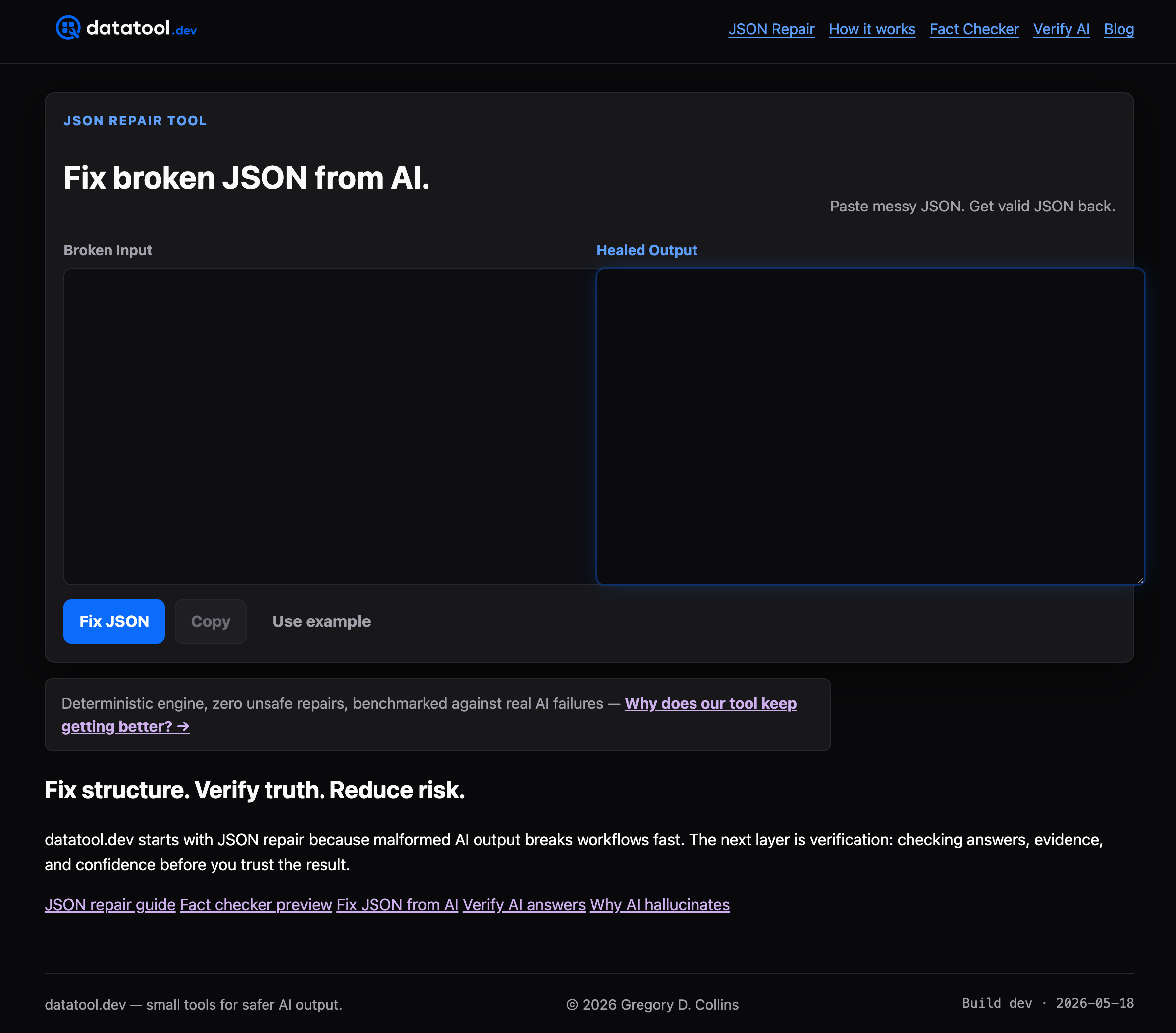
Datatool repairs malformed AI output automatically, handling broken JSON, wrapped responses, partial objects, invalid escaping, truncation, and schema drift. It fits directly into regression testing workflows as a validation and repair layer before your downstream parsers ever see the data. When your LLM returns a truncated object or an improperly escaped string, Datatool fixes it and flags it, so your regression suite catches the pattern before it becomes a production incident. For teams building reliable AI output pipelines, it removes the class of silent failures that behavioral assertions alone cannot prevent.
FAQ
What is AI output regression testing?
AI output regression testing verifies that changes to prompts, models, or agent logic do not break previously validated output behaviors. It uses behavioral assertions and probabilistic rubrics instead of exact string matching to handle LLM non-determinism.
Why do exact-match snapshot tests fail for LLM outputs?
LLMs rephrase outputs across calls, so identical inputs produce different but equally correct responses. Exact string assertions treat these valid variations as failures, producing flaky tests that teams learn to ignore.
How often should AI regression test sets be refreshed?
Test sets should be updated immediately when a production failure occurs and reviewed quarterly to remove cases that no longer reflect real traffic. Building datasets from real traffic traces produces more reliable coverage than synthetic examples alone.
What does LLM-as-a-judge mean in regression testing?
LLM-as-a-judge uses a separate model to score output quality against a calibrated rubric. Using narrow rubrics and zero temperature sampling produces consistent, reproducible scores that scale across production traffic volumes.
What assertions should every AI output regression test include?
Every test should check JSON validity, required field presence, format compliance, content constraints, and safety policy adherence. Covering multiple quality dimensions per test case catches more regression classes than single-dimension checks.