

AI output preprocessing techniques are the verification, normalization, and validation steps applied to LLM-generated data before it reaches any downstream system. Without them, 63 out of every 1,000 completions are syntactically or semantically invalid, which means broken pipelines, corrupted records, and hallucinated facts passing silently into production. The industry term for this discipline is output post-processing, and it covers everything from fixing smart quotes to routing semantically unsupported claims to a retry queue. This article walks through the core techniques in pipeline order, from schema enforcement at inference time through semantic verification at delivery.
1. AI output preprocessing techniques: start with schema-constrained generation
Schema-constrained generation enforces a specific output structure at inference time, before a single token reaches your application. The OpenAI "response_formatparameter with a JSON Schema definition and the Anthropictool_use` API are the two most widely deployed implementations. Both force the model to produce output that conforms to a declared schema during generation, not after.
This is categorically different from JSON mode. JSON mode tells the model to produce valid JSON. Schema-constrained generation tells the model exactly what fields, types, and nesting are allowed. The result is that schema adherence during inference eliminates structural format errors, missing required fields, and type coercion bugs that would otherwise require downstream repair.

The critical limitation: schema enforcement guarantees format validity, not semantic correctness. A field typed as string can still contain a hallucinated value. Layered semantic validation must follow. Schema-constrained generation is the first gate, not the only gate.
Pro Tip: Version your JSON Schemas and store them alongside your prompt templates. When the model family changes or a schema drifts, you need a clear record of what contract was in force at each deployment.
Here is a minimal example of what breaks without schema constraints and what the fix looks like:
# Broken: model returns a wrapped response
{"response": {"name": "Acme Corp", "revenue": "unknown"}}

# Fixed: schema-constrained output enforces flat structure and typed fields
{"name": "Acme Corp", "revenue": null}
The wrapped response breaks any parser expecting a flat object. Schema enforcement prevents the wrapper from appearing at all.
2. Syntactic normalization: cleaning format failures before parsing
Syntactic normalization is the process of repairing typography, whitespace, and markup artifacts in raw LLM output before any structural parsing occurs. LLMs trained on web text reproduce the formatting of that text, including smart quotes (""), Unicode em dashes, non-breaking spaces, and markdown table misalignments. Every one of these breaks a standard JSON or CSV parser.
TextKit's 2026 production workflow identifies the following normalization steps as non-negotiable for production pipelines:
- Strip preamble and postamble text (e.g., "Here is the JSON you requested:")
- Replace smart quotes with straight ASCII quotes
- Convert Unicode dashes to hyphens or remove them from field values
- Remove hidden whitespace characters including zero-width spaces and non-breaking spaces
- Fix misaligned markdown table pipes before converting tables to structured data
- Normalize bullet list syntax before converting lists to arrays
Each step is cheap. Together they prevent the class of parse failures that look random but are entirely predictable. A pipeline that skips normalization will fail intermittently, making the root cause hard to trace.
Pro Tip: Run normalization as a pure string transformation before any JSON.parse or CSV reader call. If you mix normalization with parsing, failures become ambiguous. Keep the stages separate and log the pre-normalized string on any parse error.
For practical examples of what malformed output looks like in the wild, the malformed AI response guide from Datatool covers the most common patterns with fixes.
3. Deterministic regex filtering: the fast first pass
A regex pre-pass is the cheapest filter in any AI output post-processing strategy. It runs in approximately 50 microseconds and catches about 35% of PII leaks before any LLM classifier is invoked. That matters because LLM classifiers cost real money per call. Filtering obvious cases upfront reduces guardrail cost per request significantly.
The pattern is straightforward. Write regex rules for the categories you can define deterministically: email addresses, phone numbers, Social Security Number formats, credit card patterns, and known sensitive field names. Run every output string through this filter before it touches any downstream system. Matches trigger an immediate block or redaction without waiting for a semantic classifier.
CallSphere's 2026 production data shows this two-tier guardrail approach reduced cost per request from $0.0021 to $0.0004 by catching easy positives upfront. That is an 80% cost reduction on the guardrail layer alone.
Regex handles what is structurally definable. Semantics handles what is not. Never use one where the other is required.
The cases regex cannot handle are ambiguous claims, factual errors, and context-dependent PII. Those go to the semantic layer described next.
4. LLM-based semantic verification: catching hallucinations
Semantic verification uses a second LLM call, or a retrieval-augmented verification step, to check whether the content of an output is supported by authoritative evidence. This is the primary defense against hallucinations that pass syntactic and schema checks cleanly.
The AI Signals 2026 implementation uses a three-step pattern:
- Extract specific claims from the output
- Retrieve the top 3 relevant documents from a trusted knowledge base
- Compute semantic similarity between each claim and the retrieved evidence
Outputs with similarity scores below 0.6 are flagged as unsupported. The pipeline then routes them to one of three actions: deliver with a confidence annotation, retry with the retrieved evidence injected into the prompt, or block and escalate to a human reviewer. This routing logic is what separates a production-grade system from a basic filter.
The cost of semantic verification is higher than regex. Run it only on outputs that passed the deterministic pre-pass. That sequencing keeps latency and cost manageable while maintaining coverage on the cases that actually require semantic judgment.
5. What production pipeline architecture looks like
A production AI output preprocessing pipeline has three ordered stages. TextKit's guidance is explicit: semantic checks must operate only on parseable content, so early failures must exit the pipeline before wasting compute on invalid output.
| Stage | Operation | Failure action |
|---|---|---|
| Stage 1: Syntactic normalization | Fix quotes, whitespace, markdown, preamble | Log and retry with cleaner prompt |
| Stage 2: Schema validation | Validate against versioned JSON Schema | Reject and retry up to N times |
| Stage 3: Semantic verification | Claim extraction, retrieval, similarity check | Route to deliver, retry, or escalate |
NVIDIA's TensorRT-LLM documentation recommends placing post-processing handlers close to the model-serving layer. Specialized reasoning parsers and output handlers at the serving layer convert raw generation results into standard API responses before they reach application code. This reduces application complexity and ensures consistency across model families.
Fallback strategies are not optional. Every stage needs a defined behavior for failure: retry with a modified prompt, return a structured error, or escalate. Pipelines without fallbacks fail silently, which is worse than failing loudly. For a detailed setup guide, the pre-production validation setup from Datatool covers stage configuration and retry logic in depth.
Key takeaways
Effective AI output preprocessing requires three ordered stages: syntactic normalization, schema validation, and semantic verification, each with defined failure handling.
| Point | Details |
|---|---|
| Schema constraints are the first gate | Use OpenAI JSON Schema or Anthropic tool_use to enforce format at inference, not after. |
| Normalization prevents silent parse failures | Strip preamble, fix smart quotes, and remove hidden whitespace before any parser call. |
| Regex pre-pass cuts guardrail costs | A deterministic filter catches ~35% of PII leaks at ~50 microseconds per call. |
| Semantic verification needs routing logic | Set similarity thresholds and define deliver, retry, and escalate paths for flagged outputs. |
| Pipeline order is not negotiable | Semantic checks on unparseable content waste compute. Normalize and validate first. |
Why normalization is the most underestimated step
Most teams I have worked with spend weeks tuning semantic verification thresholds and almost no time on normalization. That is the wrong priority order. A hallucination that slips through is a product problem. A smart quote that breaks your JSON parser at 2 a.m. is an incident.
Normalization is unglamorous. It does not show up in model evals or benchmark comparisons. But in my experience, it is the step that separates pipelines that work in demos from pipelines that work in production. The failures it prevents are the ones that are hardest to debug because they look like random noise.
The other thing teams consistently underestimate is schema evolution. You lock in a schema at launch, the model family gets updated three months later, and suddenly a field that was always a string starts returning arrays. Structured output generation solves the initial contract problem, but versioned schemas with explicit migration paths solve the drift problem. Build that infrastructure before you need it.
Semantic validation is genuinely hard to tune. A threshold of 0.6 is a starting point, not a universal answer. The right threshold depends on your domain, your retrieval corpus quality, and your tolerance for false positives versus false negatives. Treat it as a parameter you will adjust over time, not a setting you configure once.
— Gregory
Fix malformed AI output before it reaches your pipeline
If your preprocessing pipeline is catching broken JSON, truncated objects, or schema drift from LLM output, Datatool is built for exactly that problem.
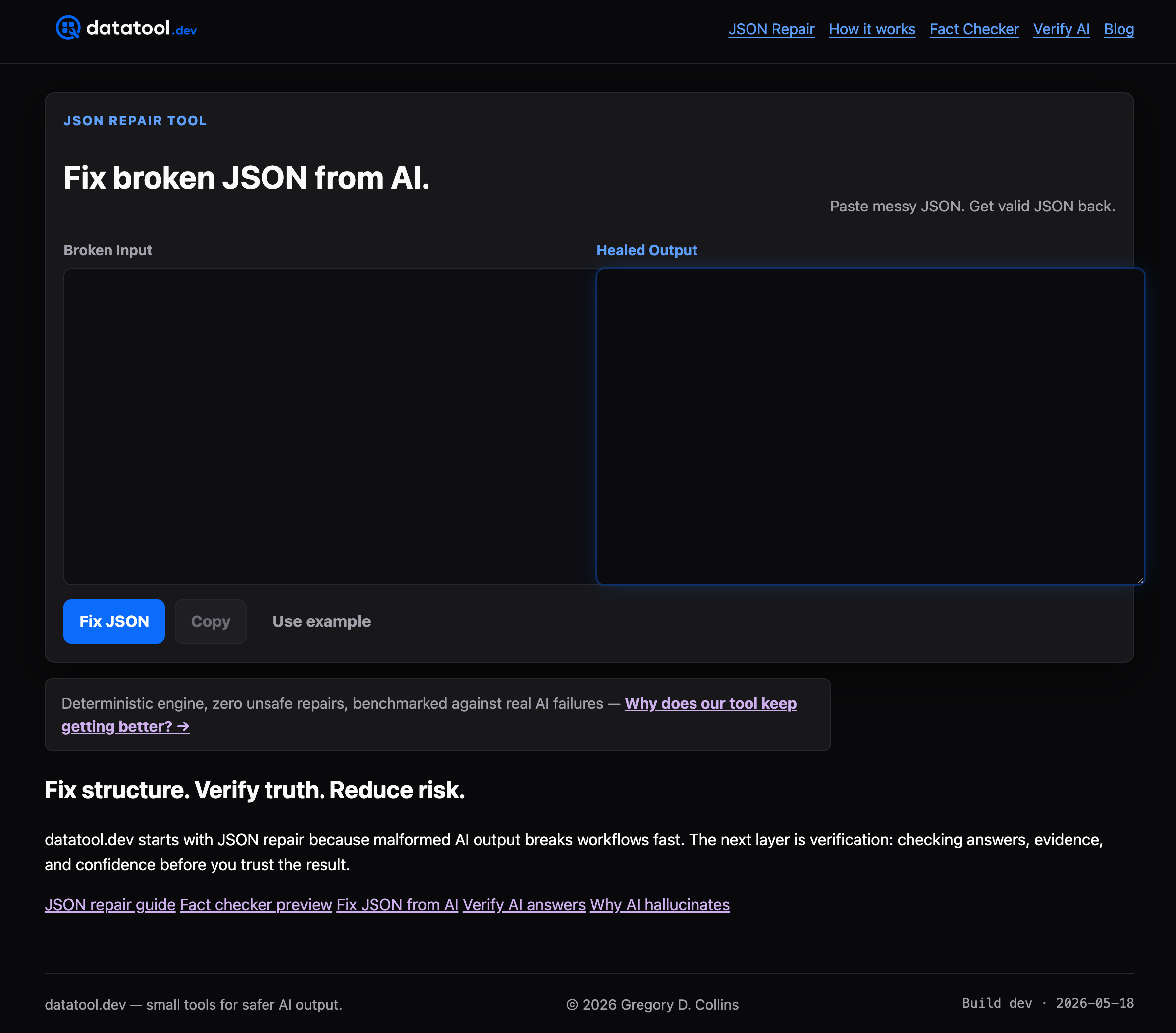
Datatool handles the real-world failures that schema constraints and normalization scripts miss: partial objects, invalid escaping, wrapped responses, and nested structure corruption. Paste broken output and get valid, schema-conformant JSON back. The platform integrates directly into your validation stage, so your pipeline gets a reliable fix layer without custom repair code. Fix broken JSON from AI and reduce the time your team spends debugging malformed output. For teams building test coverage around AI output, the AI output testing guide from Datatool covers validation patterns that pair well with the preprocessing pipeline described here.
FAQ
What are AI output preprocessing techniques?
AI output preprocessing techniques are the normalization, validation, and filtering steps applied to LLM-generated data before it reaches downstream systems. They cover syntactic cleanup, schema validation, PII filtering, and semantic verification.
Why is schema-constrained generation not enough on its own?
Schema constraints enforce format validity but not semantic correctness. A field can be correctly typed and still contain a hallucinated value, so semantic validation against authoritative sources must follow schema checks.
How does regex filtering reduce preprocessing costs?
A deterministic regex pre-pass runs at approximately 50 microseconds per call and catches roughly 35% of PII leaks before an LLM classifier is invoked, cutting guardrail cost per request by up to 80%.
What is the correct order for output preprocessing stages?
The correct order is syntactic normalization first, then schema validation, then semantic verification. Running semantic checks on unparseable content wastes compute and produces unreliable results.
How do you handle schema drift in production pipelines?
Version your schemas and store them alongside prompt templates. When a model update causes field type changes or new nesting patterns, detecting output errors early with schema diff tooling lets you catch drift before it propagates to downstream consumers.