

Malformed AI responses are structurally invalid or schema-violating outputs produced by large language models that cause parsing failures, data corruption, or silent data loss in production systems. These are not edge cases. LangChain with OpenAI's GPT-5-mini intermittently returns JSON that begins valid but never closes, followed by tens of thousands of whitespace characters, triggering Pydantic EOF errors. The industry term for this failure class is structured output violation, though developers commonly call them malformed AI response examples. Understanding the full taxonomy of these failures is the first step to building systems that don't break silently.
1. Malformed AI response examples and what they look like
The most common malformed AI response examples share a pattern: the output looks plausible at first glance but breaks the moment a parser touches it.
Trailing whitespace and unclosed JSON objects. This is the failure mode documented with GPT-5-mini. The model emits a syntactically valid opening, then floods the remainder of the token budget with newlines and spaces instead of closing the structure. The result is a Pydantic "ValidationError: EOF while parsing`. The output is not empty. It is actively misleading.

Missing required fields. The model returns a valid JSON object but omits one or more fields defined as required in your schema. Downstream code that assumes field presence throws a KeyError or NullPointerException. This is one of the most common AI mistakes in production because it passes a basic JSON parse check and only fails at the application layer.
Embedded refusal messages. Before structured outputs, models would inject refusal text directly into a JSON string value. You would get {"result": "I'm sorry, I can't help with that."} instead of the expected data type. Refusals are now programmatically indicated in structured output schemas, which improves parsing reliability. Older integrations still see this failure.
Token prediction mismatches. LLM attention mechanisms can cause the model's reasoning trace and its final selected token to contradict each other. The model reasons toward option A, then outputs option B. This produces logically inconsistent structured data that passes schema validation but is factually wrong.
Hallucinated field values. The model fabricates plausible-looking data for fields it cannot actually populate. A date field returns "2024-13-45". A UUID field returns a string that looks like a UUID but fails format validation. These are flawed AI interactions that corrupt databases when validation is absent.
Pro Tip: Run a JSON schema validator on every LLM response before it touches your database or frontend. A response that parses as valid JSON is not the same as a response that satisfies your schema.
2. How schema and validation frameworks reduce malformed outputs
Structured output enforcement is the single most effective control for reducing AI response failures at the model boundary.
Switching to OpenAI Structured Outputs reduced malformed response failure rates from 2 to 3 percent down to near-zero in internal tooling. That improvement is real, but it applies only to the model output layer. Downstream parsing layers remain fragile.
Here is a practical validation and retry pattern using Pydantic and the OpenAI Python SDK:
from pydantic import BaseModel, ValidationError
import openai

class ExtractedData(BaseModel):
    name: str
    score: int
    tags: list[str]

client = openai.OpenAI()

def call_with_validation(prompt: str, retries: int = 2) -> ExtractedData:
    last_error = None
    for attempt in range(retries + 1):
        response = client.beta.chat.completions.parse(
            model="gpt-4o-mini",
            messages=[{"role": "user", "content": prompt}],
            response_format=ExtractedData,
        )
        try:
            return response.choices[0].message.parsed
        except ValidationError as e:
            last_error = e
            prompt = f"{prompt}

Previous attempt failed validation: {e}. Fix the output."
    raise last_error
This pattern does three things. It uses the native parse method to enforce schema at the API level. It catches ValidationError on the client side. It retries with validation feedback injected into the prompt, which produces better results than a blind retry.
Zod serves the same role in TypeScript environments. The key principle is identical: validate against a typed schema, not just against JSON.parse().
Pro Tip: Use output templates in AI to constrain model behavior before the response is generated, not just after. Schema enforcement at the prompt level and the parse level together outperform either alone.
The table below compares the two primary validation approaches:
| Approach | Failure rate | Handles streaming | Retry support |
|---|---|---|---|
Raw JSON.parse() only | High | No | Manual |
| Pydantic or Zod schema validation | Low | Partial | Built-in with retry logic |
3. What causes malformed AI responses despite schema enforcement
Schema enforcement reduces AI response issues. It does not eliminate them. Several root causes persist even with structured outputs enabled.
Model updates change output generation patterns. Malformed responses persist after model version changes because updated weights alter token probability distributions. A schema that worked reliably with one model version may see new failure modes after a silent API update. You do not always get a changelog.
Streaming and event boundary parsing. Streaming responses arrive as partial chunks. A parser that expects a complete JSON object will fail on any chunk boundary that splits a string value or a number. This is a downstream fragility problem, not a model problem. The model output is correct. The parser is not built for partial input.
Model non-determinism. LLM calls are not deterministic. The same prompt with the same parameters can produce structurally different outputs across calls. Temperature settings reduce but do not eliminate this variance. Production systems that assume deterministic output will encounter inconsistent AI outputs under load.
Ambiguous prompt design. A prompt that asks for "a list of items" without specifying whether the response should be a JSON array or a newline-separated string will produce both, depending on context. Ambiguity in the prompt creates ambiguity in the output. This is one of the most preventable examples of AI errors.
Token-level prediction mismatches. As noted earlier, the model's reasoning and its final token selection can diverge. This is a property of how attention mechanisms work, not a bug that will be patched. Build for it.
4. How to implement defensive parsing and graceful degradation
Validation before using AI output is not optional. It is the baseline for any production AI integration. Here is a practical implementation sequence:
-
Validate at the boundary. Every AI response passes through a schema validator before any application logic runs. No exceptions. Raw output never reaches your frontend or database.
-
Retry with error context. On validation failure, inject the specific error message back into the next prompt. A retry that tells the model exactly what failed produces better corrections than a generic retry.
-
Set a retry limit and fall back. Two retries is the practical ceiling before you accept that this request will not resolve cleanly. Return a structured fallback response to the user rather than an error state. Maintain user experience even when the model fails.
-
Monitor malformed output rates. Track validation failure counts per model, per endpoint, and per prompt template. A spike in AI response failures after a model update is a signal, not noise. Log the raw response alongside the error.
-
Implement circuit breakers. If a model endpoint produces validation failures above a threshold rate over a rolling window, stop sending requests and alert. This prevents cascading failures in agentic pipelines where one bad output feeds the next step.
Pro Tip: Use structured data error detection tooling to surface malformed output patterns across your full request history, not just in real time. Batch analysis reveals systematic prompt or schema design problems that single-request logging misses.
Key takeaways
Malformed AI responses require layered defenses: schema enforcement at the model boundary, typed validation in application code, retry logic with error feedback, and monitoring across all endpoints.
| Point | Details |
|---|---|
| Schema enforcement alone is insufficient | Downstream parsing fragility persists even after switching to structured outputs. |
| Retry with error context | Inject the specific validation error into the retry prompt for better model correction. |
| Monitor failure rates by model version | Silent model updates change output patterns and require active tracking to catch. |
| Token mismatches produce valid-looking bad data | Schema-passing outputs can still be logically wrong due to attention mechanism divergence. |
| Graceful fallback is required | Return structured fallback responses on retry exhaustion to protect user experience. |
Why I stopped trusting "zero failure rate" claims
I have seen the 2 to 3 percent to near-zero improvement from OpenAI Structured Outputs cited as proof that malformed output is a solved problem. It is not. The model boundary is cleaner. The system is not.
Every production pipeline I have reviewed has at least one downstream layer that was written before structured outputs existed. A streaming parser, a legacy deserializer, a third-party SDK that wraps the raw response. These layers do not benefit from schema enforcement at the API level. They still break on trailing characters, partial chunks, and unexpected field ordering.
The deeper issue is cultural. Teams adopt structured outputs and stop treating AI output reliability as an active concern. Monitoring drops off. Retry logic never gets written. Then a model update ships and failure rates climb again, silently, until a user reports corrupt data.
My recommendation: treat every AI response as untrusted input, the same way you treat user input from a web form. Schema validation, type checking, range checks, and logging. Not because the model is unreliable by design, but because the system around it always is.
— Gregory
Fix malformed AI output with Datatool
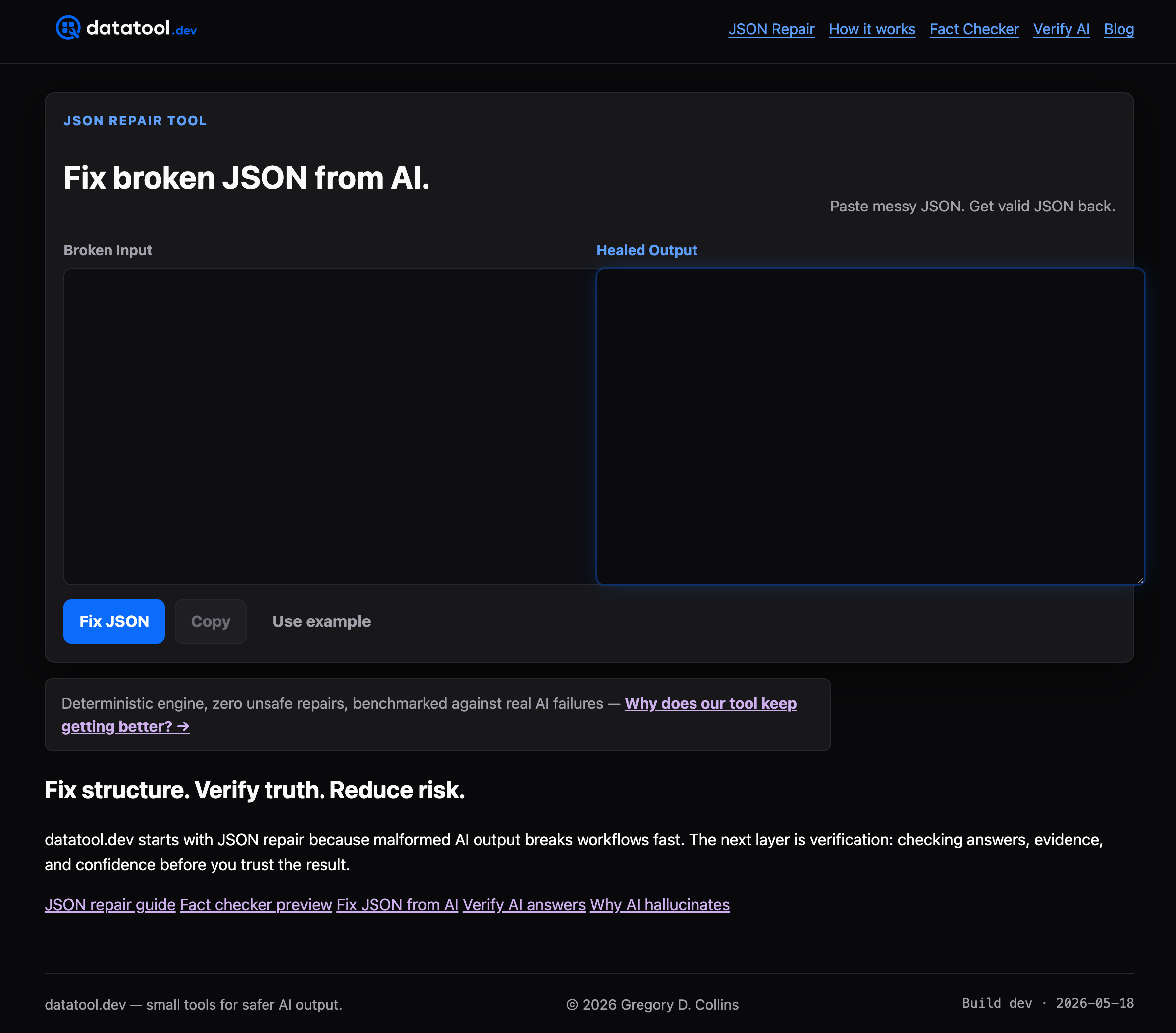
Datatool is built specifically for the failure modes described in this article. Broken JSON, wrapped responses, partial objects, invalid escaping, truncation, and schema drift are all handled by the repair and validation pipeline at datatool.dev. Paste a malformed LLM response and get valid, schema-conforming JSON back. The platform integrates directly into LLM workflows, giving you a repair layer between the model and your application. For teams running high-volume AI pipelines, Datatool also surfaces malformed output patterns across request history so you can fix the source, not just the symptom.
FAQ
What is a malformed AI response?
A malformed AI response is any LLM output that violates the expected structure, schema, or data type, causing parsing failures or data integrity issues in the consuming application.
Why does GPT-5-mini return JSON filled with whitespace?
This is a documented intermittent failure where the model emits a valid JSON opening and then fills the remaining token budget with whitespace instead of closing the structure, triggering Pydantic EOF errors.
Does using structured outputs eliminate malformed responses?
Structured outputs reduce model-level failures significantly, but downstream parsing layers remain fragile to streaming boundaries, model updates, and token prediction mismatches.
How many retries should I use for malformed AI output?
Two retries with validation error feedback injected into the prompt is the practical limit. Beyond that, fall back to a structured default response rather than continuing to call the model.
What is the best way to detect AI output errors in production?
Validate every response against a typed schema using Pydantic or Zod, log raw responses alongside validation errors, and track failure rates per model version and prompt template to catch systematic issues early.