

AI output entropy measures how unpredictable the next token is, defined by the Shannon entropy formula H(s|C) = -∑ P(si|C) log P(si|C). High entropy means the model is uncertain between many candidates. For structured data, that uncertainty breaks JSON, drifts schemas, and truncates objects mid-field.
Immediate actions:
- Set
temperature=0(argmax sampling) to reduce entropy for schema-bound generations - Add a schema validator after every generation and trigger a regenerate loop on failure
- Record per-token entropy vectors from logits; alert when a spike appears inside the expected JSON region
- Use datatool.dev as an empirical reference for real-world failure rates and repair patterns
Temperature acts as a direct dial on entropy: lower values sharpen the probability distribution; higher values flatten it toward uniform, multiplying the chance of an unexpected token, as demonstrated by Best AI Tools For Gaming Highlights which explore AI-driven video generation scenarios where output unpredictability matters.
Table of Contents
- What is AI output entropy, exactly?
- How high entropy breaks your structured outputs
- How to measure entropy in a production pipeline
- Prioritized fixes for entropy-driven structured data failures
- Observability and CI tests that catch entropy failures early
- When should you suppress entropy, and when should you keep it?
- What Datatool testing shows in the wild
- Key Takeaways
- Entropy is a signal, not just noise
- Datatool repairs malformed AI output
- Useful sources and further reading
What is AI output entropy, exactly?
Shannon entropy quantifies the uncertainty in a probability distribution over the next token, given the context C:
H(s|C) = -∑ P(si|C) log P(si|C)
- P(si|C) is the probability the model assigns to token si given all prior context
- The sum runs over the full token vocabulary
- Log base 2 gives entropy in bits; natural log gives nats. Most ML tooling defaults to nats; bits are easier to reason about in information-theoretic terms
When the model is confident, one token dominates and entropy is near zero. When it is uncertain, probability mass spreads across many tokens and entropy climbs.
Computing entropy from logits in Python:
import torch
import torch.nn.functional as F

def token_entropy(logits: torch.Tensor) -> float:
    # Stable softmax via log-sum-exp
    log_probs = F.log_softmax(logits, dim=-1)
    probs = log_probs.exp()
    return -(probs * log_probs).sum().item()  # nats

If your API exposes only top-K probabilities, renormalize before computing entropy to get a usable approximation:
def entropy_from_top_k(top_k_probs: list[float]) -> float:
    total = sum(top_k_probs)
    normed = [p / total for p in top_k_probs]
    return -sum(p * __import__('math').log(p) for p in normed if p > 0)
Pro Tip: Top-K renormalization underestimates true entropy because it ignores probability mass on tokens outside the top-K window. Treat the result as a lower bound, not a precise measurement.
How high entropy breaks your structured outputs
High entropy does not fail uniformly. It fails at specific positions, and the failure mode depends on where in the token sequence the spike occurs.
Common failure fingerprints:
- Mid-object entropy spike → truncated JSON; the model abandons the current object before closing braces
- Key-name region spike → schema drift; the model generates a plausible but wrong field name
- String-value region spike → invalid escaping or unquoted values
- End-of-structure spike → extra text appended after the closing brace (see why AI returns extra text in JSON)
Exploratory reasoning tokens like "first," "however," and "because" correlate with elevated entropy. When those tokens appear inside a JSON value field, the model is treating structured output like open-ended prose.
Before (high-entropy generation, broken JSON):
{"name": "Acme Corp", "revenue": 4200000, "tags": ["enterprise",
The model truncated mid-array. No closing bracket, no closing brace.
After (temperature=0, explicit stop sequence, schema prompt):
response = client.chat.completions.create(
    model="gpt-4o",
    messages=[
        {"role": "system", "content": "Return only valid JSON matching this schema: {name: string, revenue: number, tags: string[]}. No extra text."},
        {"role": "user", "content": user_input}
    ],
    temperature=0,
    stop=["

"],
    response_format={"type": "json_object"}
)

import json
try:
    result = json.loads(response.choices[0].message.content)
except json.JSONDecodeError:
    # trigger regenerate loop
    ...
{"name": "Acme Corp", "revenue": 4200000, "tags": ["enterprise", "b2b"]}
Explicit stop sequences and response_format constraints cut mid-schema entropy runaway by anchoring the model's generation path. Pair them with output templates for the most reliable results.
How to measure entropy in a production pipeline
Per-token entropy and aggregation
Compute a per-token entropy vector for every generation. Then aggregate:
import numpy as np

def sequence_entropy_stats(entropy_vector: list[float]) -> dict:
    arr = np.array(entropy_vector)
    return {
        "mean": arr.mean(),
        "p95": np.percentile(arr, 95),
        "spike_count": int((arr > arr.mean() + 2 * arr.std()).sum()),
        "max": arr.max()
    }
For black-box APIs without logit access, estimate entropy via sample diversity: generate N completions at a fixed temperature and compute the empirical token distribution across samples. KL divergence between two independent runs also flags instability without needing raw probabilities.
Reference metric ranges
Entropy-UID research reports a standard deviation in per-token entropy of approximately 2.8 and a balanced surprisal near 5.7 nats when combining entropy and surprisal objectives. Use those as rough stability baselines.
| Metric | Example range | Interpretation |
|---|---|---|
| Mean token entropy | approximately 2.8 nats | Normal generation; structured output usually sits at the lower end |
| 95th-percentile entropy | approximately 5.7 nats | Elevated; review tokens at these positions |
| Entropy spike count | 0–2 per sequence | More than 2 spikes inside a JSON region warrants a regenerate |
| Sample KL (N=5 runs) | — | Low run-to-run divergence; higher values signal instability |
Note that LLMs in production are nondeterministic even at temperature=0, due to batching and floating-point rounding. Batch ordering alone can flip argmax outcomes, so treat temperature=0 as a strong mitigation, not a guarantee. See the AI output observability guide for logging patterns that account for this.
Prioritized fixes for entropy-driven structured data failures
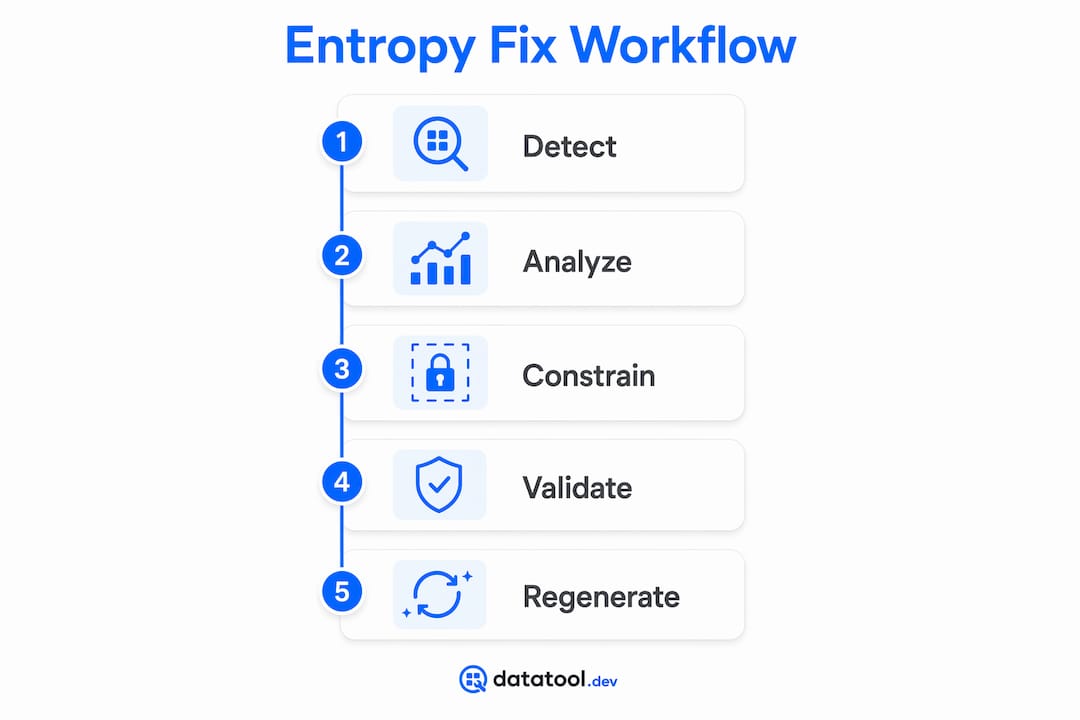
Work through these in order. Stop when parse failures drop to an acceptable rate.
-
Set deterministic sampling. Set
temperature=0,top_p=1,top_k=1. This is the fastest single fix for schema failures. -
Tighten
top_p/top_k. If temperature=0 is not available or causes reasoning failures, settop_p=0.1andtop_k=5to narrow the candidate pool. -
Apply a strict output template. Provide the exact JSON skeleton in the system prompt. The model fills values, not structure. Pair with
response_format={"type": "json_object"}where supported. -
Add a validate-and-regenerate loop. Parse the output. On failure, re-run with an amended prompt that includes the error. Cap retries at 3.
for attempt in range(3):
    raw = call_model(prompt, temperature=0)
    try:
        return json.loads(raw)
    except json.JSONDecodeError as e:
        prompt = f"{prompt}
Previous attempt failed: {e}. Return only valid JSON."
fallback
return repair_with_datatool(raw)
5. **Fall back to programmatic repair.** If repeated generation fails, apply heuristics: close unclosed brackets, strip trailing text, re-escape strings. Datatool's repair tooling handles these cases directly.
For deeper detection patterns, the [malformed output detection guide](https://blog.datatool.dev/blog/detect-malformed-output-ai-agents-a-developers-guide) covers post-generation repair flows in detail.
***
## Observability and CI tests that catch entropy failures early
**Core metrics to track per generation:**
- Per-token mean entropy
- 95th-percentile token entropy
- Sample KL divergence across N runs
- Parse-failure rate (rolling 100-request window)
- Time-to-first parse error (position in token sequence)
**CI test checklist:**
- Assert schema validity across 20+ random seeds for every prompt template
- Run regression tests that compare mean entropy and p95 against a stored baseline; fail the build if either exceeds threshold by more than 10%
- Fuzz-test by sampling 50 completions and measuring parse-failure probability; flag any prompt with failure rate above 5%
**Alerting rules:**
- Alert when rolling parse-failure rate exceeds 2% over 100 requests
- Alert when p95 token entropy exceeds your baseline by more than 2 standard deviations inside the JSON region
- Attach the full per-token entropy vector to every trace in your logging system; this lets you correlate failure position with entropy spikes after the fact
Tracking [AI output consistency](https://blog.datatool.dev/blog/what-is-ai-output-consistency-a-developers-guide) metrics alongside entropy gives a fuller picture of where generation is drifting.
***
## When should you suppress entropy, and when should you keep it?
Forcing entropy to zero everywhere is a mistake. Entropy is a signal for exploratory reasoning: reflective tokens like "verify" and pivotal connectors like "therefore" appear in high-entropy regions. Suppressing them in a multi-step reasoning chain degrades answer quality.
| Dimension | Allow entropy | Suppress entropy |
|---|---|---|
| When to use | Open-ended reasoning, creative tasks, chain-of-thought | Single-shot schema returns, structured data extraction |
| Expected failure mode | Schema drift, truncation, invalid escaping | Brittle reasoning, missed edge cases, repetitive outputs |
| Mitigation pattern | Post-validate and repair; entropy-based alerts | Constrained generation, templates, stop sequences |
The practical solution for complex tasks is a two-stage pipeline: run the reasoning pass at normal temperature, then feed the result into a second, constrained extraction call at temperature=0. The first pass gets the right answer; the second pass formats it correctly. See [AI output constraints](https://blog.datatool.dev/blog/benefits-of-ai-output-constraints-for-developers) for implementation patterns.
***
## What Datatool testing shows in the wild
Datatool sees three failure modes repeatedly across malformed AI output submissions:
**1. Mid-object truncation.** A mid-sequence entropy spike causes the model to stop generating before closing braces or brackets. The output is syntactically incomplete and fails `json.loads()` immediately.
**2. Unexpected extra text.** The model appends a natural-language explanation after the closing brace. Entropy climbs again after the JSON ends, and the model continues generating prose. This is the most common single failure mode in Datatool's repair queue.
**3. Invalid string escaping.** High entropy inside string values produces unescaped quotes or raw newlines, breaking the JSON string boundary.
In Datatool's testing, applying temperature=0 plus a validate-and-regenerate loop (capped at 3 retries) resolves the majority of these failures before repair heuristics are needed. When generation still fails after retries, programmatic repair handles the remainder: closing unclosed structures, stripping trailing text, and re-escaping strings.
**Pro Tip:** *Attach the per-token entropy vector to every failed generation in your logs. When you replay the failure, you can pinpoint the exact token position where the spike preceded the parse error, which makes prompt fixes targeted rather than speculative.*
***
## Key Takeaways
Suppressing entropy with deterministic sampling plus schema validation resolves the majority of AI-generated structured data failures before programmatic repair is needed.
| Point | Details |
|---|---|
| Shannon entropy formula | H(s|C) = -∑ P(si|C) log P(si|C) quantifies next-token uncertainty; higher values mean more schema risk. |
| Set deterministic sampling first | temperature=0 is the fastest single fix; expect residual variability from batching and floating-point rounding. |
| Validate and regenerate | Parse every output; on failure, re-run with the error in the prompt, capped at 3 retries. |
| Watch p95 token entropy | Alert when 95th-percentile entropy exceeds approximately 5.7 nats inside the JSON region; correlate with parse-failure rate. |
| Datatool for repair | Datatool handles truncation, extra text, and invalid escaping when generation retries are exhausted. |
***
## Entropy is a signal, not just noise
Most developers treat broken JSON as a formatting problem and reach for regex fixes. That misses the cause. The break happened because the model was genuinely uncertain at a specific token position, and that uncertainty is measurable before the parse error occurs.
The practical implication: entropy monitoring is not a nice observability add-on. It is the earliest reliable signal you have that a generation is about to fail. A parse-failure rate tells you something went wrong. A per-token entropy spike tells you *where* and *when*, which is what you need to fix the prompt rather than patch the output.
The two-stage pipeline recommendation follows from this directly. Suppressing entropy everywhere trades one problem for another: you get valid JSON but degraded reasoning. Keeping entropy high for the reasoning pass and low for the extraction pass gives you both. That is not a theoretical preference; it is what the failure data supports.
***
## Datatool repairs malformed AI output
[](https://datatool.dev/how-it-works/)
Datatool is a developer-focused platform for repairing and validating malformed AI-generated structured data. It handles the failure modes covered in this article: broken JSON, truncated objects, invalid escaping, extra text outside schema boundaries, and schema drift. The repair and validation tooling runs against real LLM output, not synthetic examples.
The findings referenced throughout this article come from Datatool's own testing queue. If your validate-and-regenerate loop is still producing failures, fix broken JSON from AI directly on the platform.
***
## Useful sources and further reading
1. Entropy-UID: A Method for Optimizing Information Density — https://arxiv.org/pdf/2502.14366
2. Nondeterministic Torts: A Technical Approach to AI Liability (Yale Law Journal) — https://yalelawjournal.org/note/nondeterministic-torts-a-technical-approach-to-ai-liability
3. Entropy of a Large Language Model Output (Gwern) — https://gwern.net/doc/www/nikkin.dev/cd424fb0b3f08b984d90ecea9885f022d7943ac6.html
4. I Finally Understood Entropy (TowardAI) — https://pub.towardsai.net/i-finally-understood-entropy-heres-the-simplest-way-to-think-about-it-even-in-llms-1b0da5a610d7
5. AI Will Never Give the Same Answer Twice — Alex Banks (The Signal) — https://thesignal.substack.com/p/ai-will-never-give-the-same-answer
6. Reasoning with Exploration: An Entropy Perspective (AAAI) — https://ojs.aaai.org/index.php/AAAI/article/download/40290/44251
## Recommended
- [What Is AI Output Determinism: A Developer's Guide](https://blog.datatool.dev/blog/what-is-ai-output-determinism-a-developers-guide)
- [AI output observability explained: a developer's guide](https://blog.datatool.dev/blog/ai-output-observability-explained-a-developers-guide)
- [AI output testing best practices for reliable structured data](https://blog.datatool.dev/blog/ai-output-testing-best-practices)
- [What Is AI Output Consistency: A Developer's Guide](https://blog.datatool.dev/blog/what-is-ai-output-consistency-a-developers-guide)