

Grammar-based AI output forces a model to generate only strings that match a formal grammar, so every response is syntactically valid by construction. It solves a specific class of problem:
- JSON responses from APIs that must parse every time, not most of the time
- Domain-specific language (DSL) generation, like SQL fragments or config files
- Command generation where a typo breaks an automated pipeline
- Code snippets that must compile, not just look plausible
The mechanics come down to two things: an incremental parser and logit masking. That's next.
Key Takeaways
Grammar-based AI output guarantees syntactic validity by masking invalid tokens at decode time, but it never guarantees that the resulting data is factually correct.
| Point | Details |
|---|---|
| Decode-time enforcement is strongest | Masking logits with an incremental parser prevents invalid tokens from ever being sampled. |
| Grammar formats matter | BNF, GBNF, and LL(prefix) trade expressive power against tokenizer compatibility. |
| Syntax isn't semantics | Valid JSON shape doesn't mean correct values; pair grammars with validation. |
| Black-box APIs need a fallback | Grammar prompting and post-output repair work when you can't access token logits. |
| Datatool covers the gap | Deterministic repair and schema validation catch structural failures when decode-time enforcement isn't available. |
Table of Contents
- How Does Grammar-Based AI Output Work?
- What Grammar Formats Do You Need to Know?
- How Do You Implement Grammar Constraints in Practice?
- Which Tools Support Grammar-Constrained Decoding?
- What Does Grammar-Based Output Actually Fix?
- How Do You Roll This Out in Production?
- What Do You Do When the API Won't Expose Token Probabilities?
- What Did Datatool.dev's Testing Show?
- Is Grammar Enforcement Worth the Engineering Cost?
- Getting Reliable Structured Output Without Decode-Time Access
- Frequently Asked Questions
- Sources
How Does Grammar-Based AI Output Work?
The model still predicts probabilities over its full vocabulary at every step. A parser tied to your grammar intercepts that distribution, removes any token that would produce an invalid string, and lets the model sample only from what remains. That's grammar-constrained decoding (GCD), and research on structured NLP tasks shows a parser-driven "completion engine" can prune the distribution at each step so the output is valid by the grammar, no finetuning required.
Here's the sequence:
- The grammar compiles into an automaton (often a pushdown automaton for context-free grammars).
- At each decoding step, the parser inspects the tokens generated so far and returns the set of tokens that would still lead to a valid completion.
- The decoder masks the logits for every token outside that set, typically by setting them to negative infinity before the softmax.
- The model samples from what's left, using greedy, beam, or top-k/top-p decoding exactly as it would without a grammar. Masking doesn't change your sampling strategy; it changes the menu.
One wrinkle: subword tokenizers don't always split cleanly at grammar boundaries. A token might complete a valid string with one prefix and an invalid one with another, so the parser has to reason about partial tokens, not just full ones. Some automatons handle this by inserting deterministic tokens automatically, closing a JSON brace the grammar knows must come next.
Pro Tip: If your grammar has a rule with only one legal continuation, like a closing quote after a string value, some engines will auto-insert it instead of spending a decode step sampling for something that's already certain. That's free latency back.
What Grammar Formats Do You Need to Know?
Three formats show up repeatedly: BNF/EBNF, GBNF (the dialect used by llama.cpp and Fireworks), and LL(prefix), a newer class designed for tokenizer compatibility. Each trades expressive power against parser efficiency and how well it maps to subword tokens.
- BNF/EBNF is the classic context-free grammar notation. Readable, well-documented, but not tokenizer-aware.
- GBNF extends BNF with regex-like repetition and character classes, and it's what you'll write for llama.cpp or Fireworks AI's grammar mode.
- LL(prefix) grammars, described in recent work on integrating formal grammars into LLM decoding, can be converted to LL(1) so a deterministic pushdown automaton enforces them efficiently during left-to-right generation, which matters because LLMs decode left to right, one token at a time.
Here's a minimal GBNF-style grammar for a tiny JSON object with a name and age:
root    ::= "{" ws "\"name\"" ws ":" ws string "," ws "\"age\"" ws ":" ws number ws "}"
string  ::= "\"" [a-zA-Z ]* "\""
number  ::= [0-9]+
ws      ::= [ \t
]*
Every rule constrains one part of the shape: root fixes the key order and braces, string and number fix the value types, and ws tolerates whitespace without letting it appear where a brace or colon belongs. In practice you rarely hand-write these for real schemas. Tooling exists to compile JSON Schema or Pydantic models directly into grammars, which is the approach most production teams take.
How Do You Implement Grammar Constraints in Practice?
Implementation needs two things: a grammar, and an inference runtime that either masks logits at decode time or gives you a repair path when it can't. Here's what a real failure looks like.
A model asked for {"name": "Ada", "age": 36} instead returns:
{"name": "Ada", "age": 36,
Truncated, no closing brace. JSON.parse() throws immediately. Two fixes exist.
Fix A: enforce a grammar at decode time. Compile the schema into a GBNF grammar (like the one above) and pass it to a runtime that supports masking. Fireworks AI's grammar mode accepts a response_format: {"type": "grammar", "grammar": "..."} field directly in the request, so the truncation above becomes structurally impossible: the automaton won't let decoding stop before the closing brace exists.

Fix B: deterministic post-repair. When you can't touch the decode loop (a black-box API, for instance), run the output through a deterministic repair pass that closes the dangling structure before parsing:
raw_output = '{"name": "Ada", "age": 36,'
repaired  = repair_json(raw_output)  # -> '{"name": "Ada", "age": 36}'
data      = json.loads(repaired)
Checklist for choosing a path:
- Local inference (llama.cpp, vLLM): mask logits directly, lowest overhead.
- Server APIs with grammar support (Fireworks-style): pass the grammar string in the request.
- Black-box APIs with no grammar option: repair the output after the fact.
Token-step masking adds negligible latency locally, but grammar mode over an API call still costs one round trip. Repair-based fixes add a parse-and-patch step, usually a few milliseconds, well below the cost of a retry.
Which Tools Support Grammar-Constrained Decoding?
Check these first: llama.cpp, which accepts GBNF grammars natively for local inference; Fireworks AI, whose grammar mode enforces GBNF server-side; vLLM and Outlines, both of which expose grammar or schema-constrained sampling; and academic tooling built around Backus-Naur Form (BNF) and Earley or other incremental parsers, which underlie most of the above.
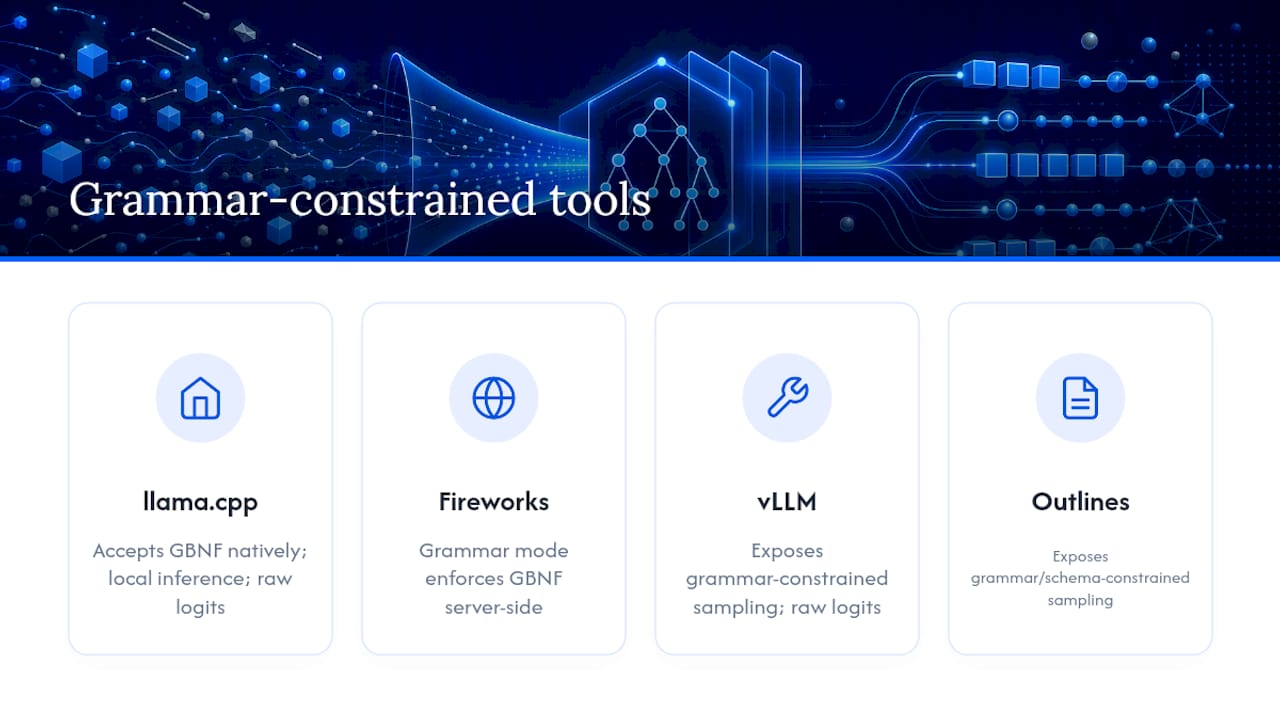
Open-source inference stacks that expose raw logits, llama.cpp and vLLM among them, make direct masking straightforward. Closed-box cloud APIs rarely expose token distributions, so you either use a vendor's built-in grammar mode (Fireworks) or fall back to prompting and repair.
Watch for tokenizer collisions: a single grammar rule can map to several different subword tokens depending on context, which is exactly the problem LL(prefix) grammars were designed to solve. Older academic frameworks like Grammatical Framework (GF) handle multi-language grammar generation and are worth knowing if your DSL needs to target more than one output language, though they predate the LLM decoding use case by years.
What Does Grammar-Based Output Actually Fix?
Grammar constraints guarantee syntactic validity. They do not guarantee the content is correct.
What it reliably fixes:
- Eliminates malformed JSON, unclosed braces, and bad escaping entirely, since invalid tokens can never be sampled.
- Removes most downstream parsing failures caused by structural errors, not logic errors.
- Cuts retry loops built just to catch syntax problems.
- Helps smaller, cheaper models produce valid structure they'd otherwise fumble.
What it doesn't fix:
- Wrong values in the right shape. A grammar-valid JSON object can still have the wrong age or a hallucinated field.
- Tokenizer edge cases that require careful grammar design, not just a schema dump.
- Engineering overhead: writing, testing, and versioning grammars is real work.
- Latency, in setups that require an extra API round trip for grammar mode.
Explainers on constrained decoding are direct about this: the mask only removes illegal tokens; meaning is still entirely the model's responsibility. If your pipeline needs factual accuracy, not just valid structure, you still need retrieval, fine-tuning, or a verification layer on top.
How Do You Roll This Out in Production?
Decide your enforcement point first: decode-time masking if you control inference, post-repair if you don't. Everything else follows from that choice.
- Generate the grammar from your existing schema (JSON Schema, Pydantic, protobuf) rather than writing it by hand.
- Test against edge cases: empty arrays, nested objects, optional fields, unicode strings.
- Let the automaton auto-insert deterministic tokens (closing braces, required commas) where only one valid continuation exists.
- Log every enforcement failure or repair event so you catch grammar bugs before they hit production.
- Version your grammars alongside your schema. A schema change without a matching grammar update is a silent outage waiting to happen.
Pro Tip: Combine a strict system prompt with your grammar rather than relying on the grammar alone. The grammar guarantees shape; the prompt still does most of the work of getting the right values into that shape.
What Do You Do When the API Won't Expose Token Probabilities?
Three fallbacks work when you can't mask logits directly: grammar prompting, speculative or multi-call sampling, and post-output repair pipelines.
Grammar prompting has the model predict a specialized BNF grammar first, then generate output that follows it. Research on grammar prompting shows real gains on DSL tasks this way, at the cost of extra API calls compared to direct constrained decoding.
Speculative or stepwise sampling breaks generation into smaller calls, validating and trimming after each one, rather than trusting a single long completion to stay valid the whole way through.
Post-output repair is the practical default for most black-box API users: generate normally, then run the raw output through a deterministic repair and validation pass before it reaches your application code. This is where a tool like Datatool fits, catching the truncated braces and bad escaping that grammar prompting alone won't always prevent, without requiring any changes to how you call the model.
What Did Datatool.dev's Testing Show?
In testing, grammar-constrained decoding removed structural parse failures entirely from high-stakes pipelines where the runtime supported it. Where it wasn't available, deterministic repair caught the same category of errors after the fact.
Three failure patterns showed up repeatedly across test runs:
- Missing closing brace, from truncation mid-object, fixed by grammar enforcement at decode time or by a repair pass that closes the structure before parsing.
- Broken escaping, quotes inside string values left unescaped, caught reliably by validating malformed JSON output before it reaches application code.
- Partial objects, where a response cuts off mid-array, requiring detection logic to flag incomplete structures rather than silently passing them through.
Datatool.dev testing found that grammar enforcement removed the need for manual parse-error handling in the structured pipelines it was applied to, since invalid tokens simply couldn't be sampled in the first place.
Where decode-time enforcement isn't an option, the same class of failures is still catchable. Deterministic repair won't stop a model from truncating output, but it stops that truncation from reaching your database.
Is Grammar Enforcement Worth the Engineering Cost?
I'd tell any team shipping structured output at scale: enforce the grammar at decode time wherever your stack allows it, and treat repair as the fallback, not the plan. Grammar constraints solve syntax completely. They solve nothing about meaning, so pair deterministic enforcement with real semantic validation before you trust the output downstream.
Getting Reliable Structured Output Without Decode-Time Access
Datatool is the practical fallback when your inference stack won't let you touch logits, whether that's a black-box API or a legacy pipeline you can't rewrite around a grammar. It catches the exact failures grammar enforcement prevents at the source, after the fact, deterministically.
- Deterministic JSON repair for broken braces, bad escaping, and truncated objects.
- Schema validation to catch structurally valid but semantically wrong output.
- Regression testing so a model update doesn't silently break your output format.
If decode-time masking isn't on your roadmap this quarter, start by pointing your existing pipeline at Datatool's JSON repair tools and see what it catches on your last week of production logs.
Frequently Asked Questions
What is grammar-based AI output, in one sentence? It's model output constrained by a formal grammar so every generated string is guaranteed to be syntactically valid, whether that's JSON, a DSL, or a code snippet.
Is grammar-based AI output effective for small models? Yes, often more so than for large ones. Grammar-based representations reduce syntax errors that smaller models are more prone to making in the first place.
Does grammar-constrained decoding slow down inference? Locally, masking adds negligible overhead per token. Over an API with a grammar mode, expect the same latency as a normal request, since enforcement happens server-side.
What if my API doesn't support grammar constraints at all? Use grammar prompting, where the model predicts a grammar before generating, or run outputs through a deterministic repair and validation step after generation.
Can grammar constraints fix a model that hallucinates facts? No. They guarantee shape, not truth. A grammar-valid response can still contain a wrong number or an invented field.
Sources
- Grammar prompting: enabling LLMs to respect formal grammars in few-shot generation
- structured-output-grammar-based
- What is grammar-constrained decoding?