

AI output confidence scoring is the practice of assigning a numerical value to indicate the certainty of each prediction produced by an AI model, typically expressed on a 0–1 or 0–100 scale derived from softmax outputs or Bayesian posterior probabilities. These scores tell you whether to accept a result automatically or route it to a human reviewer. An OCR engine returning a character recognition score of 0.97 behaves differently from one returning 0.61. The same logic applies to classification tasks, named entity recognition, and LLM-generated structured data. Understanding what these numbers actually represent, and where they break down, is the foundation of reliable AI system design.
What is AI output confidence scoring?
AI output confidence scoring attaches a probability estimate to each model prediction. The score reflects how much probability mass the model placed on its chosen output at inference time. A score of 0.94 means the model assigned 94% of its internal probability to that output. That is useful for triage. It does not confirm the output is correct.
Practitioners use these scores to build decision thresholds. Outputs above a threshold get accepted automatically. Outputs below it go to a human review queue. This is the core utility of output scoring in AI: it converts a continuous probability into a routing decision. LlamaIndex, Kognitos, and MIT research all treat this threshold logic as the primary operational use case.

The score itself comes from one of three sources: internal model probabilities, explicit self-reported confidence from an LLM, or heuristic proxies like document retrieval relevance. Each source has a different reliability profile. Conflating them is where most production failures begin.
How are confidence scores generated in modern AI models?
Neural classifiers generate confidence scores through a softmax layer. Softmax converts raw logit outputs into a probability distribution across all possible classes. The highest probability class becomes the prediction. Its probability value becomes the confidence score.
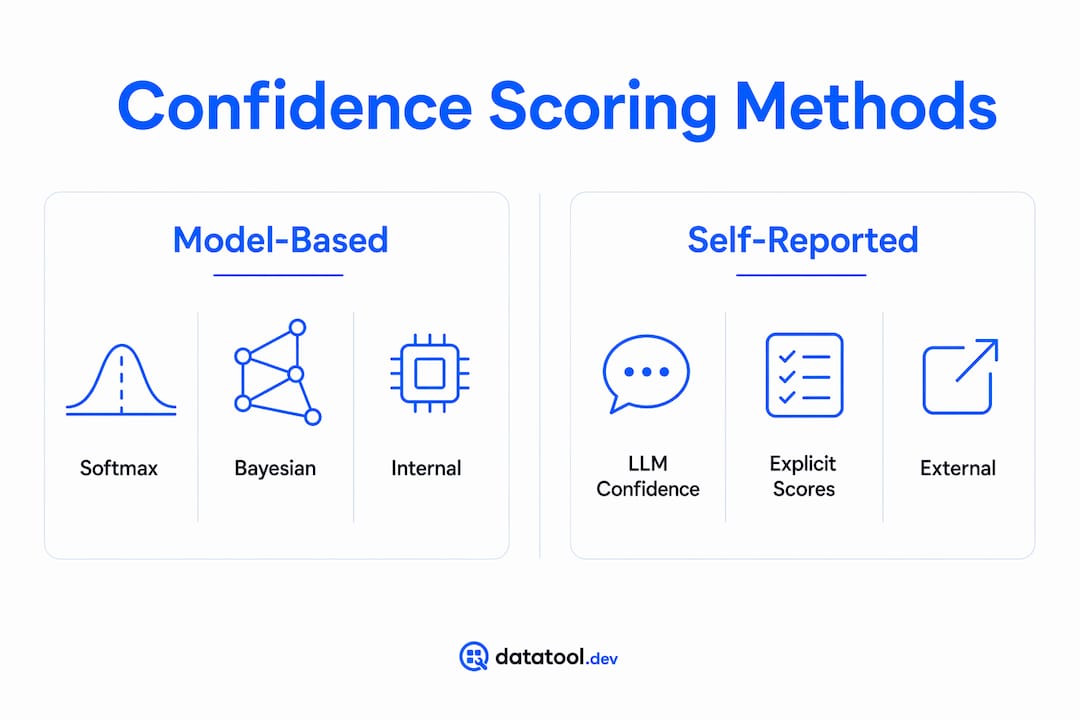
Bayesian models take a different approach. They compute posterior probabilities by combining prior beliefs with observed data. The result is a score that explicitly accounts for uncertainty in the model parameters, not just the output distribution. This makes Bayesian posteriors better calibrated in theory, though harder to scale in practice.
LLMs present a third case. They can produce self-reported confidence by generating phrases like "I am 80% confident." These self-assessments do not correlate reliably with internal token probabilities. They are generated text, not extracted probabilities. Treating them as calibrated scores causes deployment failures.
The three mechanisms are:
- Internal probabilities: softmax or posterior outputs from the model architecture
- Self-reported confidence: LLM-generated text estimates, unreliable without validation
- Heuristic proxies: retrieval relevance scores or similarity metrics used as confidence stand-ins
Pro Tip: When building a triage pipeline, always identify which of the three mechanisms your confidence score comes from before setting thresholds. A retrieval relevance score of 0.85 and a softmax probability of 0.85 are not equivalent.
What are the common pitfalls of AI confidence scores?
The most dangerous assumption in output scoring is that a high confidence score means a correct answer. It does not. Confidence measures internal certainty, not external accuracy. A model can be confidently wrong when it has learned a spurious pattern with high consistency.
Calibration is the technical term for the alignment between stated confidence and empirical accuracy. A well-calibrated model that says 0.80 should be correct 80% of the time across a large sample. Most production models are not well calibrated out of the box. Overconfidence is the common failure mode: models report high scores on outputs that are factually incorrect.
Here are the four most common pitfalls practitioners encounter:
- Treating proxies as probabilities: Search relevance scores and embedding similarity are not calibrated probabilities. Using them as confidence scores in a triage pipeline produces misleading routing decisions.
- Skipping calibration validation: Deploying a model without testing its calibration on a held-out set means you have no evidence that your thresholds are meaningful.
- Using confidence as audit evidence: A confidence score alone cannot satisfy SOX or ECOA compliance requirements. It shows internal probability mass, not decision reasoning.
- Ignoring distribution shift: A model calibrated on training data may become miscalibrated when input distributions change in production.
Confidence scores answer "how certain was the model?" Audit trails answer "why did the system make this decision?" You need both. Neither replaces the other.
How have recent advances improved confidence score calibration?
MIT's Reinforcement Learning with Calibration Rewards (RLCR) method is the most significant recent advance in confidence score reliability. RLCR adds a calibration reward term to the standard RL training objective, using Brier score penalties to discourage both overconfident wrong answers and underconfident correct ones. The result is a model that learns to express uncertainty accurately as part of training, not as a post-hoc adjustment.
The quantitative results are significant. RLCR reduced calibration error by up to 90% across multiple benchmarks without degrading task accuracy. That is not a marginal improvement. It changes what practitioners can reasonably expect from a model's stated confidence.
| Method | Calibration Approach | Calibration Error Reduction |
|---|---|---|
| Standard RL training | No calibration objective | Degrades calibration |
| Temperature scaling | Post-hoc adjustment | Moderate improvement |
| RLCR (MIT) | Brier score reward during training | Up to 90% reduction |
Standard RL training actively degrades model calibration because the reward signal does not penalize confident wrong answers. RLCR closes that gap by making calibration a first-class training objective. For practitioners building systems where AI prediction reliability matters, this is the method to watch.
Pro Tip: Calibration training is necessary but not sufficient. Always close the loop by evaluating your model against a held-out calibration set after training. Training alone does not guarantee that stated confidence aligns with empirical correctness.
How can practitioners apply confidence scoring effectively?
Effective use of confidence scoring in production requires more than setting a threshold. Start with a calibration validation protocol. Run your model against a held-out calibration set and measure the gap between stated confidence and actual accuracy. If a model says 0.90 but is correct only 70% of the time at that score, your threshold is wrong.
Confidence is one dimension of output quality, not the whole picture. Iris's Output Quality Score (OQS) integrates completeness, relevance, and safety into a single 0–1 metric using veto logic for critical failures like safety violations. A high confidence score on an unsafe output is worse than a low confidence score on a safe one. Composite metrics prevent that failure mode.
For triage frameworks, structure your pipeline around three zones:
- Auto-accept zone: confidence above your validated upper threshold, output passes without review
- Human review zone: confidence between thresholds, output queued for manual inspection
- Auto-reject zone: confidence below lower threshold, output discarded or regenerated
Store confidence scores alongside audit trails for every routed decision. Confidence tells you the model's internal state. The audit trail records what happened and why. Both are required for governance under compliance frameworks. Relying on scores alone is inadequate for regulated environments.
For teams working with LLM-generated structured data, malformed outputs are a separate reliability problem that confidence scores do not address. A model can return high-confidence JSON that is structurally broken. Validation against a schema is a distinct check from confidence thresholding. See Datatool's AI output testing practices for a concrete framework covering both.
Key takeaways
AI output confidence scoring is only reliable when the score source is identified, calibration is validated against ground truth, and scores are combined with audit trails for governance.
| Point | Details |
|---|---|
| Identify the score source | Softmax probabilities, self-reported LLM confidence, and heuristic proxies are not interchangeable. |
| Validate calibration | Test against a held-out set to confirm stated confidence matches empirical accuracy before deploying thresholds. |
| Use composite quality metrics | Confidence alone misses safety, completeness, and relevance. Iris OQS shows how to combine dimensions. |
| Store audit trails | Confidence scores satisfy triage needs. Audit trails satisfy compliance and explainability requirements. |
| Apply RLCR where possible | MIT's RLCR method reduces calibration error by up to 90% by making calibration a training objective. |
Confidence scores are a starting point, not a verdict
I have reviewed a lot of AI pipelines where the confidence score was treated as the final word on output quality. The pattern is consistent: a team sets a threshold, ships the system, and then discovers months later that their model was confidently wrong on a specific input class they never tested. The score looked fine. The outputs were not.
The core issue is that calibration is not a property you can assume. It has to be measured. I have seen teams skip held-out calibration sets entirely because the model "felt accurate" during development. That is not a protocol. That is optimism.
What actually works is treating confidence scoring as one layer in a stack. You need the score for routing. You need calibration validation to trust the score. You need an audit trail to explain decisions after the fact. And you need schema validation to catch structural failures that confidence scoring cannot see. None of these layers replaces the others.
The RLCR research from MIT is genuinely useful because it addresses calibration at the training level rather than patching it afterward. But even RLCR requires evaluation against held-out data to confirm the improvement holds on your specific distribution. Training advances do not eliminate the need for response fidelity checks in production.
The practitioners who build reliable systems treat confidence scores as a signal to be verified, not a guarantee to be trusted.
— Gregory
Fix broken AI output before it reaches your pipeline
Confidence scores tell you how certain a model was. They do not tell you whether the output is structurally valid. LLMs regularly produce malformed JSON alongside high-confidence scores: broken escaping, truncated objects, schema drift, and wrapped responses that fail parsing before any threshold logic runs.

Datatool is built for exactly this problem. It repairs malformed AI-generated structured data, including broken JSON, partial objects, and invalid escaping from real LLM output. Use it alongside your confidence scoring layer to catch structural failures that probability estimates miss entirely. Visit datatool.dev to fix broken JSON from AI and build a more reliable output pipeline.
FAQ
What is AI output confidence scoring?
AI output confidence scoring assigns a numerical value (typically 0–1) representing how certain a model is about its prediction, derived from softmax outputs or posterior probabilities. It is used to route outputs to automatic acceptance or human review based on decision thresholds.
How do you measure AI confidence accurately?
Accurate measurement requires identifying whether the score comes from internal model probabilities, self-reported LLM text, or heuristic proxies, then validating calibration against a held-out dataset to confirm the score aligns with empirical accuracy.
Why can't a confidence score serve as an audit trail?
A confidence score shows the model's internal probability mass on a chosen output. It does not record the decision path, policy logic, or reasoning, which are required for compliance under frameworks like SOX and ECOA.
What is RLCR and why does it matter for calibration?
RLCR (Reinforcement Learning with Calibration Rewards) is an MIT-developed training method that uses Brier score penalties to reduce calibration error by up to 90% without losing task accuracy. It makes calibration a first-class training objective rather than a post-hoc fix.
Is a high confidence score enough to trust an AI output?
No. A high confidence score confirms the model's internal certainty, not output correctness. Miscalibrated models produce confidently wrong answers. Composite quality metrics that include safety, completeness, and relevance provide a more complete picture of output reliability.