

An AI output schema contract is a formal JSON Schema that specifies the exact structure, types, and constraints an LLM's response must follow, enforced at token decode time. The industry term for this practice is "structured output," and understanding what is ai output schema contract means treating AI responses as versioned API payloads rather than freeform text. Leading providers including OpenAI, Anthropic, and Gemini now enforce schema compliance proactively, reducing violations to under 0.1%. This guide covers enforcement mechanics, versioning strategy, validation layers, and schema design practices for production systems.
What is an AI output schema contract and how does it work?
An AI output schema contract defines the rules your LLM must follow when generating a response. JSON Schema is the universal language for this purpose. All major providers and agent frameworks have converged on it, preferring it over alternatives like Protocol Buffers or GraphQL for generation-time enforcement.
The key mechanism is constrained decoding. Instead of generating free text and parsing it afterward, the model's token selection is restricted at each step to only tokens that keep the output valid against the schema. OpenAI's strict mode passes the JSON Schema directly to the API at generation time, which reduces schema violations drastically. This eliminates retry loops and complex post-hoc parsing.

Without a schema contract, a typical LLM response might look like this:
{
  "result": "The answer is 42",
  "confidence": "high",
  "tags": "math, arithmetic"   // string instead of array
}
With a strict JSON Schema enforcing "tags": { "type": "array", "items": { "type": "string" } }, the model cannot produce that malformed output. The fix is not downstream repair. It is upstream prevention.
Schema contracts shift validation from error-prone post-hoc parsing to proactive enforcement at decode time, fundamentally changing how AI output reliability is achieved.
- Define required fields explicitly with
"required": [...]arrays. - Use
"additionalProperties": falseto block unexpected keys. - Restrict string fields with
"enum"or"pattern"where the domain is bounded. - Avoid deeply nested
oneOforanyOfconstructs that some providers do not fully support in constrained decoding.
Pro Tip: Stick to the JSON Schema subset your provider's constrained decoding engine supports. Complex combiners like if/then/else often fall outside that subset and silently disable strict mode.
How does schema versioning prevent AI output drift?
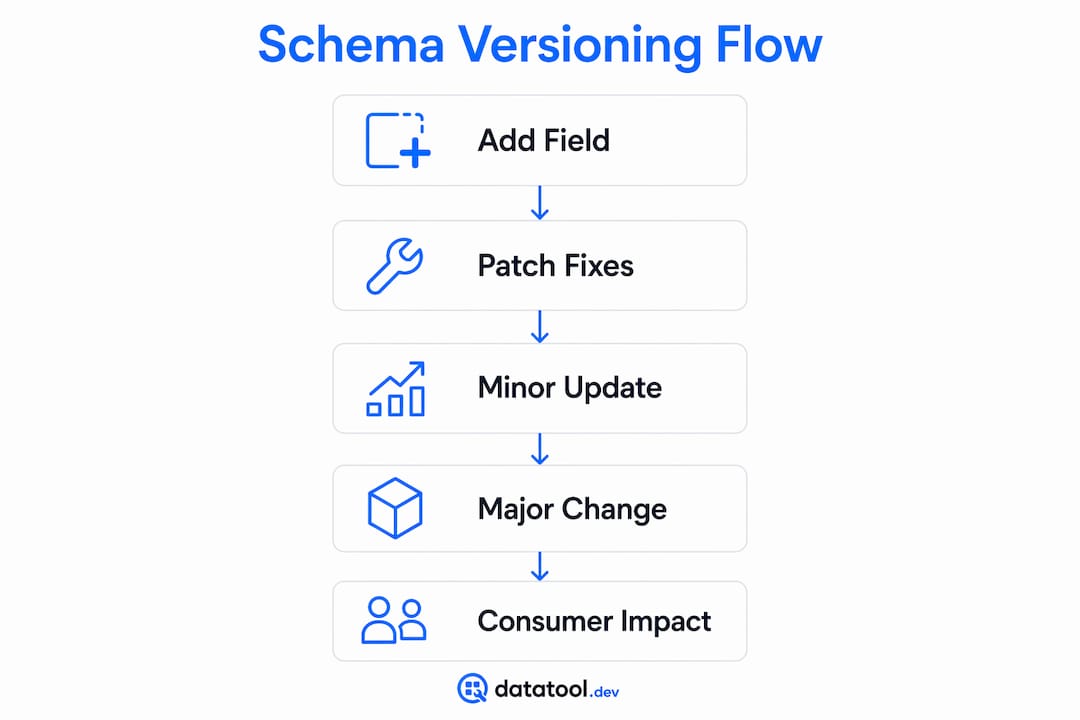
Schema drift is the silent failure mode of AI pipelines. A field gets renamed, a type changes, and downstream consumers break without any obvious error at the model boundary. Semantic Versioning applied to output schemas solves this by treating the schema as a versioned product interface, not an informal prompt instruction.
The principle maps directly from REST API versioning. A patch increment covers documentation fixes with no structural change. A minor increment adds optional fields that do not break existing consumers. A major increment covers any breaking change: field renames, type changes, removed fields, or reordered required properties.
The accuracy impact of breaking changes is severe. A single field rename can drop model accuracy from 95% to 4.5%. That is a 90-percentage-point collapse from one seemingly minor edit. The model's internal priors were trained on the original field name, and renaming it breaks the alignment between schema and model behavior.
| Change type | Version bump | Consumer impact |
|---|---|---|
| Add optional field | Minor | No breakage; consumers ignore unknown fields |
| Rename required field | Major | Model accuracy collapses; downstream parsing breaks |
| Change field type | Major | Runtime type errors in all consumers |
| Remove field | Major | Null reference errors in dependent systems |
| Fix schema description | Patch | No structural impact |
Pro Tip: Embed version metadata directly in your schema using a "$schema" URI or a top-level "version" field. This gives every response a self-describing audit trail and simplifies debugging when schema drift occurs.
What are the four layers of AI output validation?
Relying on schema validation alone is an anti-pattern. Professional AI output validation uses four distinct layers, each catching a different class of failure.
- Schema design. The contract itself. Define field types, required properties, and constraints before writing a single prompt. Schema-first development means the schema drives prompt design, not the reverse.
- Syntax and type validation. Run JSON Schema validation at the API boundary immediately after receiving a response. This catches malformed JSON, wrong types, and missing required fields. Schema compilation adds 100–500ms latency on first call; cache compiled validators to eliminate that cost on subsequent calls.
- Repair logic. Apply targeted fixes for syntax errors only. Truncated JSON, invalid escape sequences, and trailing commas are repairable. Datatool handles exactly these cases: broken JSON, wrapped responses, partial objects, and invalid escaping from real LLM output.
- Semantic and business validation. Check that values make sense in context. A
"confidence"field of0.99with an empty"evidence"array is syntactically valid but semantically wrong. Semantic failures should halt the workflow immediately rather than propagate bad data downstream.
Here is a concrete example of the repair layer in action:
import json

raw = '{"name": "Alice", "score": 0.87, "tags": ["ml", "nlp"'  # truncated

try:
    data = json.loads(raw)
except json.JSONDecodeError:
    # Repair: close the open array and object
    repaired = raw + "]}"
    data = json.loads(repaired)
    # Now validate against schema before passing downstream
Pro Tip: Cache your compiled JSON Schema validators. The 100–500ms compilation cost is a one-time expense per schema version. Paying it on every request is a preventable latency tax.
How should you design schemas to improve AI accuracy?
Schema design directly affects model output quality. Placing reasoning fields before answer fields guides the model's chain-of-thought processing and improves accuracy. A schema that asks for "reasoning" before "conclusion" produces better conclusions than one that reverses the order.
Field naming matters just as much as field order. Names that align with the model's training priors produce more accurate outputs. Generic names like "data" or "result" give the model no signal. Specific names like "extracted_entities" or "sentiment_label" align with patterns the model has seen in training.
- Place
"reasoning"or"chain_of_thought"fields first in the schema's property order. - Use descriptive, domain-specific field names that match common training vocabulary.
- Keep schemas narrow. Every optional field you add is a surface for the model to hallucinate a value.
- Treat field renames as breaking changes and bump the major version.
Narrow schemas with minimal repair logic outperform complex auto-repair systems for semantic issues. Fix syntax errors. Fail fast on business-rule violations. That boundary is the most important design decision in your validation pipeline.
Pro Tip: When a schema tweak improves output quality, document it as a minor version change with a note in the change log. Treat schema evolution the same way you treat API evolution: with discipline and a paper trail.
Key Takeaways
An AI output schema contract is a versioned JSON Schema enforced at decode time, and treating it as a first-class API contract is the single most effective way to achieve reliable AI output in production.
| Point | Details |
|---|---|
| JSON Schema is the standard | All major LLM providers use JSON Schema for constrained decoding at generation time. |
| Field renames are breaking changes | A single field rename can drop model accuracy from 95% to 4.5%; always bump the major version. |
| Use four validation layers | Schema design, syntax validation, repair logic, and semantic checks each catch different failures. |
| Fail fast on semantic errors | Halt the workflow on business-rule violations; do not auto-repair hallucinated values. |
| Schema design affects accuracy | Placing reasoning fields before answer fields and using descriptive names improves output quality. |
Why I stopped trusting prompts to enforce output structure
The most expensive lesson I have learned working with AI pipelines is that prompts are not contracts. You can write "always return valid JSON with these exact fields" in a system prompt, and the model will comply most of the time. Most of the time is not good enough for production.
The first time I saw schema drift destroy a pipeline, it was a field rename from "entity_name" to "name" in a schema update. The developer thought it was a cleanup. The model's accuracy on that field dropped by nearly 90 percentage points overnight. No tests caught it because the JSON was still valid. The values were just wrong.
What changed my approach was treating output schemas exactly like REST API contracts. Version them. Document changes. Never rename a field without a major version bump. The technical and legal sides of AI contracts are distinct, but both depend on the same foundation: a verifiable, auditable record of what the system was supposed to produce. Strict schema adherence gives you that record automatically.
The teams I have seen succeed with AI output contracts invest in tooling early. They do not wait for a production incident to add validation. They build the four-layer validation model before the first deployment. JSON Schema is the lingua franca here. Use it, version it, and enforce it at the token level.
— Gregory
Datatool and AI output schema enforcement
Broken AI JSON is not a rare edge case. It is the default failure mode of LLMs under load, with truncated responses, invalid escaping, and schema drift appearing regularly in production pipelines.
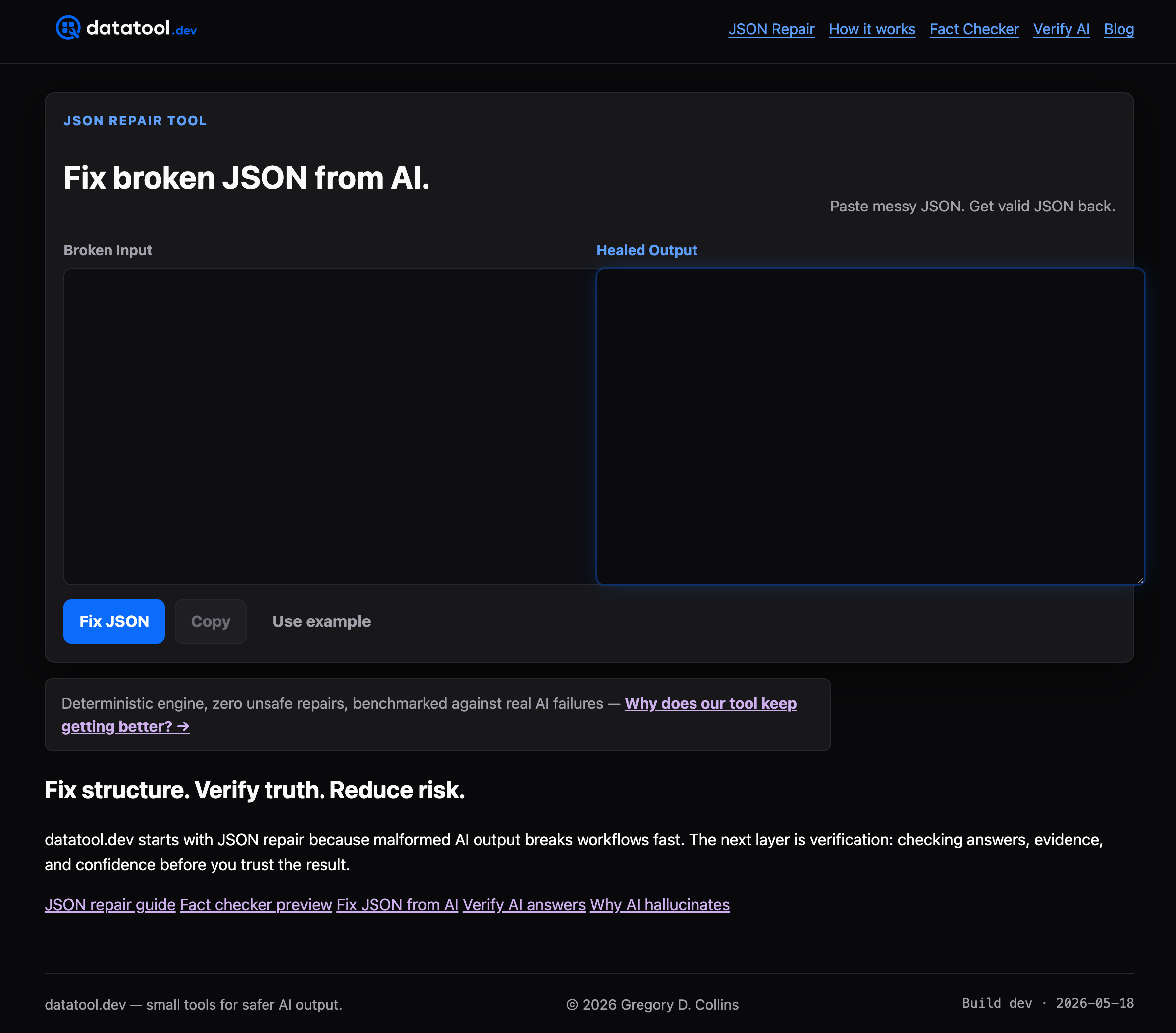
Datatool is built for exactly this problem. The platform detects and repairs malformed AI output including broken JSON, wrapped responses, partial objects, and invalid escaping from real LLM responses. It supports the structured output validation workflow that production AI systems require: fix syntax errors fast, validate against your schema, and halt on semantic failures. If your pipeline is consuming raw LLM output without a repair and validation layer, Datatool gives you that layer without rebuilding your stack. Paste broken JSON. Get valid, schema-conformant JSON back.
FAQ
What is an AI output schema contract?
An AI output schema contract is a formal JSON Schema that defines the required structure, types, and constraints for an LLM's response, enforced at token decode time using constrained decoding to guarantee format adherence.
How is an output schema different from a prompt instruction?
A prompt instruction asks the model to follow a format. An output schema contract enforces it at the token level, making non-conformant output structurally impossible rather than merely discouraged.
Why does field naming affect AI output accuracy?
Model accuracy depends on alignment between schema field names and the model's training priors. A single field rename can drop accuracy from 95% to 4.5% because the model no longer recognizes the field's semantic role.
What is schema drift in AI systems?
Schema drift occurs when an output schema changes without a corresponding version update, causing silent mismatches between the model's expected output format and the downstream consumer's parsing logic.
When should repair logic stop and validation fail?
Repair logic applies to syntax errors like truncated JSON or invalid escaping. Semantic and business-rule violations should cause immediate workflow failure to prevent hallucinated data from propagating downstream.