

Schema enforcement in AI is the process of guaranteeing that AI-generated structured outputs comply with defined data contracts, preventing malformed JSON, type mismatches, and broken integrations before they reach production. Without it, LLMs like GPT-4o and Claude 3.5 produce outputs that look valid but fail silently at the parser. A schema-first development approach reduces schema violation rates from nearly 60% to under 0.1%. That number defines the stakes. This guide covers every major schema enforcement approach, ranked by how they perform in real systems.
1. What are the key schema enforcement approaches in AI?
The four core schema enforcement approaches in AI cover different layers of the output pipeline. Each targets a different failure mode.
- Constrained decoding: Token-level pruning during generation. The model physically cannot produce tokens that violate the schema grammar. Tools like Outlines and llama.cpp's grammar mode implement this. It guarantees syntactic schema validity at generation time, not after.
- Native strict structured output modes: Provider-side enforcement via API. OpenAI's "response_format
withstrict: trueand Google Gemini'sresponse_schema` parameter both enforce JSON Schema at the provider level. The application receives a structurally valid response or an explicit error. - Application-side schema validation: Post-generation validation using libraries like Zod (TypeScript) or Pydantic (Python). The model generates freely; your code validates the result and rejects or retries on failure. Fast to implement, but it cannot stop malformed generation upfront.
- Semantic validation: Domain-specific logic checks that go beyond structural conformance. A field may be the correct type and present in the schema, yet still be logically wrong. For example, a
start_datethat is later thanend_datepasses JSON Schema validation but fails business logic. Semantic validation catches this class of error.
No single method covers all failure modes. Production systems need more than one.
2. Performance and complexity trade-offs between enforcement methods

Choosing between methods is a latency and control decision, not just a correctness one.
Constrained decoding delivers 100% syntactic validity but introduces latency overhead between 1.6% and 5.3% depending on schema complexity. For most batch workloads, that overhead is acceptable. For real-time applications where response time is under 500ms, it matters. The bottleneck is not the token sampling itself. It is the constraint mask computation, especially when schemas use additionalProperties: false on wide objects.
Application-side validation with Zod or Pydantic adds near-zero latency to generation but cannot prevent malformed output from being produced. You pay the cost of a failed generation, a retry, and the associated token spend. In high-volume pipelines, retry rates above 5% become expensive fast.
Provider-native strict modes sit between the two. They reduce application-side error handling but differ in schema dialect support. OpenAI's strict mode does not support every JSON Schema keyword. Schemas using oneOf may need to be rewritten as anyOf for cross-provider compatibility. Failure modes also differ: some providers return an error object, others return a null response, and some silently truncate.
On-premises deployments using models like Llama 3 or Mistral cannot use provider-native modes. They rely on grammar-guided generation with GBNF or finite-state machines for token masking. This gives full runtime control over schema compilation and caching, but requires manual setup and maintenance.
3. The multi-layered schema enforcement pipeline
Production best practice defines a three-layer validation pipeline. Each layer catches what the previous one misses.
- Layer 1: Syntactic enforcement. Use constrained decoding or a provider strict mode to guarantee the output is parseable and structurally matches the schema. This eliminates broken JSON, missing required fields, and wrong data types before the output reaches your application code.
- Layer 2: Schema-level validation. Run the parsed output through Zod or Pydantic to confirm field types, value ranges, string formats, and structural constraints. This catches issues that syntactic enforcement passes, such as a string field containing a value that should be an enum.
- Layer 3: Semantic validation. Apply domain-specific rules. Check cross-field dependencies, business logic constraints, and referential integrity. This layer requires code you write. No library handles it automatically because it is specific to your data model.
Retry strategy connects all three layers. When validation fails at any layer, feed the structured validation error back to the model as an explicit error message. A message like "Field 'end_date' must be after 'start_date'. Received start_date: 2026-06-01, end_date: 2026-05-15" produces a correct retry. A generic "Validation failed. Try again." does not.
Pro Tip: Derive your provider JSON Schema and your runtime Pydantic or Zod validator from a single source schema. Maintaining two separate schema definitions causes drift. One changes; the other does not. The bug surfaces in production.
4. Cloud API vs. on-premises schema enforcement
The enforcement toolchain changes significantly depending on where the model runs.
| Factor | Cloud APIs (OpenAI, Gemini) | On-premises (Llama 3, Mistral) |
|---|---|---|
| Enforcement method | Provider-native strict modes | Grammar-guided constrained decoding |
| Schema dialect | JSON Schema (partial support) | GBNF, finite-state machines |
| Latency control | Provider-managed, cached | Developer-controlled, manual caching |
| Schema customization | Limited by provider constraints | Full control over grammar rules |
| Setup complexity | Low | High |
| Cross-field semantic rules | Not supported natively | Not supported natively |
Cloud APIs cache compiled schemas on the provider side, which reduces repeated-request latency. On-premises deployments must implement schema caching manually. Without it, every request recompiles the grammar, adding measurable overhead at scale.
Hybrid architectures use both environments. The practical requirement is a standardized schema contract that both sides consume. Define the schema once in Pydantic or Zod, export it as JSON Schema for the cloud provider, and use it as the grammar source for the on-premises grammar compiler. This prevents the two environments from drifting apart over time.
5. Schema design choices that directly affect output quality
How you write the schema is as important as which enforcement method you use.
Large additionalProperties: false constraints on wide objects cause the highest decoding performance penalties in constrained decoding. If an object has 40 possible fields and you close it with additionalProperties: false, the constraint mask computation becomes expensive. The fix is to restructure wide objects into nested sub-objects, each with a smaller field count.
Enums and closed dictionaries produce more predictable outputs than open string fields. A field defined as "status": {"enum": ["active", "inactive", "pending"]} eliminates an entire class of hallucinated values. Datatool.dev testing confirms that enum-constrained fields have near-zero hallucination rates compared to open string fields on the same prompt.
Cross-provider compatibility requires attention to schema constructs. oneOf is not universally supported. Rewriting it as anyOf works across OpenAI, Gemini, and most grammar-guided decoders. Test your schema against each provider before deploying.
Pro Tip: Feed explicit validation errors back into the retry prompt with the exact field name, the received value, and the expected constraint. Vague error messages produce vague corrections.
Treating schema enforcement as a protocol-level contract rather than a post-processing step changes how AI agents self-correct. When the schema is immutable and the error message is precise, agents can resolve violations without human intervention.
Key takeaways
Effective schema enforcement in AI requires three coordinated layers: syntactic enforcement, schema-level validation, and semantic business logic checks, all connected by structured error feedback.
| Point | Details |
|---|---|
| Use layered enforcement | Combine constrained decoding, schema validation, and semantic checks to cover all failure modes. |
| Single-source schema | Derive both provider and runtime validators from one Pydantic or Zod definition to prevent drift. |
| Feed structured errors on retry | Pass explicit field-level error messages back to the model. Generic prompts produce poor corrections. |
| Constrained decoding has a cost | Expect 1.6% to 5.3% latency overhead. Avoid wide objects with additionalProperties: false. |
| Semantic validation is manual | No library handles business logic. You must write and maintain semantic checks for your domain. |
Why schema enforcement is harder than it looks in production
I have seen teams spend two weeks building a prompt and two hours on schema design. That ratio is backwards. The prompt gets the model to the right neighborhood. The schema is what makes the output usable by the system downstream.
The part that surprises most developers is semantic validation. JSON Schema handles structure. Pydantic handles types. Neither handles the rule that a medical record cannot have a discharge date before an admission date. That logic lives in your domain, and you have to encode it explicitly. There is no shortcut.
The other underestimated problem is schema drift. You update the Pydantic model for a new field. You forget to regenerate the JSON Schema sent to the OpenAI API. The provider enforces the old schema. The runtime validator expects the new one. The output passes provider validation and fails application validation. The bug is invisible until it hits production.
Automating schema derivation from a single source solves this. It is not glamorous work, but it is the kind of infrastructure that prevents 2am incidents. I also recommend unit testing AI-generated data against your schema on every CI run, not just in production monitoring.
The latency trade-off for constrained decoding is real but manageable. For batch pipelines, take the overhead and get the guarantee. For real-time APIs, use provider strict modes and accept that you need solid retry logic. The 1.6% to 5.3% overhead is a known cost. Silent schema violations in production are not.
— Gregory
Fix schema violations in your AI outputs with Datatool
Schema enforcement catches structural failures. But LLMs still produce broken JSON, truncated objects, and malformed escaping that slip through before enforcement even runs.
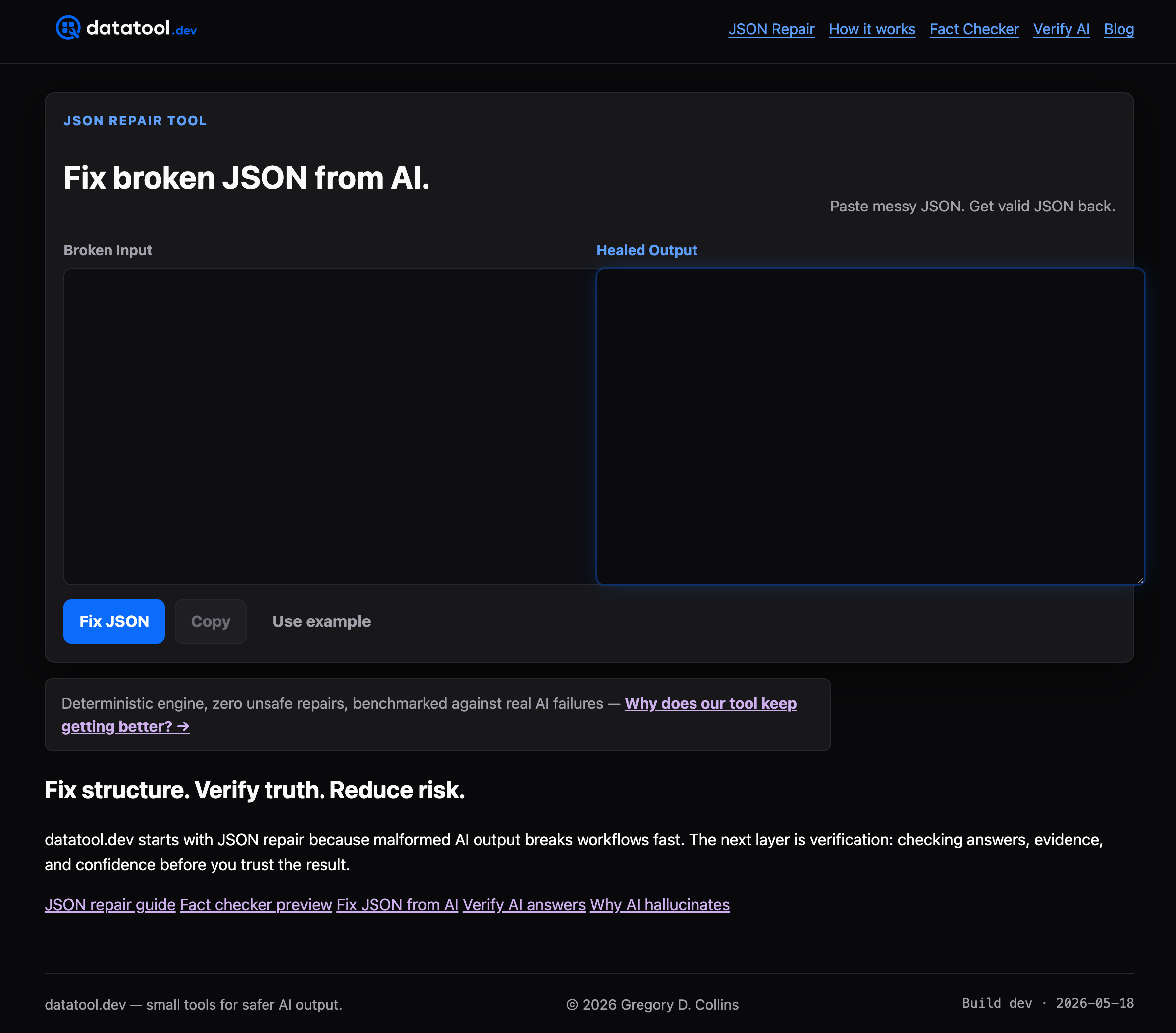
Datatool is built for exactly this. It detects and repairs malformed AI output automatically, covering broken JSON, wrapped responses, partial objects, invalid escaping, and truncation. It supports multi-layer validation with semantic rule extensions and integrates with the AI frameworks you already use. Teams running high-volume LLM pipelines use Datatool to cut integration failures and keep structured data reliable. Paste broken output. Get valid, schema-compliant JSON back. No manual repair required.
FAQ
What is schema enforcement in AI?
Schema enforcement in AI is the process of constraining or validating AI-generated outputs to conform to a predefined data schema. It prevents malformed JSON, type errors, and missing fields from reaching downstream systems.
Which schema enforcement method is most reliable?
A three-layer pipeline combining constrained decoding, schema-level validation with Pydantic or Zod, and semantic business logic checks is the most reliable approach. No single method covers all failure modes.
Does OpenAI strict mode replace application-side validation?
OpenAI strict mode eliminates structural validation needs in application code but cannot enforce semantic business rules. Runtime semantic validation is still required.
How does constrained decoding affect latency?
Constrained decoding introduces latency overhead between 1.6% and 5.3% depending on schema complexity. Wide objects with additionalProperties: false cause the highest overhead.
How should validation errors be used in AI retries?
Structured validation failures should be fed back to the model as explicit error messages with the field name, received value, and expected constraint. This produces targeted corrections and reduces the number of retries needed.