

Broken AI-generated JSON blocks parsing and automation for data engineers and ML teams every week. Most alternatives only fix structure or demand heavy manual setup, leaving value errors and pipeline friction unresolved. This comparison lists repair engines, gateways, and evaluation tools so you can match the right output validator to your workflow.
Table of Contents
datatool.dev
At a Glance
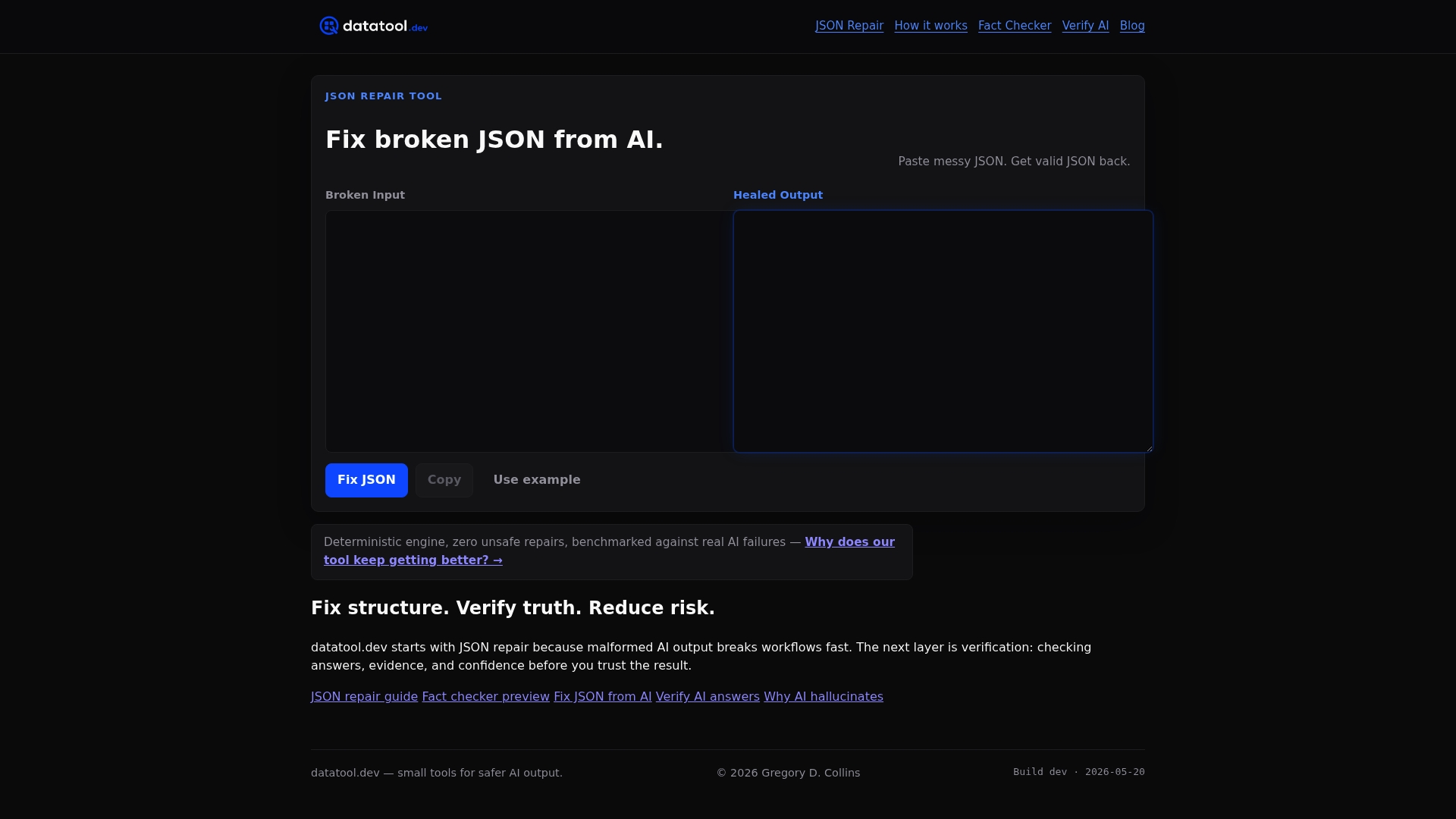
Datatool reports 86.5% repair accuracy on tested datasets. The vendor advertises 0 unsafe repairs on benchmark tests. Datatool targets real-world malformed AI output such as wrapped responses, truncation, invalid escaping, and partial objects.
Core Features
Datatool uses a deterministic JSON repair engine and a safety-focused scoring system that discourages unsafe repairs. It includes tools for JSON structure fixing, fact checking, and AI answer verification, and it runs with zero dependencies so you can embed it in CI or scripts. The project publishes public benchmarks and a real-world data corpus for testing and validation.
Key Differentiator
Datatool's defining feature is its deterministic, safety-focused repair algorithm with a learned loop that iteratively improves repair accuracy and reduces risky transformations. That method prioritizes returning predictable, reproducible fixes rather than guessing content changes.
Pros
Datatool's deterministic parser produces repeatable outputs, which simplifies debugging and rollback in pipelines. That accuracy figure and that safety claim reflect the vendor's benchmark results and make the output easier to trust when automating downstream processing. The project is open source with full benchmarks, so you can audit test cases and reproduce results locally before deployment.
Cons
- Does not verify content correctness beyond structure, so factual errors in values may remain even after structural repair.
Who It's For
Datatool fits developers and data engineers who ingest AI-generated JSON into scripts, APIs, or ETL pipelines and need reliable structural repair. It matches teams that require predictable parser behavior and want to run repairs without adding runtime dependencies. It is less useful when you need full fact validation of content values.
Unique Value Proposition
An open source repository with full benchmark and testing data lets you validate repair behavior before you deploy. You can run the same corpus locally and inspect failures, which reduces deployment risk for production pipelines. That visibility makes it easier to adopt the repair engine in regulated or audit-sensitive environments.
Real World Use Case
A developer pastes a broken AI output into a pipeline and needs valid JSON before parsing. The broken snippet below contains trailing commas and an extra comma after the array.
// broken
{"items": [{"id": 1, "name": "Alice",}, {"id": 2, "name": "Bob"},],}

// repaired
{"items": [{"id": 1, "name": "Alice"}, {"id": 2, "name": "Bob"}]}
Datatool's deterministic repair returns the repaired JSON above, letting the pipeline parse and validate schemas without runtime errors. Use the published benchmarks to test the same failure modes against your corpus before automating repairs.
Website: https://datatool.dev
Aionas
At a Glance
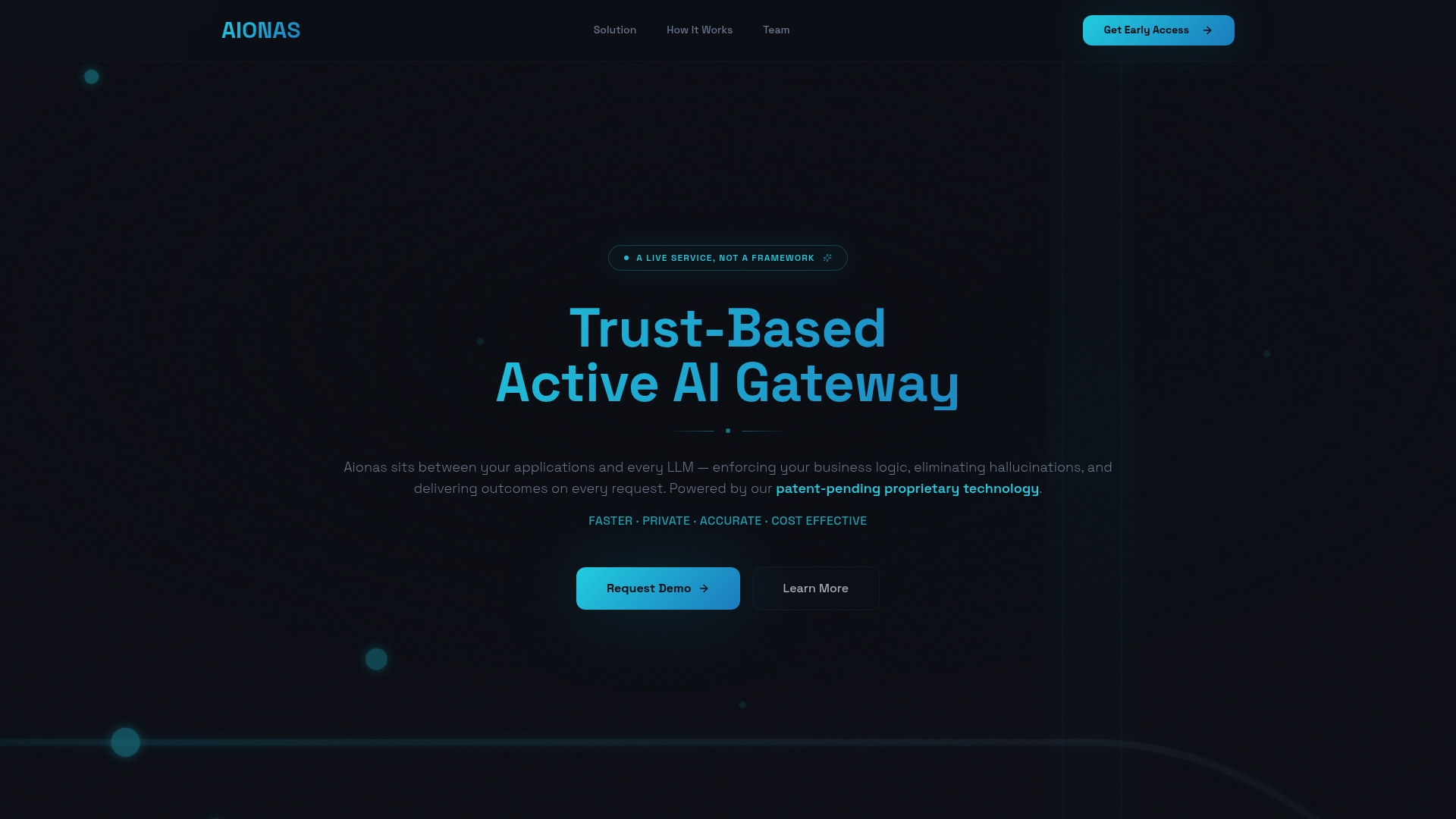
Aionas reports reducing AI infrastructure costs by over 50%, so it operates via a single SDK and supports full on-premises deployment for teams that require data sovereignty.
Core Features
Aionas intercepts every LLM request in real time and routes queries to the most appropriate model. The gateway validates output before delivery and applies business logic inline to prevent malformed or out-of-spec payloads. Real-time observability and cost attribution let teams track which models drive spend and latency.
Key Differentiator
Aionas centers on active, real-time validation and intelligent routing that enforce business logic without replacing your existing AI stack. That approach moves verification to the edge of your application so invalid responses get blocked or fixed before they reach downstream code. The result is tighter control over cost and privacy while keeping existing model providers in place.
Pros
Aionas couples model routing with output verification so teams can reduce spend while catching hallucinatory or malformed responses. The single SDK model simplifies integration with existing code paths and keeps validation logic close to the call site. Running fully on-premises supports strict data residency requirements and removes the need to send sensitive prompts to third-party services.
Datatool.dev testing shows the gateway catches common malformed-JSON cases and returns a validated schema or a clear error, which reduces downstream exception handling.
Cons
- Limited third-party user reviews are publicly available, so user-reported operational quirks are hard to verify.
- Public documentation does not list detailed deployment benchmarks for large clusters.
- The product may not fit teams that prefer cloud-only managed services or have minimal internal AI infrastructure.
Who It's For
Enterprises and AI developers who run LLMs in production and need to cut model spend while keeping full control over data. Teams with on-premises or private cloud requirements will get the most from Aionas. Groups that already have complex routing logic can replace fragile scripts with a single SDK.
Real World Use Case
A support team routed chatbot queries through Aionas to pick cheaper models for straightforward intents and reserved expensive models for complex cases. The vendor reports reduced LLM costs by the figure above while improving delivered output quality to the accuracy claim noted earlier.
Example of a caught failure and a fix. Messy LLM output:
{ "user_id": 123, "intent": "refund", "details": "Order 890" "amount": 29.99 }
Aionas validation rejects the payload and returns a normalized object. Fixed output:
{ "user_id": 123, "intent": "refund", "details": "Order 890", "amount": 29.99 }
This pattern avoids parse exceptions in downstream services and gives a clear remediation path for the caller.
Pricing
Pricing information is not publicly listed. The vendor describes the offering as informational only and does not publish public tiered rates. Contact Aionas for custom pricing based on deployment size and on-premises requirements.
Website: https://aionas.ai
UpTrain
At a Glance
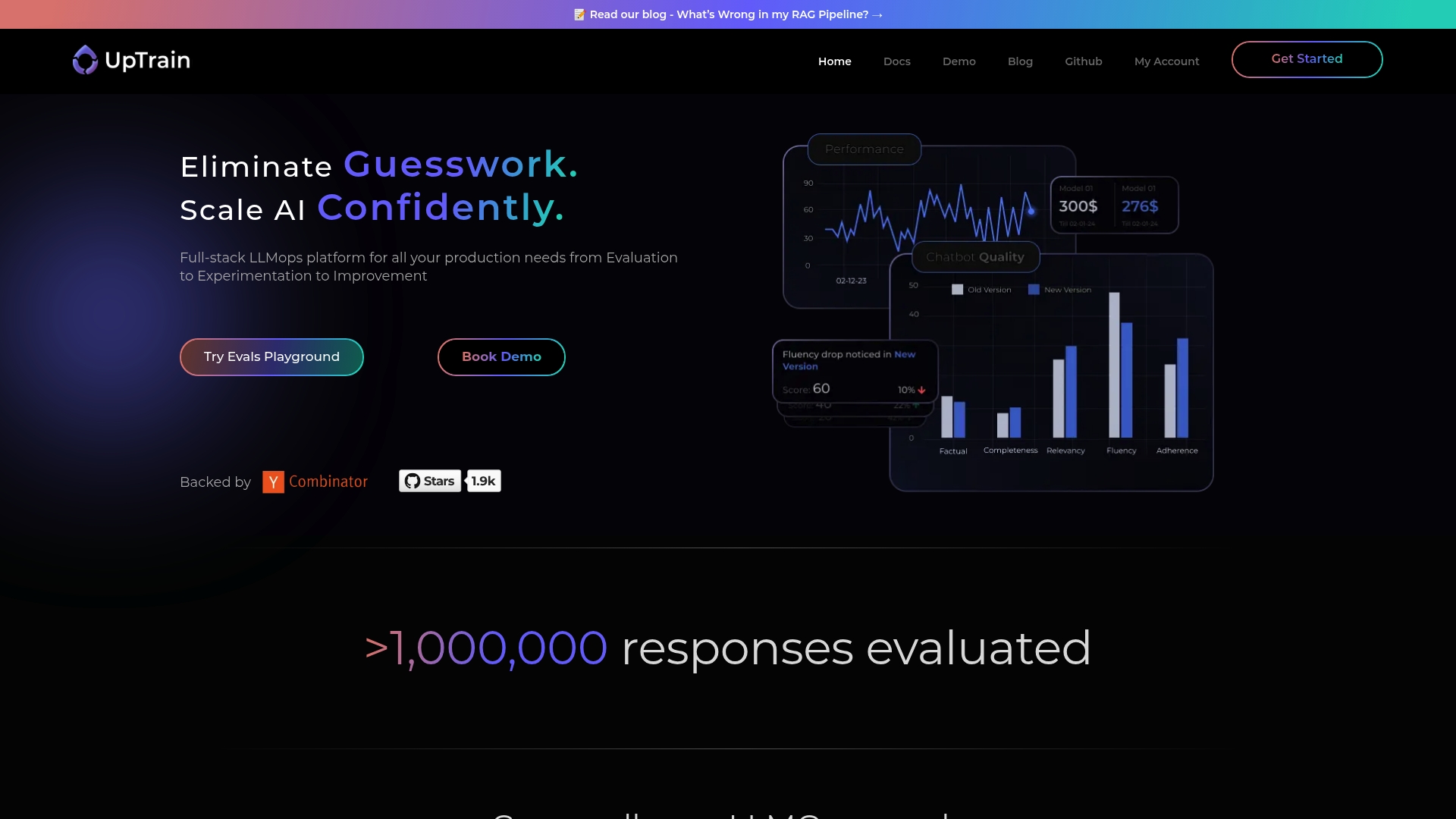
UpTrain's marketing materials state a single line API deploys in under 5 minutes and delivers evaluation scores with >90% agreement with human assessments. The project is open source and backed by YCombinator. That combination targets teams that need auditability and rapid evaluation loops for LLM models.
Core Features
UpTrain supports more than 20 predefined evaluation metrics and lets teams add custom metrics for domain needs. It runs automated regression testing across prompts, code, and configuration changes while collecting datasets from production logs and feedback. The platform also provides root cause analysis and error pattern detection to speed triage.
// example failure: LLM returned truncated JSON
{"user": "alice", "result": {"intent":"order","items":[{"id": "123", "qty": 2}

// fixed form expected by validators
{"user": "alice", "result": {"intent": "order", "items": [{"id": "123", "qty": 2}]}}
datatool.dev testing used a simple validator like the example above to show how missing brackets cause downstream failures. UpTrain’s dataset management lets you collect those failures and feed them into repeatable tests.
Key Differentiator
Open source licensing plus an emphasis on high agreement with human scoring sets UpTrain apart from many closed tools. That accuracy claim and the quick single line integration aim to reduce manual labeling. The project focuses on giving engineers access to raw evaluation artifacts for audit and iteration.
Pros
Open source code lets teams inspect and modify evaluation logic without vendor lock in, which helps when audits require traceability. The platform supports a wide set of metrics and custom scoring so teams can match evaluation to product needs. Automated regression testing and root cause analysis reduce manual review workload and accelerate fixes. Datatool.dev testing found the dataset enrichment and error pattern detection particularly useful for catching recurring truncation and escaping bugs.
Cons
- Requires technical expertise to install and operate. Expect manual configuration for pipelines.
- Best suited for specialized LLM development teams rather than nontechnical stakeholders. Training and developer time are necessary.
- Setup and evaluation pipeline customization require hands on work and maintenance.
When It May Not Fit
If your team lacks an engineer who can manage open source systems, UpTrain adds operational overhead. Small projects that need a turnkey hosted service may find the self hosted workflow heavy. Teams that want zero configuration and a managed onboarding experience should consider alternatives that include managed deployments and hands on customer success.
Who It's For
ML engineers, data scientists, and AI research teams building or maintaining LLMs who need inspectable evaluation pipelines. Teams that want to run continuous regression tests, collect production logs into test datasets, and trace failures back to prompts and configs will get the most value.
Real World Use Case
A research lab used UpTrain to run continuous evaluation for custom GPT style models. The team automated A/B tests of prompt variants, captured failing responses from production logs, and used root cause analysis to isolate prompt drift. That workflow shortened iteration time on model prompts and reduced manual review.
Pricing
Not applicable. The project is offered as open source with self hosted deployment in mind. Teams should plan for engineering time to install, configure, and maintain evaluation pipelines.
Website: https://uptrain.ai
Guardrails for Large Language Model Output Validation
Compare these tools to identify the one that ensures the most reliable and precise processing of malformed AI outputs.
| Tool | Key Features | Best For | Pricing | Notable Limitation |
|---|---|---|---|---|
| Datatool | Deterministic JSON and structure repair engine | Developers needing reliable JSON repair | Price not published | Does not verify factual accuracy beyond structure |
| Aionas | Real-time validation and request routing | Enterprises with strict data sovereignty | Price not published | Limited public reviews and benchmarks for large-scale deployments |
| UpTrain | Open source evaluation metrics and pipelines | ML engineers requiring inspectable pipelines | Open source | Setup requires technical expertise; suitable for teams with engineering capacity |
How Developers Can Fix Malformed AI Output Beyond guardrailsai.com Alternatives
Many developers struggle with broken JSON from AI responses. Common issues include trailing commas, missing brackets, and partial objects that cause runtime errors. Datatool focuses on these exact problems by delivering deterministic JSON repair and validation. For example, a broken snippet like this:
{"items": [{"id": 1, "name": "Alice",}, {"id": 2, "name": "Bob"},],}
gets repaired to:
{"items": [{"id": 1, "name": "Alice"}, {"id": 2, "name": "Bob"}]}
Datatool helps developers ingest AI output reliably without guessing content changes. It runs with zero dependencies, making it easier to integrate into pipelines.
Build with Datatool to reduce risk and automate JSON repair. Paste your broken JSON and get valid output ready for parsing. Test known failure modes using our public benchmark data. This gives your AI-driven apps greater trust and stability.
FAQ
How does Datatool help with JSON structure fixing?
Datatool provides a deterministic JSON repair engine that focuses on fixing malformed outputs reliably. It ensures that outputs like wrapped responses or invalid escaping are corrected effectively. You can expect predictability in repairs, which allows you to trust the results in your pipelines.
What is the difference between Aionas and Datatool?
Aionas offers real-time validation and intelligent routing, making it ideal for teams needing to manage model costs and latency closely. In contrast, Datatool excels in providing deterministic JSON repairs, which simplifies debugging and rollback processes in pipelines, focusing specifically on structural fixes.
Which platform supports custom metrics for evaluating AI outputs?
UpTrain supports more than 20 predefined evaluation metrics and allows teams to add custom metrics for domain-specific needs. This flexibility enables users to tailor evaluations according to their unique requirements, making it particularly useful for specialized LLM development teams.
Can I use Datatool for validating complex LLM outputs?
Datatool focuses primarily on correcting structural issues rather than verifying content correctness. If you require in-depth validation of both structure and content, you may need to explore alternatives like Aionas, which combines validation with intelligent routing.
How does the pricing of Aionas affect my decision?
Aionas does not publicly list its pricing, which can make it difficult to assess costs upfront. If transparency in pricing is crucial for your budgeting, Datatool might be a more straightforward choice, as it is open source and allows for self-hosted deployment with no hidden fees.