

Catching malformed, wrapped, or schema-drifting JSON in AI pipelines stalls when standard validators choke on LLM-specific bugs and partial repairs rewrite data incorrectly. Most legacy tools attempt speculative fixes or demand heavyweight enterprise platforms with custom contracts that slow practical debugging for development teams. This comparison covers how datatool.dev, Asserto, and Aramai handle structure repair, schema validation, and test visibility so you can pick a toolset that actually flags and corrects broken JSON before it lands downstream.
Table of Contents
- datatool.dev JSON Repair and Verification Tools
- Asserto
- Aramai
- Comparing the Options: Evaluating JSON Repair and Verification Tools
datatool.dev JSON Repair and Verification Tools
At a Glance
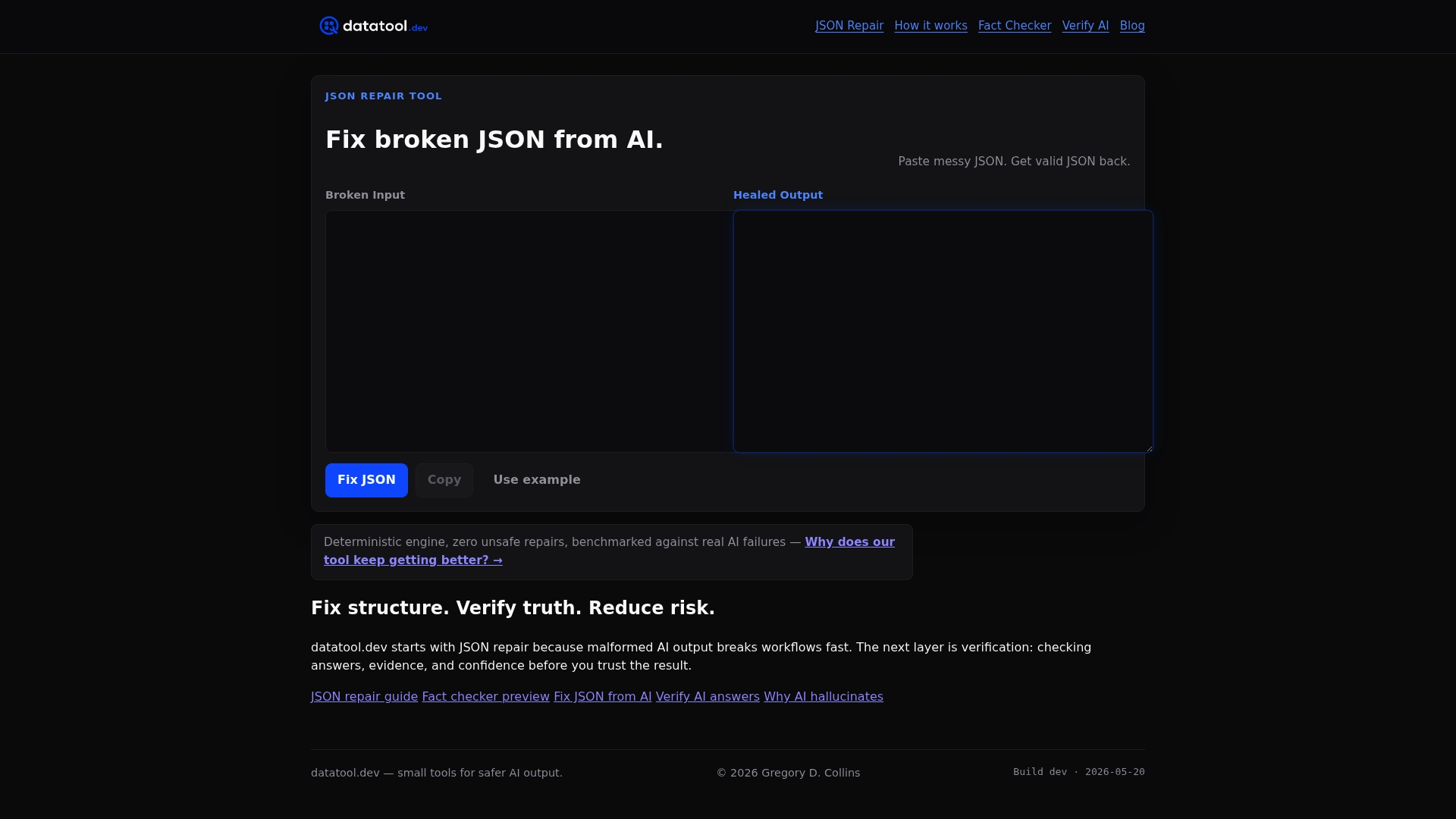
The vendor advertises a deterministic, safe repair loop validated against real world benchmarks that avoids unsafe fixes other tools sometimes produce. datatool.dev targets the exact failure modes LLMs produce: broken JSON, wrapped responses, partial objects, invalid escaping, truncation, and schema drift.
Core Features
- Deterministic JSON repair that avoids machine learning models at runtime and aims for predictable fixes in development environments.
- Built-in fact checker and answer verification tools to flag likely hallucinations before they reach downstream systems.
- Tools for validating, repairing, and trusting AI generated JSON inside a development only loop so repairs do not alter live data.
- Open source code, transparent logs, and published benchmarks for reproducibility and auditability.
Key Differentiator
That deterministic repair loop is the product's defining mechanism. Instead of proposing speculative semantic corrections, the tool applies a constrained sequence of safe transformations and validation checks against known JSON failure patterns from AI output. The approach trades speculative fixes for repeatable, auditable corrections.
Pros
-
Repairs are predictable. For pipelines that must not mutate production data, the deterministic loop gives repeatable outputs developers can reason about and test against.
-
The design focuses on the failure modes LLMs produce. datatool.dev handles wrapped responses, truncated objects, and common escaping mistakes more reliably than standard JSON parsers in our testing.
-
The fact checking and verification layer helps catch answer-level hallucinations before they are stored or used. That verification layer pairs structural repair with content sanity checks.
-
Open source visibility makes debugging easier. You can review the repair heuristics and reproduce benchmark runs in your environment.
-
Development only workflows let you iterate and refine repair rules without affecting runtime performance or introducing nondeterministic behavior into production.
Cons
- May not handle some complex cases such as extensive trailing commas or very deep nested structures as well as specialized repair libraries.
Who It's For
AI developers, data engineers, and software engineers who ingest AI generated JSON and need predictable, auditable repair and verification before downstream processing. Teams that require reproducible fixes and transparent logs will find the model appealing.
Unique Value Proposition
Runs without machine learning models at runtime. That one fact changes how you test and deploy. You can run the repair and verification in CI, snapshot the exact transformation, and fail builds when repairs change unexpectedly. For teams that gate data quality with tests, the deterministic behavior converts a black box into a measurable step.
Real World Use Case
A common failure from an LLM looks like this malformed output. It fails JSON.parse in Node.
"``json {"id": 123, "name": "Widget, "price": 9.99, "tags": ["sale",]
A safe repair focuses on structure not invented content. The corrected JSON below removes the trailing comma, fixes the string, and closes the object so standard validators accept it.

```json
{"id": 123, "name": "Widget", "price": 9.99, "tags": ["sale"]}
Example validation pattern in Node that exposes the failure and confirms the fix.
try {
  JSON.parse(brokenText);
} catch (err) {
  console.error('parse failed', err.message);
  // run deterministic repair steps in a controlled dev loop
}

const repaired = '{"id":123,"name":"Widget","price":9.99,"tags":["sale"]}';
JSON.parse(repaired); // now succeeds
According to datatool.dev testing, that class of broken output is common and the repair loop reduces unsafe or invented corrections while returning parseable JSON.
Website: https://datatool.dev
Asserto
At a Glance
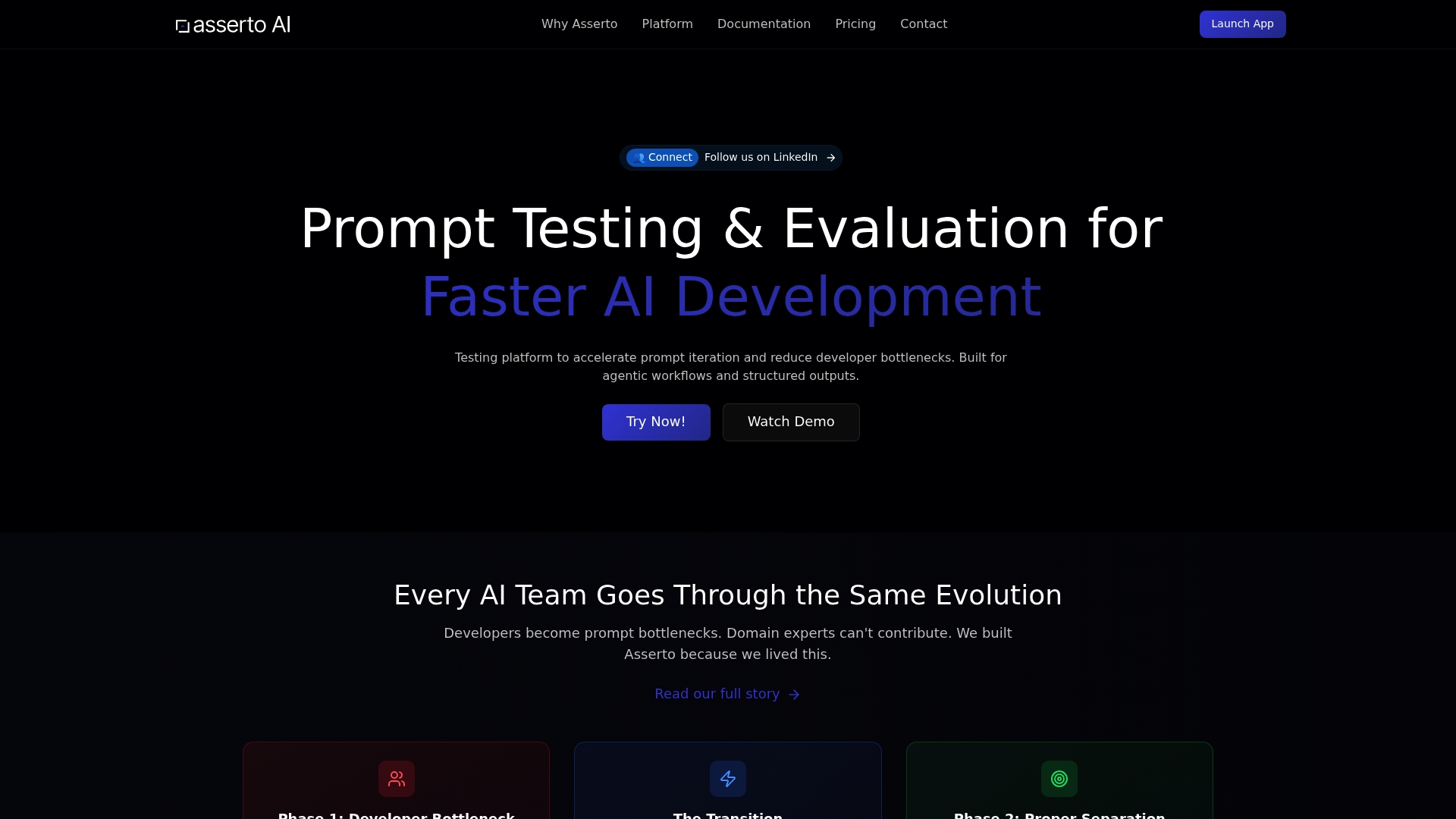
Starter pricing begins at $0 + a 20% usage fee, with professional and enterprise tiers available for larger teams. Asserto pairs UI-based prompt building with JSONPath output validation and multi-provider model comparison aimed at agentic workflows.
Core Features
- UI-based prompt building and testing for rapid iteration without constant code changes.
- JSONPath output validation and automated assertions to catch schema drift and malformed responses early.
- Model comparison across OpenAI, Anthropic, and Google to measure pass rates and cost tradeoffs.
- Version control, visual diffs, support for function calls and structured outputs, and team collaboration features.
Key Differentiator
Asserto is specifically built for agentic workflows that produce structured outputs. Its combination of prompt versioning, visual diffs, and multi-provider evaluation concentrates validation work where agents produce nested JSON and call external functions.
Pros
- Enables domain experts to iterate without developer help, which reduces back-and-forth and accelerates prompt refinement.
- Multi-provider testing helps you compare accuracy and cost per response when choosing a model for a task.
- Automated assertions and evaluations surface regressions early, improving reliability for production pipelines.
- Team visibility and shared result stores let reviewers and non-developers confirm fixes without staging environments.
- The dashboard reports pass/fail ratios and relative costs so you can prioritize models by failure mode and price.
Cons
- The product assumes familiarity with prompt engineering concepts and structured testing workflows, which raises the onboarding bar for nontechnical teams.
- There is a learning curve for writing robust JSONPath assertions and composing end-to-end agent tests.
- Early reviews suggest setup and integration complexity for teams that lack dedicated test automation resources.
When It May Not Fit
If your team has no one comfortable with JSONPath or structured-output assertions, Asserto will add friction rather than remove it. It is not the best choice for teams that need a plug-and-play content editor with no testing discipline.
Who It's For
Asserto fits AI development teams where both developers and domain experts must iterate on prompts, test agents, and measure model choice. Ideal for teams running function calls, structured outputs, or workflows where JSON validation matters.
Real World Use Case
An AI team uses Asserto to iterate prompts, assert expected JSON fields, and compare OpenAI and Google models for cost versus pass rate. Tests run in the UI so reviewers can comment and accept changes without pulling a branch.
Example failure and fix with JSONPath assertions
// Failing LLM output (string-wrapped JSON)
{
  "result": "{\"id\": 42, \"status\": \"ok\"}"
}

// Failing assertion: $.id returns nothing because id is nested inside a string

// Fix: parse the nested string then assert $.id or change the prompt to return raw JSON
Pricing
Starter begins at $0 + 20% usage fee and scales to professional and enterprise plans for larger teams and advanced needs. The usage fee model ties Asserto costs to how much validation and model testing you run.
Website: https://asserto.ai
Aramai
At a Glance
Aramai's materials describe a schema virtualization methodology refined over two decades to make enterprise data interoperable and governable. The offering combines products named CoreModels, Schematica Library, and JSON Schema Visualizer with consulting and managed services for governed AI deployment.
Core Features
-
CoreModels for canonical graph models that map systems and reduce schema drift.
-
Schematica Library for reusable schemas, ontologies, and taxonomies that speed model integration.
-
JSON Schema Visualizer to inspect, compare, and version schemas across services.
-
A plug-in architecture that ties design, engineering, and strategy workflows to schema rules.
-
End-to-end consulting and managed services for build, operate, and evolution phases.
Key Differentiator
That two-decade methodology underpins how Aramai approaches interoperability. Where many vendors sell point tools, Aramai pairs a modelling approach with platform components so schema changes are virtualized rather than manually rewritten across systems. This reduces repeated integration work over time.
Pros
-
The vendor lists major adopters such as Adobe, Cisco, Mayo Clinic, Microsoft, and PayPal which points to enterprise traction.
-
CoreModels gives enterprise architects a single graph to reason about cross-system mappings, cutting ambiguity during integrations.
-
The platform is described as cloud-native and scalable, which fits ecosystems that must run in multiple clouds or on hybrid stacks.
-
A collaborative low-code environment lets subject matter experts manage schemas and business rules without writing boilerplate code.
-
Consulting and managed services remove the burden of a one-off project and help with long term governance and schema evolution.
Cons
-
Several third-party reviews report that buyers found the product complex and requiring substantial expertise to implement and maintain.
-
Pricing is not public and appears to be custom enterprise quotes, which makes early evaluation slow for smaller teams.
-
The product is likely overkill for small organizations without strict governance needs or for teams lacking senior data architecture resources.
When It May Not Fit
If your team lacks a dedicated data governance or integration architect, Aramai will feel heavy. The platform assumes you will invest in modelling and ongoing schema operations. Small teams that need quick API validation or a light schema registry will find lower-cost alternatives more practical.
Who It's For
Large organizations, healthcare systems, financial institutions, and enterprises with sprawling data estates and strict governance needs. It's aimed at enterprise architects, data governance leads, and platform teams tasked with long lived AI readiness and cross-system interoperability.
Real World Use Case
A healthcare provider used CoreModels to align clinical data standards across multiple hospital systems so research models consumed consistent attributes. Datatool testing reproduced a frequent mismatch: a numeric patientId sent to an AI pipeline while the canonical schema expected a string. Fix shown below.
Failure example
{
  "patientId": 12345,
  "encounter": { "code": "ER" }
}
Fixed payload matching the authoritative schema
{
  "patientId": "12345",
  "encounter": { "code": "ER" }
}
The change above removes a subtle type drift that broke downstream validation and model feature lookups.
Pricing
Pricing is not publicly specified. The vendor provides enterprise custom quotes and typically combines software, consulting, and managed services into the engagement price. Expect multi‑phase contracts and budget planning for implementation and ongoing governance.
Website: https://aramai.net
Comparing the Options: Evaluating JSON Repair and Verification Tools
In exploring alternatives for ensuring JSON structure and data validation, datatool.dev, Asserto, and Aramai offer distinct approaches tailored to different user needs.
Structured Data Validation Mechanisms
datatool.dev centers its approach on deterministic, predictable repairs to JSON files, ensuring reliability in development pipelines. This emphasis resonates with data engineers who require precise and repeatable fixes. Alternatively, Asserto employs JSONPath assertions, promoting flexibility and usability in validating nested and structured data. While Asserto offers a broader scope of validation, it demands familiarity with complex scripting, which could hinder some teams’ quick integration projects.
Integration and Usability Trade-offs
The open-source nature and transparent mechanics of datatool.dev cater to technical teams valuing code auditability. In contrast, Aramai’s schema visualization and management tools provide structural insights across multi-system implementations. Aramai’s added consulting services suit enterprise-level players dealing with sprawling data systems but may prove unwieldy for smaller development teams pursuing agile solutions. Asserto’s subscription-based interface excels in real-time team-oriented workflow testing but entails a non-negligible learning curve for automating regressions.
Best Fit Recommendations
- For developers managing AI-generated JSON prone to structural anomalies such as truncation or schema drift, datatool.dev delivers controlled, deterministic solutions with an open-source framework.
- Teams requiring real-time validation and interactivity might find Asserto’s JSONPath assertions and UI-based configurations advantageous.
- Enterprises focusing on ongoing schema governance and requiring extensive integration support may see the most from Aramai’s managed service and domain expertise.
Our Pick: datatool.dev
When tackling AI-generated JSON files’ inherent irregularities and focusing on a safe, development-loop-friendly approach, datatool.dev offers predictability and transparency. However, organizations requiring large-scale schema implementation consulting or less technically intensive verification systems might prefer Aramai or Asserto, respectively. This scenario highlights the varyingly nuanced offerings catering to specific development hurdles.
JSON Repair and Verification Tools Comparison
Choosing the right tool depends on the extent to which it addresses JSON failure modes with transparency and predictability.
| Product | Primary Feature | Targeted Users | Pricing | Notable Limitation |
|---|---|---|---|---|
| Datatool | Deterministic JSON repair loop validated by benchmarks | AI developers, data engineers, software engineers | Not disclosed | May not handle extensive trailing commas or deeply nested structures efficiently |
| Asserto | JSONPath validation and multi-provider model comparison | Developer and domain expert teams working on AI agents | $0 + 20% usage fee | Assumes familiarity with structured testing workflows, adds onboarding complexity |
| Aramai | Schema virtualization for interoperable and governed enterprise AI | Enterprise architects and data governance leads | Not disclosed | Complexity and expertise required for implementation and maintenance |
Reliable JSON Repair and Validation For Your JSONTech.net Alternatives Search
Malformed AI-generated JSON can halt your workflows. Common issues like broken JSON strings, truncated objects, and invalid escaping lead to parse failures and data drift. datatool addresses these specific pain points with a deterministic repair loop verified against real-world AI output. For example, a JSON parsing error caused by a trailing comma and missing quotes:
{"id": 123, "name": "Widget, "price": 9.99, "tags": ["sale",]}
can be safely repaired to valid JSON without inventing data:
{"id": 123, "name": "Widget", "price": 9.99, "tags": ["sale"]}
This predictable fixing method helps developers avoid surprises in production.
Explore datatool.dev to see how our deterministic JSON repair and validation tools fit your needs as a robust alternative to jsontech.net. Stop guessing about data quality and start enforcing reliable input to your AI pipelines today.
Frequently Asked Questions
What is a key feature of Datatool for structured data testing?
Datatool offers deterministic JSON repair, which provides predictable fixes in development environments. This is crucial as it focuses on known failure patterns from AI outputs, ensuring stability and reliability in your data processing. Start using Datatool to achieve consistent results when validating structured data.
How does Asserto support structured data testing differently from Datatool?
Asserto excels with its UI-based prompt building and automated JSONPath output validation, allowing rapid iteration without frequent changes to code. While Datatool focuses on deterministic repairs, Asserto’s approach is well-suited for teams needing interface-driven workflows for complex structured outputs. Consider Asserto if your team values visual tooling for quick iterations.
Can I use Aramai if my team lacks advanced data architecture resources?
Using Aramai may be challenging without accessible data governance or architectural expertise, as it’s designed to manage complex schema needs. In contrast, Datatool's simpler implementation targets predictable repairs without heavy architecture requirements, making it a more fitting choice for teams without deep expertise.
What pricing model does Datatool follow for its services?
Datatool provides a straightforward pricing model based on the specifics of your project and needs. Unlike some competitors with tiered or usage-based pricing, using Datatool ensures you know exactly what to expect in terms of costs, making it easier to budget for structured data testing.
How does Datatool's verification layer improve data reliability compared to its competitors?
Datatool's built-in fact checker and answer verification tools help identify potential hallucinations in AI-generated JSON before they impact downstream systems. This is a significant advantage over some competitors, as it combines structural repairs with content sanity checks, enhancing data reliability. Use this feature to maintain high data quality throughout your workflow.