

AI schema inconsistency happens when the schema your model was trained or prompted against no longer matches the data it receives at runtime. The three root causes are schema drift (the underlying service changes while the schema document stays frozen), provider-level interpretation differences (OpenAI's strict mode, Anthropic's tool-use path, and Pydantic validators each enforce the same JSON Schema differently), and semantic contract mismatches (a field keeps its name but its meaning shifts, like transaction_amount moving from cents to dollars with no alert). All three cause the same downstream result: your model produces outputs that are structurally valid but logically wrong.
The industry term for the accumulating version of this problem is schema entropy, and research shows it accounts for roughly 60% of production AI agent failures, most of them silent. No stack trace. No 500 error. Just wrong answers delivered with full confidence.

Here is a minimal example of the structural bug that breaks every call without any obvious error:
{
  "type": "object",
  "properties": {
    "to": { "type": "string" },
    "subject": { "type": "string" }
  },
  "required": ["recipient", "subject"]
}
The required array names "recipient", but properties defines "to". The schema is valid JSON. The model sees a mandatory field it has no slot to fill, so every generated call comes out malformed. This is one of the most common structural bugs Datatool testing surfaces in production tool definitions.
Schema definitions are living contracts, not static documents. Continuous validation against runtime reality is the only way to prevent silent logical failures that look like model errors but are actually data contract violations.
Pro Tip: Run a quick audit: for every name in your required array, confirm it exists verbatim in properties. This single check catches the silent killer that breaks every call in production.

How schema inconsistency breaks your AI models
Schema inconsistency does not just produce malformed JSON. It produces a spectrum of failures, and the most dangerous ones produce no error at all.
A controlled study on schema-first tool APIs identified three distinct failure categories. Interface misuse covers structurally malformed calls: wrong types, missing required fields, hallucinated parameter names. These are the failures a well-enforced schema prevents. Execution failures are calls that are well-formed but trigger runtime preconditions the agent did not know about. Semantic misuse is the worst category: the call is schema-valid, the structure is correct, but the values are logically wrong for the task.
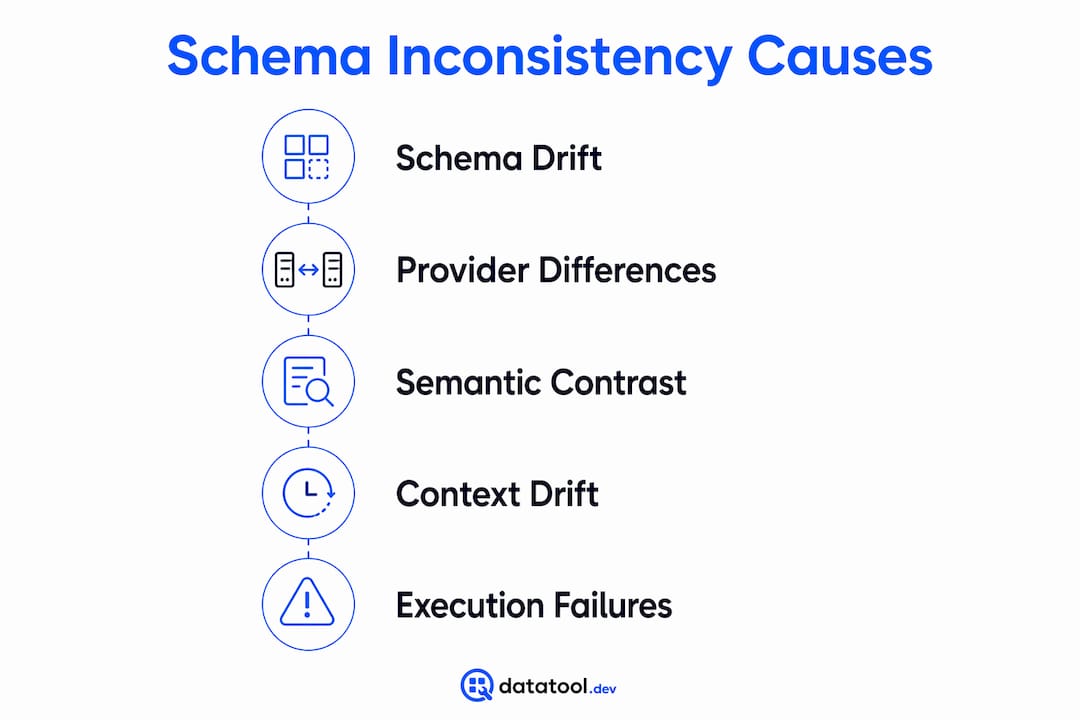
Schema entropy primarily causes execution failures and semantic misuse. Your tool definition can be syntactically correct and still point the model toward the wrong behavior because the meaning of the schema has drifted from the behavior of the service.
The cascade gets worse in multi-agent pipelines. If Agent A misinterprets a renamed column, it passes plausible but incorrect data to Agent B, which summarizes the wrong information, which Agent C uses to make a recommendation. The error does not amplify in magnitude. It amplifies in confidence. By the time a human sees the final output, three agents agreed on it.
Common failure symptoms to watch for:
- HTTP 200 responses that contain
{"status": 200, "data": null}, which agents interpret as "no records" rather than "request failed" - Enum values returned from the API that the agent's tool description never listed, causing silent misclassification
- Fields that used to be required becoming optional in a backend refactor, triggering different backend behavior the agent does not know exists
- A model echoing the JSON Schema definition itself instead of generating a conforming data instance
- Integer fields returning string-of-digits (
"42"instead of42) due to inconsistent coercion across SDK validators
When HTTP success does not mean business success, your agent has no signal that the schema has led it astray.
AI citation systems treat schema errors as active trust signals in the negative direction. A page with no schema is evaluated on content quality alone. A page with invalid schema is flagged as unreliable. The same logic applies inside your pipelines: a model operating on a broken schema contract does not just produce wrong outputs. It produces outputs that look authoritative.
Why static mapping rules cannot keep your schema consistent
Static mapping rules feel like a solution. They are actually a snapshot. The moment the underlying service evolves, the snapshot is wrong, and nothing in your pipeline tells you.
The core problem is that static rules lack continuous enforcement. They validate the schema at write time, not at runtime. When a backend team renames a field, adds an enum value, or changes a parameter from accepting a bare integer to requiring a string-formatted integer, the static rule does not update. The agent keeps calling the old contract with full confidence.
Static mapping also misses semantic changes entirely. A field called transaction_amount that shifts from cents to dollars passes every structural validator. The name is the same. The type is the same. The schema document is unchanged. The agent's reasoning about thresholds is now off by 100x, and no alert fires.
Why static mapping alone leads to gradual schema entropy:
- Renamed fields produce surface drift that validators miss if the old name still parses loosely
- New enum values added by the backend are invisible to an agent whose tool description lists only the original values
- Optional parameters that become required (or vice versa) change backend behavior without changing the schema's structural validity
- Semantic shifts in field meaning (units, timezones, currencies) are undetectable by any schema checker
- Tool definitions live near agent code while the services they describe live in separate repositories, so updates rarely stay synchronized
- Few-shot examples and retrieval corpora are never updated when the schema changes, so the model's dominant context signal stays wrong even after the manifest is corrected
The practical consequence is schema entropy accumulating silently across sprints. Each individual change is small. The cumulative drift is what kills reliability.
How to detect and manage schema drift in AI data pipelines
Schema drift takes three forms: structural (a field is renamed or removed), semantic (the field name stays but its meaning changes), and behavioral (the endpoint accepts the same input but its side effects change). Detection strategies differ for each.
Structural drift is the easiest to catch. A live schema probe calls each tool endpoint with a canned, idempotent input and compares the response envelope against what the manifest promises. Field names, types, required-ness, and nesting all get checked. This catches surface drift the moment it ships.
Semantic drift requires golden input/output pairs. Keep a small set of representative cases per high-stakes tool and replay them nightly against the live endpoint. If the response values drift outside an acceptable delta, alert. This is the only probe that catches a unit change from cents to dollars, and it is the one most teams skip.
Behavioral drift is the hardest. The endpoint accepts the same input and returns the same shape, but its side effects changed. Catching this requires integration tests that verify downstream state, not just response shape.
A practical detection workflow:
- Parse your prompt templates, few-shot examples, and tool definitions to build a manifest of every field name, type, enum value, and semantic constraint the agent depends on.
- Run a live schema probe against each endpoint on every deploy of either the manifest or the endpoint.
- Validate every tool response at runtime through the manifest's declared schema with strict mode on. Log unknown fields, missing fields, and type mismatches with tool name and context.
- Replay golden input/output pairs nightly. Alert on value drift, not just shape drift.
- When a schema change is confirmed, treat it as a full context hygiene event: refresh few-shot examples, rebuild retrieval indexes, re-summarize stored trajectories, and regenerate test prompts.
Pro Tip: Updating the manifest without flushing few-shot examples and retrieval corpora is cosmetic. The model follows the dominant signal in its context window, and that signal is usually the prior turns and examples, not the updated description.
Key validation technologies for this workflow include JSON Schema for structural validation, the Open Cybersecurity Schema Framework (OCSF) for cross-system event normalization, Pydantic for runtime type enforcement in Python pipelines, and contract testing between agent and backend layers to verify assumptions before they cause runtime errors.
Schema drift detection works best when it runs continuously, not just at deployment time. External services change without notice. A payment processor adds a new charge state. A CRM evolves its contact model. Every external tool dependency is a potential drift vector, and you will not get a webhook when their API changes.
Strategies for preventing AI schema inconsistency
Prevention starts at the contract layer. The schema is not documentation. It is the only instruction the model gets about when and how to use a tool. Write it accordingly.
Contract testing between backend and agent layers is the highest-leverage practice. Just as consumer-driven contract tests verify that an API provider still satisfies its consumers' expectations, schema-prompt contract tests verify that a database schema still satisfies the agent's assumptions. Run these on every deploy of either the manifest or the endpoint.
Automated schema validation in CI/CD catches structural bugs before they reach production. A unit test that iterates over every name in the required array and confirms it exists in properties takes ten lines of code and prevents the silent killer described earlier.
Here is a minimal Python validation check using Pydantic:
from pydantic import BaseModel, model_validator
from typing import Any

class ToolSchema(BaseModel):
    properties: dict[str, Any]
    required: list[str]

    @model_validator(mode="after")
    def required_fields_exist(self) -> "ToolSchema":
        missing = [f for f in self.required if f not in self.properties]
        if missing:
            raise ValueError(f"required fields missing from properties: {missing}")
        return self

# This raises immediately on the broken schema from the intro
schema = ToolSchema(
    properties={"to": {"type": "string"}, "subject": {"type": "string"}},
    required=["recipient", "subject"]  # 'recipient' not in properties
)
Running this check in CI catches the mismatch at commit time, not in production at 2 AM.
Do's and don'ts for schema maintenance:
- Do use
enumfor any field with a fixed set of values."priority": {"type": "string"}invites"urgent","P0", and"pretty important tbh". An enum closes that gap before the model can create it. - Do treat description fields as prompt fragments, not comments. Write them for the model: when to call this tool, when not to, and what each argument means.
- Do version your tool descriptions. A one-word edit can redirect agent traffic to the wrong tool, and the model will not tell you it happened.
- Do maintain synthesized examples alongside the schema. When a model echoes the schema definition back instead of generating an instance, adding an explicit example with "return an INSTANCE, not the schema" language in the system prompt fixes it.
- Don't mark fields
requiredthat the model cannot reasonably infer. If a missing field affects money, publishing, deletion, or customer communication, make the agent ask rather than guess. - Don't treat a manifest update as complete until few-shot examples, retrieval corpora, and stored trajectories are also updated.
- Don't add schema markup (or schema constraints) unless you are prepared to maintain them. Partial or stale schema is worse than no schema for AI citation and pipeline reliability alike.
Pro Tip: Treat tool description changes the same way you treat production prompt changes: paired review, behavioral evaluation on a held-out set, version bump, and a deployment log entry. An intern can silently redirect your agent's traffic with a one-line description edit.
Schema enforcement approaches vary by provider and pipeline architecture. The core principle for safe schema evolution is asymmetric: adding is almost always safe, removing is never safe, and changing depends on direction. Adding new optional parameters with documented defaults is safe. Removing or renaming any parameter is a breaking change. Changing the semantic meaning of a parameter without changing its name is the most dangerous change of all, because no validator will catch it.
What Datatool testing reveals about real-world schema failures
Datatool's analysis of production AI pipelines surfaces the same failure patterns repeatedly. Understanding them by name makes them faster to fix.
Provider-level interpretation differences are the first category. OpenAI's strict mode requires every property in properties to also appear in required and rejects schemas that omit additionalProperties: false. Anthropic does not natively accept a json_schema response format at all. You express the contract as a tool's input_schema and force the model to call it. Gemini historically required every array items to declare an explicit type. The same schema, dropped into three providers, takes three different paths through the request pipeline, and the compliance behaviors do not fully overlap.
The integer-versus-string-of-digits problem illustrates this concretely. When the schema says integer, models trained on web-scale text have a persistent tendency to emit "42" instead of 42, especially for fields that feel like identifiers or amounts. Pydantic will silently coerce "32" into 32. A stricter validator will reject it. Your pipeline absorbs the coercion on one route and fails on the other, and the divergence is invisible until you compare outputs side by side.
The schema-echo error is a specific failure worth naming. The model returns the JSON Schema definition itself, verbatim, rather than a data instance that conforms to it. In the raw response, top-level keys like "properties", "type": "object", and "$defs" appear where the schema's actual fields should appear. The fix is to assemble the system prompt with both the schema and a synthesized example instance, plus explicit "return an INSTANCE, not the schema" language. Smaller and older models hit this more often than tool-trained models.
Pro Tip: If the schema-echo error persists after adding an example, the schema is likely too abstract for the auto-derived example to be useful. Override the prompt assembly with a prompt_template that bakes in a real domain example. If the model still does not recover, switch to a tool-trained model.
Common schema entropy failure modes Datatool testing has documented:
requiredarray naming a property absent fromproperties, breaking every generated call silently- Enum fields left as
"type": "string"instead of using"enum", causing the model to invent values like"done-ish"or"urgent" - Two similar tools in the same manifest with thin descriptions, causing the model to mix them up and route queries to the wrong endpoint
- Stale
dateModifiedfields in Article schema, causing AI quality filters to treat recently updated content as outdated - Few-shot examples referencing renamed fields after a schema migration, with the model following the example context over the updated manifest
- Missing
additionalProperties: falseon objects in strict-mode providers, causing unexpected field acceptance
The null-versus-missing problem is a cross-provider trap. A field declared as {"type": ["string", "null"]} can be returned as "field": null or omitted entirely. Both are valid under common interpretations, but they parse differently in downstream code. One yields a key with a None value. The other raises a KeyError. One provider consistently emits explicit nulls. Another consistently omits. Your code that does payload["address"] works for one and crashes for the other, and the schema does not distinguish between them.
Context-window drift compounds all of these. After a schema update, the retrieval corpus, few-shot examples, and stored conversation summaries all still reference the old field names. The model follows the dominant signal in its context window, which is usually the accumulated prior turns and examples, not the updated description. Any schema change requires full re-indexing of retrieval corpora and clearing of conversational context to avoid agent confusion.
For developers dealing with malformed AI responses from these failure modes, the repair workflow matters as much as the prevention workflow.
Schema governance in practice: pipeline examples
Good schema governance is a process, not a one-time setup. Here is what it looks like across a real multi-agent pipeline.
Before governance: A backend team renames last_login_date to last_activity_ts and expands its semantics to include API calls. No service breaks. Tests pass. The AI agent answering customer questions about user engagement silently starts generating wrong answers. No error, no alert, no stack trace. The agent confidently reasons over a world that no longer exists.
After governance: The same rename triggers a contract test suite that runs against the live backend on every deploy. The suite parses the agent's prompt templates, few-shot examples, and tool definitions to build a manifest of every column name, type, enum value, and semantic constraint the agent depends on. The rename produces an immediate alert. The team updates the manifest, refreshes the few-shot examples, rebuilds the retrieval index, and re-summarizes stored trajectories before the agent goes back into production.
A practical governance flow for a multi-agent pipeline:
- Define the contract. For each tool, document every field name, type, enum value, and semantic constraint the agent depends on. This is the agent's world model. Version it.
- Run live schema probes on every deploy. Call each endpoint with a canned input and compare the response envelope against the manifest. Log any divergence immediately.
- Validate responses at runtime. Parse every tool response through the declared schema with strict mode on. Unknown fields and type mismatches get logged with tool name and context.
- Sync all context layers on schema changes. Manifest updates, few-shot example refreshes, retrieval index rebuilds, and trajectory re-summarization happen together, not separately.
- Review description changes like code. A tool description is a prompt fragment. Treat pull requests that modify descriptions the same way you treat production prompt changes.
- Audit external dependencies on a schedule. Third-party APIs change without notice. A monthly probe of external tool endpoints catches drift before it accumulates into a reliability problem.
Pro Tip: Most backend teams have no idea their endpoint is consumed by an agent. When you add an agent dependency on an internal service, tell that team explicitly. A routine refactor that renames an internal field can silently break a contract nobody told them existed.
The data contract between agent and backend is never written down by default. It lives scattered across prompt templates, example banks, retrieval indices, and tool schemas. Making it explicit, versioned, and tested is the single change that most reduces silent schema failures in production.
For teams building on JSON Schema and OCSF, the governance principles are the same. OCSF provides a normalized event schema across security tools and data sources, which means schema drift in one contributing system can silently corrupt cross-system analysis. The same contract-testing approach applies: define the expected shape, probe it continuously, and treat any divergence as a deployment blocker.
Unit testing AI-generated data at the schema layer is the practical implementation of all of this. Tests that iterate over required fields, validate enum constraints, and compare response shapes against the manifest catch the majority of schema entropy failures before they reach users.
Key Takeaways
Schema inconsistency in AI systems is caused by schema drift, provider-level enforcement differences, and semantic contract mismatches, and the majority of resulting failures are silent, producing wrong outputs with no error signal.
| Point | Details |
|---|---|
| Schema entropy is the primary cause | A significant portion of production AI agent failures trace to schema drift between tool definitions and live backend behavior. |
| Static rules miss semantic changes | A field that keeps its name but changes its meaning (e.g., cents to dollars) passes every structural validator and fails silently. |
| Provider enforcement diverges | OpenAI strict mode, Anthropic tool-use, and Pydantic each enforce the same JSON Schema differently, causing cross-provider output mismatches. |
| Context hygiene is required after updates | Updating the manifest without refreshing few-shot examples and retrieval corpora is cosmetic; the model follows the dominant context signal. |
| Contract testing is the fix | Running schema-prompt contract tests against the live backend on every deploy catches drift before it causes runtime failures. |