

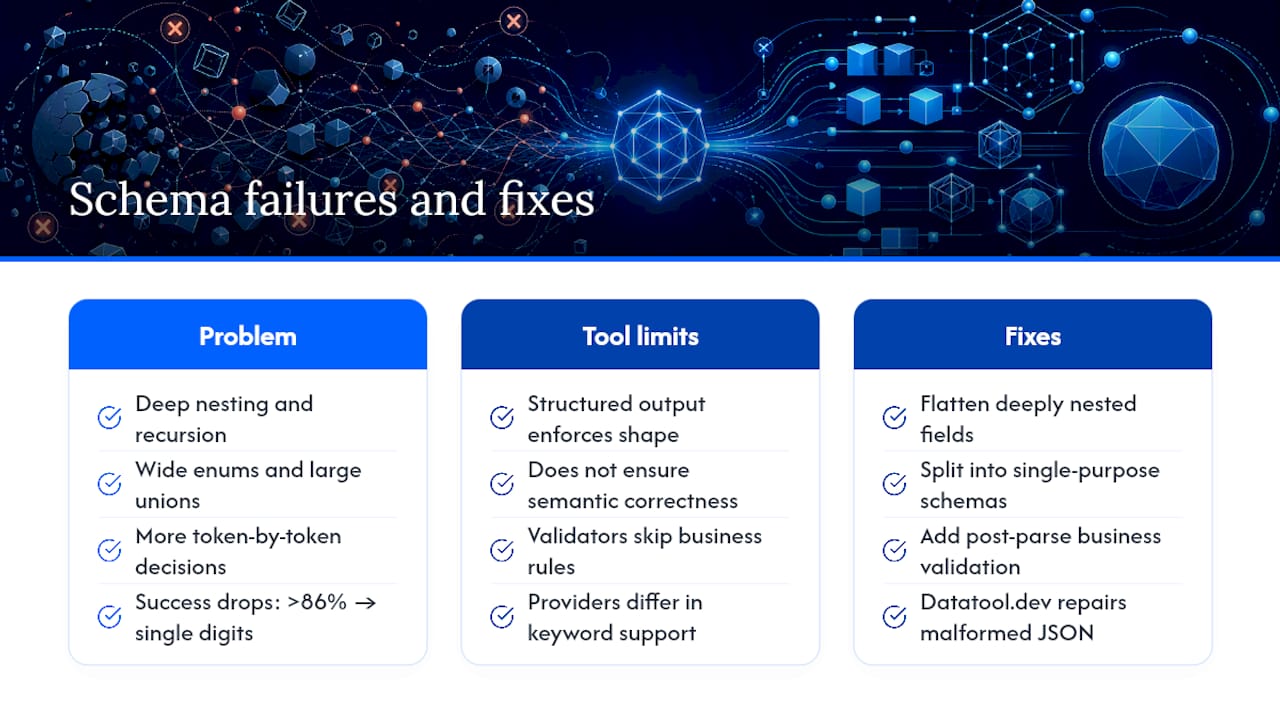
AI models fail on complex JSON Schemas for three reasons: token-by-token generation can't hold long-range constraints in view, providers implement incompatible subsets of the spec, and even perfect syntax says nothing about whether the data is correct. That last gap is the one most teams miss. Schema-valid output can still be wrong.
Here are three fixes you can apply today, before you read another paragraph of explanation:
- Flatten or split the schema. Break large, deeply nested objects into smaller, single-purpose schemas. A model asked to fill one flat object with 12 fields will beat a model asked to fill a nested tree with the same 12 fields, every time.
- Turn on provider strict mode where it exists. OpenAI's structured outputs and comparable features in Gemini narrow the model's decoding space so it can't emit syntactically invalid JSON. This fixes parsing. It does not fix meaning.
- Add a second validation pass after parsing. Structural validation (does this match the schema?) and semantic validation (does this make sense?) are different jobs. Run both, in that order, every time.
Should you trust schema enforcement alone? No. Constrained decoding and strict mode reduce syntax errors, but structured output modes solve parsing, not semantic sanity. A negative invoice total or a future-dated birth date will sail through a schema check every time. Treat schema compliance as the floor, not the finish line.
| Fix | What it solves | What it doesn't solve |
|---|---|---|
| Flatten/split schema | Reduces decoding errors and truncation | Cross-field logic, business rules |
| Provider strict mode | Guarantees parseable, schema-shaped JSON | Semantic correctness |
| Post-parse validation layer | Catches invalid values, bad ranges, wrong relationships | Nothing, if you skip it |
Key Takeaways
AI fails complex JSON Schemas because token-by-token generation can't enforce long-range structure reliably, providers implement incompatible schema subsets, and no provider validates semantic correctness at all.
| Point | Details |
|---|---|
| Flatten before you prompt | Deep nesting past three levels is where field omission and reliability problems concentrate most. |
| Strict mode is a floor, not a guarantee | Provider structured-output features fix syntax but never check whether the data makes sense. |
| Run two validation layers | Check schema structure first, then run explicit semantic assertions for business logic. |
| Test per provider, not per schema | Provider dialect gaps mean a schema that passes on one provider can silently fail on another. |
| Use Datatool.dev for repair and validation | Datatool.dev deterministically repairs malformed JSON and runs structural plus semantic checks before data reaches your system. |
Table of Contents
- Why AI Fails Complex JSON Schemas in Production
- Root Causes: Why Complex Schemas Break Model Output
- What Constrained Decoding and Strict Mode Actually Guarantee
- Benchmarks: How Failure Rate Scales With Schema Complexity
- Practical Fixes That Actually Raise Reliability
- A Real Failure and the Fix: Debugging Workflow With Code
- Metrics and Tests That Catch Schema Drift Before Users Do
- Validators and Tooling That Belong in Your Pipeline
- What Datatool.dev's Testing Found Across Providers
- What I'd Change in Production This Sprint
- When Datatool.dev Is the Faster Path to Reliable Output
- Frequently Asked Questions
- Sources
Why AI Fails Complex JSON Schemas in Production
Schema failures rarely show up as a clean exception with a helpful stack trace. They show up as a support ticket three weeks later because a downstream report had negative revenue in it. Recognizing the actual failure modes is the first skill worth building.
The most common symptoms, in order of how often engineering teams report them:
- Truncated JSON. The model runs out of tokens mid-object and the response cuts off with an unclosed bracket.
- Parse errors from JS-flavored syntax. Trailing commas, single-quoted strings, unquoted keys. Models trained heavily on code repeat JavaScript object literal habits even when asked for strict JSON, a pattern documented in detail by UnblockDevs.
- Missing required fields. The schema says
required, the model disagrees. - Type coercion drift. A field defined as an integer comes back as
"42"(string) or42.0(float). - Enum case mismatches. Your enum says
"ACTIVE", the model returns"active"or"Active". - Valid-but-wrong semantics. The JSON is perfectly schema-compliant and completely nonsensical: a negative total, a discount above 100%, an end date before the start date.
If you want to find these in your own logs today, search for JSONDecodeError, Unexpected token, is not valid under any of the given schemas, or simply count how often a field you marked as required is absent in raw responses.
The dangerous category is the last one. Under-constrained outputs parse cleanly and pass schema validation, then silently corrupt your data over weeks. Structured-output failures on high-volume pipelines are frequently silent rather than loud, which is exactly why they go undetected until someone downstream notices the numbers don't add up.
Pro Tip: *Log every coerced value, not just every error.
On complex, deeply nested "GitHub-Hard" schemas, some constrained-decoding engines drop to single-digit success rates, as low as 3%, even though the same engines score above 86% on simple schemas. That is not a rounding error. That's the difference between a pipeline you can trust and one you can't.
Root Causes: Why Complex Schemas Break Model Output
Symptoms tell you something broke. Root causes tell you what to fix. Four mechanisms account for almost every structured-output failure engineers report.
- Token-by-token generation fights schema complexity. A model writes JSON one token at a time, left to right, with no ability to revise earlier tokens. Deep nesting, recursive
$refchains, and long-range constraints (like "field B must be greater than field A, which appears 40 tokens earlier") are exactly the kind of thing this generation process handles worst. - Schema complexity itself is the biggest lever. Depth and nesting, recursive references, wide enums, large
anyOf/oneOfunions, regex patterns, and long arrays each add decision points the model can get wrong. Stack enough of these and error compounds instead of adding. - Provider dialect gaps cause silent divergence. JSON Schema is the closest thing AI has to a common structural language, but no provider implements the full spec identically. One provider treats
additionalProperties: falsestrictly; another ignores it. One defaults undeclared fields to required; another treats them as optional. Route the same schema to two providers and you get two different contracts. - Training data blurs JSON with JavaScript. Models learn from code repositories where object literals routinely use trailing commas, single quotes, and Python-style
True/False/None. That habit leaks into JSON output even when the prompt explicitly asks for strict JSON.
Each cause maps to a specific symptom, and that mapping is what lets you pick the right fix instead of guessing:
- Deep nesting and recursion → truncation and missing nested fields.
- Wide enums and unions → wrong-value and case-mismatch symptoms.
- Provider dialect gaps → inconsistent behavior across your fallback chain, invisible until you switch providers.
- Training data confusion → parse errors from trailing commas, single quotes, unquoted keys.
What Constrained Decoding and Strict Mode Actually Guarantee
Constrained decoding restricts the model's token choices at each generation step so the output can only take a shape that's syntactically legal, sometimes schema-legal. Providers ship this under different names. OpenAI calls it structured outputs with strict mode. Google's Gemini offers structured output configuration. Anthropic's models support tool-use schemas that constrain function-call arguments. None of these guarantee your data is correct. All of them guarantee your data is parseable, or close to it.
That distinction matters for what you build next. Here's what each layer actually covers:
- JSON mode (loose): Guarantees the output is valid JSON. Says nothing about matching your schema.
- Strict mode / structured outputs: Guarantees the output matches your schema's structure, types, and required fields, within the subset of JSON Schema keywords the provider supports.
- Semantic correctness: Guaranteed by nothing on the provider side. This is entirely your responsibility.
Provider gaps you'll hit in practice: incomplete support for oneOf and anyOf, inconsistent handling of required versus optional defaults, silent coercion of types instead of rejection, and occasional refusal objects returned in place of your expected schema. JSON mode functions as a dialect rather than a shared standard, which means a fallback router that swaps providers mid-request can break silently if you assumed identical behavior.
Constrained decoding helps most on medium-complexity schemas where the model would otherwise wander. It introduces new failure modes on the extremes: added latency from grammar compilation, occasional outright refusals on schemas the provider can't compile, and caching quirks where a schema change doesn't invalidate a cached compilation the way you'd expect.
Pro Tip: Never assume strict mode behaves the same across providers, even for the identical schema. Run the same test payload through every provider in your fallback chain quarterly and diff the results.
Benchmarks: How Failure Rate Scales With Schema Complexity
The numbers are not subtle. On simple, shallow schemas, constrained-decoding frameworks routinely score above 86%. Push the same frameworks to complex, real-world schemas pulled from public repositories (researchers call this the "GitHub-Hard" tier) and success rates for some engines collapse to between 3% and 41%, depending on which decoding engine you use.
| Schema complexity tier | Typical success rate | What drives the drop |
|---|---|---|
| Simple (flat, few fields) | Above 86% | Minimal nesting, few decision points |
| Nested (2-3 levels, some enums) | Moderate, engine-dependent | Compounding constraint errors |
| Recursive / GitHub-Hard (deep, real-world) | As low as 3% to 41% | Deep $ref chains, wide unions, long arrays |
A separate line of research attacks the problem from the other direction: instead of asking how much a complex schema hurts the model, it asks how much simplifying the schema helps. Projecting a JSON response down to only the fields the task actually needs (researchers call this "oracle projection") cut response size roughly 12x and produced accuracy gains of 8 to 38 points depending on the model tested.
That's not a marginal optimization. It's the single highest-leverage change you can make to a schema without touching your provider or your prompt. If your schema handles a 40-field object and the task only needs 8 of them, you are paying an accuracy tax for the other 32 on every single call.
Practical Fixes That Actually Raise Reliability
Design decisions you make before the first API call matter more than any prompt tweak you make afterward; for example, considering a storage website built for AI search is crucial for handling durable, validated data pipelines. Here's what consistently moves the needle:
- Flatten nested structures wherever the domain allows it. A flat object with prefixed field names (
shipping_city,billing_city) often outperforms a nested object with twocityfields, because the model has fewer structural decisions to make per field. - Split large tool schemas into focused, single-purpose ones. A mega-schema with a discriminator field that switches between eight modes forces the model to reason about which mode applies before it even fills in a value. Small, single-purpose schemas cut that decision burden and shrink the failure surface accordingly.
- Avoid deep recursion and large
anyOf/oneOfunions. If you must support a union type, consider whether two separate calls with two separate flat schemas beat one call with a union. - Run two-layer validation on every response. Layer one checks structure with a schema validator. Layer two checks semantics: is the total positive, is the end date after the start date, does the enum value exist in your business logic, not just your schema.
- Add a normalization layer between the provider and your application code. This is where you log every coercion, every unexpected null, every field that arrived as the wrong type before you silently accept it.
- Write contract tests per provider, not per schema. A schema that passes on one provider is not proof it passes on another. Provider dialect differences are common enough that this needs to be a scheduled test, not a one-time check.
- Pre-warm or compile schemas where the provider supports it. Some constrained-decoding engines cache the grammar compiled from your schema; calling the same schema shape repeatedly amortizes that cost.
Pro Tip: To cut nesting without losing expressiveness, pull deeply nested optional sub-objects into flat, prefixed fields and only nest the parts of the schema that are genuinely one-to-many (arrays of line items, for example). One-to-one nested objects almost never need to stay nested.
For deeper technique on handling optional fields across nested structures, validating nested JSON responses reliably is worth a closer read once you've applied the basics above.
A Real Failure and the Fix: Debugging Workflow With Code
Here's the repeatable workflow, then a real example.
- Reproduce the failure with a minimal prompt. Strip everything except the schema and the input that triggers the bug.
- Isolate the schema subset that causes it. Remove fields one at a time until the failure disappears. The last field you removed is usually your culprit.
- Toggle constrained decoding or strict mode on and off. Compare the two outputs directly. If strict mode fixes syntax but the semantic bug remains, you've confirmed it's a semantic issue, not a parsing one.
- Run the output through a schema validator. Confirm exactly which keyword or constraint fails, don't guess.
- Add explicit semantic assertions and re-test. Structural validity and business logic are separate checks; write them separately.
Here's what this looks like with a real schema. Say you're extracting invoice data and your schema requires a total field as a positive number and a line_items array.
The prompt asks the model to extract an invoice total and line items from a scanned receipt with a discount applied.
The broken output looks like this:
{
  "total": -12.50,
  "line_items": [
    {"description": "Widget", "amount": 45.00},
    {"description": "Discount", "amount": -57.50}
  ]
}
This parses fine. It validates against a naive schema fine, because total is a number and the schema never said it had to be positive. The bug is semantic: a negative total on an invoice is almost always wrong, even though nothing in the JSON Schema layer catches it.
The fix is two parts. First, tighten the schema itself with a minimum constraint where the domain allows it:
"total": {
  "type": "number",
  "minimum": 0
}
Second, and more importantly, add a post-parse semantic assertion that a schema can't express on its own, because the real rule is "sum of line items should reconcile with total," which is a cross-field check:

def validate_invoice(data):
    computed = sum(item["amount"] for item in data["line_items"])
    if abs(computed - data["total"]) > 0.01:
        raise ValueError(f"Total {data['total']} does not match line items sum {computed}")
    return data
Running the broken output through this function raises immediately instead of shipping bad data downstream. That's the two-layer pattern in practice: schema constraint catches the obviously wrong shape, application-level assertion catches the logically wrong value. For a deeper set of validation patterns, how to validate AI-generated structured data walks through more assertion examples.
The single biggest mistake engineering teams make with structured output is assuming that "it validated against the schema" means "it's correct." Those are two different claims, and only one of them is checked by default.
On instrumentation: log the raw model output, the parsed object, the validation result, and any coerced fields, for every request, even successful ones. Sample at least a few hundred requests before drawing conclusions about a failure rate. A one-day sample on a low-volume endpoint will lie to you about your real error rate.
Metrics and Tests That Catch Schema Drift Before Users Do
You can't fix what you don't measure, and schema compliance is measurable in ways most teams don't bother tracking until something breaks in production.
Track these metrics continuously, not just during incidents:
- Field-presence rate per field, not just per response. A field that's present 98% of the time is a slow leak, not a crash.
- Parse-success rate, separated from schema-validation-success rate. These are different failure points and conflating them hides where the problem actually is.
- Semantic-assertion pass rate, tracked separately from schema validation.
- Enum-match rate, specifically case-sensitive matches against your canonical enum values.
- Downstream-invariant violation rate, meaning how often your business logic assertions fail after schema validation already passed.
| Metric | What it catches | Alert threshold guidance |
|---|---|---|
| Parse-success rate | Truncation, syntax errors | Alert on any drop below your historical baseline |
| Field-presence rate | Silent omission of optional-but-expected fields | Track per-field, not aggregate |
| Semantic-assertion pass rate | Valid-but-wrong data (negative totals, bad dates) | Alert on any sustained drop |
| Enum-match rate | Case mismatches, invalid enum values | Alert on first occurrence of an unrecognized value |
Test strategy should mix three approaches: contract tests per provider run on every deploy, scheduled provider-drift tests that run the same golden-set payloads weekly against each provider you use, and synthetic edge-case sampling that deliberately probes deep nesting, boundary values, and unusual enum inputs. Add shadow runs on your fallback provider even when it's not serving live traffic, so drift shows up before a failover event forces you to discover it live. For a structured approach to catching drift specifically, see detecting schema drift in AI output.
Validators and Tooling That Belong in Your Pipeline
Pick the right validator for the layer it's checking, and don't ask one tool to do both jobs.
For structural validation, the ecosystem has mature, boring, reliable options. Python teams reach for Pydantic or the jsonschema library. TypeScript and JavaScript teams reach for Zod. Each of these enforces types, required fields, and constraint keywords, exactly the structural layer, without trying to reason about your business logic.
For the semantic layer, there's no equivalent off-the-shelf library, because your business rules are yours. This is where you write explicit assertion functions, the kind shown in the invoice example above, and where a normalization layer earns its keep by centralizing every coercion decision in one place instead of scattering try/except blocks through your codebase.
On provider features, prefer server-side structured-output support wherever your provider offers it: OpenAI's strict mode, Gemini's structured output configuration, Anthropic's constrained tool-use schemas. Where provider support is incomplete for a keyword you need (a complex oneOf, a regex pattern, a recursive $ref), don't fight the provider. Simplify the schema for that call and enforce the missing constraint in your own validation layer instead.
A reliable stack pattern looks like this, in order: provider strict mode compiles the schema and constrains generation, a structural validator (jsonschema, Pydantic, Zod) checks the parsed response, a normalization layer logs and corrects known coercions, and a semantic assertion layer checks cross-field business logic before the data reaches your database. Skipping any one of these four steps is where silent corruption creeps back in. A deeper walkthrough of where each validator fits lives in JSON validators in AI pipelines.
What Datatool.dev's Testing Found Across Providers
Datatool.dev runs repeated tests against real, messy model output, not synthetic edge cases designed to be easy to catch. The pattern that shows up most consistently across schema shapes and provider modes: field omission climbs sharply once a schema passes roughly three levels of nesting, and type coercion (numbers returned as strings, booleans returned as "true"/"false" text) is the single most common silent failure, more common than outright parse errors.
The fixes that reliably recovered structured output in that testing were not exotic. A normalization layer placed directly after the provider response, before any application code touches the data, caught the overwhelming majority of coercion issues before they reached the database. Generating provider-specific schema variants at call time, rather than reusing one canonical schema across every provider, eliminated most of the dialect-driven failures described earlier. Scheduled contract tests, run weekly against a fixed golden set of payloads, caught provider drift before it reached production traffic on every occasion it was tested.
Field omission on deeply nested schemas isn't random. It clusters at the third and fourth level of nesting almost every time we've tested it, which tells you the fix is architectural, not incremental.
Pro Tip: If you're debugging a schema that fails intermittently, check nesting depth before you check anything else. Three levels deep is roughly where reliability starts dropping in practice.
Gregory D. Collins leads this research at Datatool.dev, focused on reproducing real-world AI structured-output failures and building deterministic repair patterns around them, including the contract-ownership approach referenced above.
What I'd Change in Production This Sprint
If you're running a schema-driven pipeline right now, here's my prioritized list for the next sprint, not the roadmap six months out.
First: audit your schemas for nesting depth. Anything past three levels is a candidate for flattening this week, not eventually. This is the single highest-leverage change available to most teams, and it costs nothing but engineering time.
Second: stop trusting provider strict mode as your only validation layer. It's a genuinely useful floor. It is not a ceiling. If you don't have a post-parse semantic check running today, that's the gap most likely to be silently corrupting your data right now.
Third: rely on provider strict mode for syntax, and build your own semantic and cross-field validation for meaning. That split isn't a compromise, it's the correct architecture. Don't wait for a provider to add a feature that checks whether your invoice total makes sense. They won't, because they can't know your business rules.
One governance point worth calling out directly: someone on your team needs to own the schema contract the way someone owns an API contract. That means version control on the schema itself, a changelog when it evolves, and a named owner who signs off before a schema change ships. Pair that with scheduled provider-drift tests, run weekly at minimum, checked against a fixed golden set. Without an owner, schema drift becomes everyone's problem and nobody's job.
When Datatool.dev Is the Faster Path to Reliable Output
Building the normalization layer, the semantic assertion suite, and the scheduled contract tests described above is the right architecture. It's also real engineering work that competes with your roadmap every sprint. Datatool.dev exists for teams that want that reliability without building and maintaining the repair and validation layer themselves.
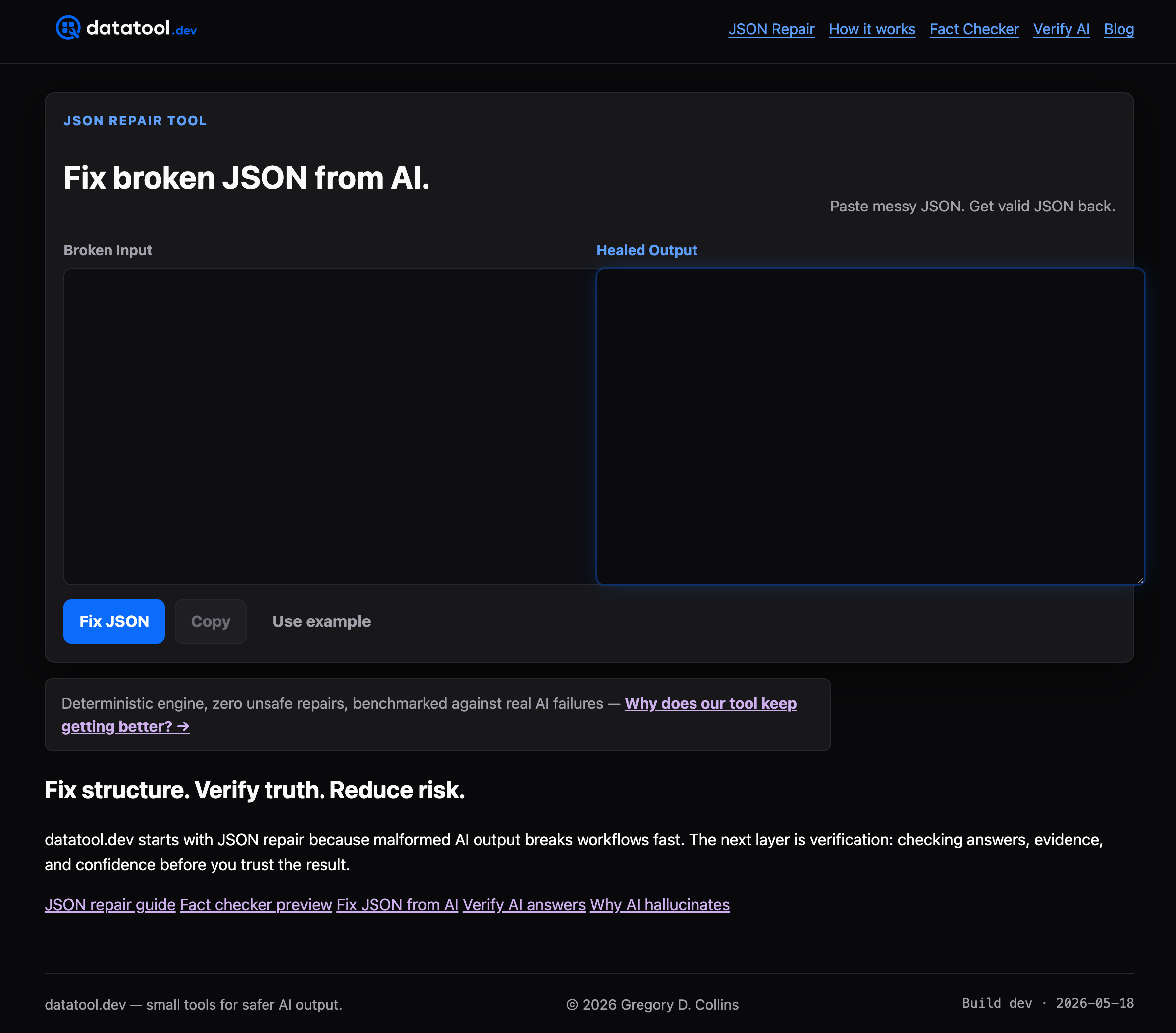
Datatool.dev repairs broken, truncated, and malformed JSON from AI outputs deterministically, validates the result against your schema, and runs the semantic checks that catch valid-but-wrong data before it reaches your database. Paste in messy output and get back valid, verified JSON, without hand-writing a repair function for every new failure pattern your provider introduces.
Building this in-house makes sense when you have one provider, a stable schema, and a small team that can own it long-term. It makes less sense once you're juggling multiple providers, schemas that change monthly, or a pipeline where a 3% silent failure rate translates into hundreds of corrupted records a day. If that's your situation, start by running your worst-offending schema through Datatool and compare the output against what your current pipeline produces today.
Frequently Asked Questions
Why does AI fail complex JSON schemas more often than simple ones? Complex schemas add nesting, recursion, wide enums, and large unions, each of which adds a decision point the model can get wrong during token-by-token generation. Benchmark results show success rates dropping from above 86% on simple schemas to single digits on the most complex real-world schemas.
Does OpenAI's strict mode or Gemini's structured output guarantee correct data? No. These features guarantee the output matches your schema's structure, types, and required fields, but none of them validate semantic correctness. A schema-valid response can still contain a negative total or an impossible date.
What's the fastest fix for schema failures in production? Flatten deeply nested fields and split large multi-purpose schemas into smaller, single-purpose ones. This reduces decoding errors without requiring a provider change or a new validation layer.
How do I catch valid-but-wrong AI output that passes schema validation? Add a second validation layer after parsing that checks business logic explicitly, things like "does the total match the sum of line items" or "is the end date after the start date." Schema validators like Zod, Pydantic, and jsonschema don't check this by default.
Do different AI providers handle the same JSON Schema the same way? No. Providers implement overlapping but different subsets of JSON Schema keywords, with different defaults for required fields and different coercion behaviors. Test each provider separately if you use a fallback chain.
Can Datatool.dev fix broken JSON automatically without rewriting my schema? Yes. Datatool.dev's repair engine deterministically fixes malformed, truncated, and improperly escaped JSON from AI outputs and validates the result against your existing schema, without requiring changes to your prompt or provider setup.
Sources
For engineers who want to verify the claims above or go deeper on a specific failure mode, these sources are worth reading directly rather than taking secondhand.
- Constrained decoding benchmarks (arXiv)
- EACL 2026 paper on LLMs processing structured (JSON) responses
- Json-schema
- Why AI-generated JSON is always broken — UnblockDevs