

Use constrained decoding at the provider level, add a typed schema validator (Pydantic or AJV) as a second layer, and route production failures to a deterministic repair service like Datatool. That three-layer stack is the shortest path to reliable LLM JSON in production.
TL;DR:
- Enable structured outputs (
json_schemamode withstrict: true) on every provider call where available. - Validate parsed output against typed models; reject unknown fields.
- Route parse failures and semantic violations to a deterministic repair service; never guess-close truncated objects.
Measure three signals from day one: parse success rate, repair rate, and downstream contract failures. If repair rate climbs, your schema or prompt drifted.
Table of Contents
- Why schema-valid JSON still breaks your pipeline
- What every tool in this stack must actually provide
- How to wire the pipeline: architecture and a real failure example
- How to test the pipeline against your exact production schema
- Operational safeguards your production system needs
- When to auto-repair and when to reject
- How to choose the right tool for your situation
- Key Takeaways
- The gap most teams don't close until it's too late
- Datatool handles the repair layer so your pipeline doesn't have to guess
- Useful sources
Why schema-valid JSON still breaks your pipeline
Schema validity is a syntactic guarantee. It tells you the braces closed and the keys exist. It says nothing about whether the values are correct.
A price field typed as
numberpasses schema validation whether it contains49.99or-0.01. An order date typed asstringpasses whether it holds"2024-03-15"or"2099-99-99". The model hallucinated the value; the validator never noticed.
Common production failures Datatool testing surfaces regularly:
- Negative or zero monetary amounts on fields that must be positive.
- Future dates on fields that must be historical (e.g.,
invoice_dateset three years ahead). - Wrong currency codes —
"USD"returned when the schema expects an ISO 4217 enum the model ignored. - Missing external IDs that break downstream joins (the field exists, the value is fabricated).
- Type-correct but out-of-range integers — a confidence score of
147on a 0–100 scale.
OpenAI Structured Outputs explicitly warns that schema compliance does not guarantee semantic correctness. Engineering posts confirm the same pattern: syntactic guarantees convert your measurable risk from parse failures to value failures. You must measure both.
What every tool in this stack must actually provide
Any tool claiming to handle malformed or hallucinated structured data needs these capabilities. Use this checklist to evaluate pipeline components:
- Constrained decoding or native structured outputs. JSON Schema, Pydantic, or Zod integration at the generation layer. Providers: OpenAI
json_schema, Anthropic Claudeoutput_config.format, Google Geminiresponse_json_schema. - Deterministic repair. The repair engine must never fabricate field values. It fixes structure (missing braces, bad escaping, code fences) without inventing data. Non-deterministic repair is worse than rejection.
- Semantic rule engine. Range checks, regex patterns, cross-field rules, enum lookups, and referential integrity checks against external data sources.
- Integration points. Streaming support,
finish_reasondetection, retry caps, and a provider compatibility layer so schema changes don't silently break one provider. - Operational features. Structured logs with model/prompt/schema version, repair rate metrics, human-in-the-loop routing, and versioned schemas.
Pro Tip: Set extra='forbid' in Pydantic models. Unknown fields silently entering your data model cause schema drift downstream — extra='forbid' turns that silent failure into a hard error you can catch and log.
| Capability | Why it matters |
|---|---|
| Constrained decoding | Eliminates syntactic failures at generation time |
| Deterministic repair | Fixes structure without fabricating values |
| Semantic rule engine | Catches hallucinated values that pass schema |
| Versioned schemas | Detects schema drift across model/prompt updates |
| Observability hooks | Surfaces repair rate spikes before they hit downstream |

How to wire the pipeline: architecture and a real failure example
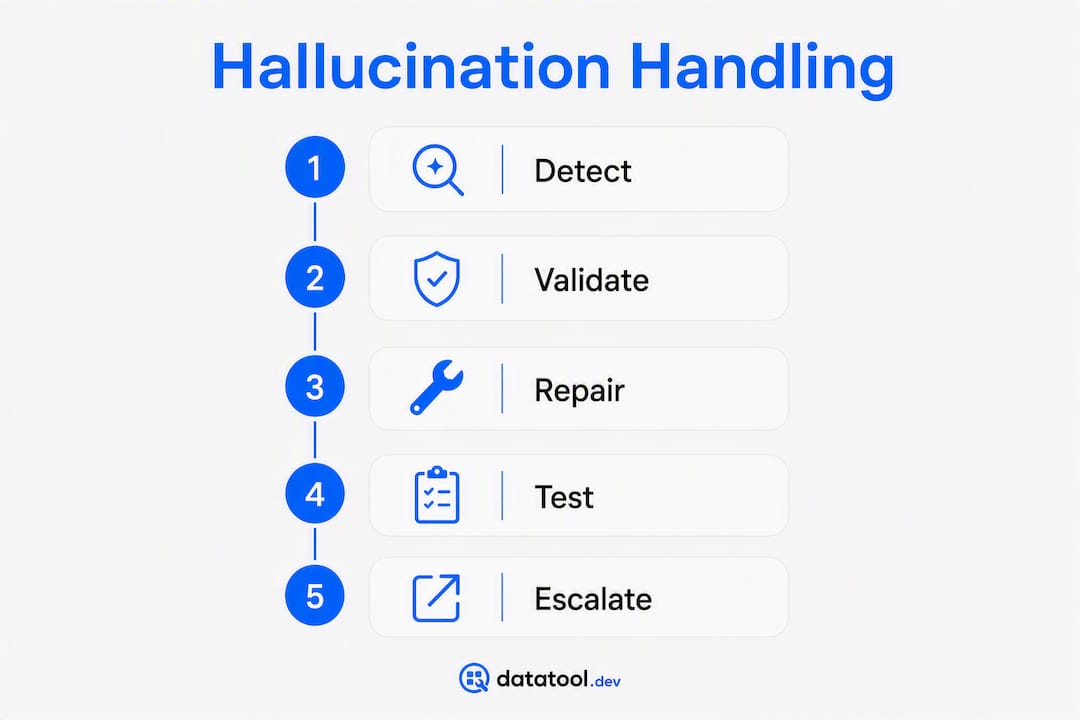
The canonical pipeline in one sentence: generate → detect truncation/refusal → parse → schema validate → semantic validate → repair or retry or reject → record.
Each stage has a specific job:
- Generate. Call the provider with structured outputs enabled. Pass the exact production schema.
- Detect. Check
finish_reason. A value oflengthmeans truncation; do not attempt repair by closing braces. Re-run with more tokens. - Parse. Use a strict parser. Catch trailing commas, code fences, and wrapped responses here.
- Schema validate. Run AJV (Node.js) or Pydantic. Reject unknown fields. Log every violation with field path.
- Semantic validate. Apply business rules: range checks, enum lookups, cross-field constraints, external ID verification.
- Repair or retry or reject. Deterministic repair for safe structural fixes. Retry with field-level error messages for semantic failures. Reject and escalate for high-impact fields.
- Record. Log model version, prompt version, schema version, raw response, and repair action taken.
Here is a real failure pattern and the fix:
import json
import requests

raw = '{"order_id": "ORD-991", "amount": -5.00, "currency": "USD"'
# Failure 1: truncated — missing closing brace
# Failure 2: negative amount on a must-be-positive field

# Step 1: detect truncation via finish_reason before attempting parse
finish_reason = "length"  # returned by provider
if finish_reason == "length":
    raise ValueError("Truncated response — re-run with higher max_tokens")

# Step 2: send to deterministic repair for structural fix only
repair_response = requests.post(
    "https://datatool.dev/api/repair",
    json={"raw": raw, "schema": {"type": "object", "required": ["order_id", "amount", "currency"]}}
)
repaired = repair_response.json()["result"]
# repaired = {"order_id": "ORD-991", "amount": -5.00, "currency": "USD"}

# Step 3: semantic validation — repair does not fix values
parsed = json.loads(repaired) if isinstance(repaired, str) else repaired
if parsed["amount"] <= 0:
    raise ValueError(f"Semantic failure: amount={parsed['amount']} must be positive — escalate")
The repair call fixes the missing brace. It does not touch the value. Semantic validation catches the negative amount and escalates it. That separation is the point.
Pro Tip: Never auto-close a truncated JSON object by appending }. The model stopped mid-field. Closing the brace produces structurally valid but semantically wrong data. Detect truncation via finish_reason and re-run.
Constrained decoding using token-level masking (Outlines, vLLM guided decoding) eliminates most syntactic failures for self-hosted models. For hosted providers, native structured outputs do the same job. Either way, parse failures convert to value failures — which is why the semantic layer is not optional.
How to test the pipeline against your exact production schema
Test the schema you actually use in production, not a simplified version. Providers support a subset of JSON Schema; keywords your application model uses may be silently ignored.
Test checklist for every critical workflow:
- Clean, valid example — confirm baseline pass.
- Missing required key — confirm rejection and correct error path.
- Wrong type on a numeric field — confirm schema validator catches it.
- Truncated object (simulate
finish_reason: length) — confirm no brace-closing attempt. - Negative value on a must-be-positive field — confirm semantic rule fires.
- Future date on a historical field — confirm range check rejects it.
- Unknown field present — confirm
extra='forbid'or AJVadditionalProperties: falserejects it. - Empty list on a required array — confirm downstream handles it gracefully.
- Adversarial prompt injection in a string field — confirm sanitization step.
Metrics to collect per test run: field-level accuracy, semantic acceptance rate, parse success rate, retry count, and repair rate. Add CI hooks that validate AI output against the provider-compatible schema subset on every pull request. If the schema diverges from what the provider supports, the build fails before it reaches production.
Schema validation patterns at the extraction layer are most effective when the test fixtures mirror real LLM failure modes, not idealized inputs.
Operational safeguards your production system needs
Monitor these five metrics. If any spikes, you have a schema drift or prompt regression:
- Parse failure rate — structural errors the provider's constrained decoding should have prevented.
- Repair rate — structural fixes applied by the repair layer.
- Semantic rejection rate — outputs that passed schema but failed business rules.
- Retry count per request — rising retries mean your error messages are too generic.
- Downstream contract failures — the metric that actually costs money.
Engineering posts recommend logging model version, prompt version, and schema version with every event. Without those three fields, root-cause analysis after a regression is guesswork.
Operational checks to implement:
- Shadow mode. Run the new schema or prompt version in parallel before cutting over. Compare repair rates between versions.
- Rate-limited retries. Cap retries at 2–3 per request. Log every retry with the specific field-level error that triggered it.
- Circuit breaker. If failure rate exceeds your threshold in a rolling window, stop sending requests and alert. Runaway retries compound token cost fast.
- Human-in-the-loop routing. Any request that exhausts retries without a clean result goes to a review queue, not to the downstream system.
When to auto-repair and when to reject
Auto-repair only structural, bounded, non-authoritative problems. Reject or escalate everything else.
The rule: if the correct value can be determined without inventing data, repair it. If it cannot, reject it.
Auto-repair (safe):
- Missing closing brace on a complete object (all fields present).
- Trailing comma before
}or]. - Code fence wrapping (````json ... ````).
- Invalid escape sequences in string values.
Reject and escalate:
- Monetary amounts outside valid range.
- Account IDs or external reference IDs that don't match known records.
- Dates that fail business-rule constraints (future invoice dates, impossible ranges).
- Classification categories not in the allowed enum.
- Attempt structural repair once.
- Re-validate. If semantic rules still fail, log the specific violation with field path and value.
- On second failure, route to human review queue with the raw response and repair attempt attached.
- Never attempt a third auto-repair on the same request.
Pro Tip: Log an evidence pointer with every escalation: the field name, the hallucinated value, the rule that failed, and the raw model response. That record is your audit trail and your training signal.
How to choose the right tool for your situation
Native structured outputs when you're on a single hosted provider. Token-level constrained decoding when you self-host. Validation-retry libraries for multi-provider coverage. Add a deterministic repair service when you need guaranteed, auditable fixes regardless of provider.
- Single hosted provider (OpenAI, Anthropic, Gemini). Enable native structured outputs. Add Pydantic or AJV for semantic validation. Route failures to Datatool for deterministic repair.
- Self-hosted models. Use Outlines or vLLM guided decoding for constrained decoding. Syntactic failures drop to near zero; focus budget on semantic validation.
- Multi-provider or provider-agnostic. Use Instructor or a Pydantic retry loop for validation. Add Datatool as the post-parse repair step so repair behavior is consistent across providers.
- High-volume, low-stakes outputs. Auto-repair structural issues; log semantic failures; alert on rate spikes.
- Low-volume, high-stakes outputs (financial data, medical records, legal documents). Reject on any semantic failure; route every repair attempt to human review.
Key Takeaways
Reliable LLM JSON in production requires constrained decoding at generation, typed schema validation at parse, semantic business-rule checks after parse, and deterministic repair for structural failures — no single layer is sufficient alone.
| Point | Details |
|---|---|
| Schema validity ≠ correctness | A schema-valid response can still contain hallucinated values; add semantic checks. |
| Detect truncation first | Check finish_reason before parsing; never close truncated objects programmatically. |
| Cap retries at 2–3 | Uncapped retries cause runaway token costs; route persistent failures to human review. |
| Log three versions | Record model, prompt, and schema version with every event for root-cause analysis. |
| Datatool for deterministic repair | Use Datatool as the post-parse repair step for structural fixes that never fabricate field values. |
The gap most teams don't close until it's too late
Most engineering teams treat JSON validation as a solved problem the moment they enable structured outputs. That's the mistake. Structured outputs eliminate the parsing problem. They don't touch the correctness problem.
The teams that get burned are the ones who see a clean parse rate, declare victory, and skip the semantic layer. Then a negative invoice amount reaches accounting, or a fabricated account ID breaks a downstream join at 2 AM, and the incident post-mortem reveals there was never a range check on that field.
The right mental model: constrained decoding is a floor, not a ceiling. It guarantees the JSON is parseable. Everything above that floor — value correctness, referential integrity, business-rule compliance — is your responsibility. The tools exist to handle it systematically. The only question is whether you wire them in before the first production incident or after.
Datatool handles the repair layer so your pipeline doesn't have to guess
Datatool is the deterministic repair and validation service built specifically for LLM output failures in production. It fixes broken JSON structure without fabricating values, validates against your schema, and returns an audit trail with every repair action.
Key integration points engineers care about:
- Deterministic repair semantics. The same malformed input produces the same repaired output every time. No randomness, no invented fields.
- Schema versioning. Pin your validation schema to a version so drift is detectable, not silent.
- Evidence pointers. Every semantic rejection returns the field path, the failing value, and the rule that fired.
- Low-latency API. Drop it into the post-parse stage of your pipeline with a single HTTP call.
Fix broken JSON from AI at datatool.dev — paste a malformed response and see the repair in seconds, or integrate the API directly into your pipeline.
Useful sources
- Structured model outputs | OpenAI API — authoritative reference for
json_schemamode,strict: true, and the provider's supported JSON Schema subset. - LLM Structured Outputs: JSON Schema and Validation — maps the canonical pipeline stages and explains explicit business decisions at each step.