

AI models are unreliable narrators when it comes to data structure. You ask for JSON, you get JSON wrapped in a markdown code fence. You define a schema, the model adds fields you never asked for. The output formatting approaches AI developers choose directly determine how much postprocessing, repair work, and silent failure they deal with in production. This article breaks down the three main approaches, how to evaluate them, and exactly when to use each one.
Table of Contents
- Key takeaways
- 1. Output formatting approaches AI developers use most
- 2. JSON mode
- 3. Structured outputs with strict schema enforcement
- 4. Tool and function calling
- 5. Side-by-side comparison of the three approaches
- 6. Best practices for choosing and implementing AI output formatting
- My take on AI output formatting after years of real production work
- Fix broken AI output before it breaks your pipeline
- FAQ
Key takeaways
| Point | Details |
|---|---|
| JSON mode has no schema guarantee | It produces valid JSON but the model can omit required fields or add unexpected ones. |
| Structured outputs enforce schema at sampling time | Constrained decoding masks invalid tokens, making schema violations impossible by design. |
| Tool calling adds latency and complexity | Use it only when your workflow involves external data fetching or side effects, not simple extraction. |
| Validate beyond JSON Schema | Libraries like Pydantic and Zod catch semantic errors that schema enforcement alone misses. |
| Always check the refusal field | Skipping this check on structured output responses causes runtime errors you won't see coming. |
1. Output formatting approaches AI developers use most
Before picking a format, you need a framework for evaluation. Not every project has the same requirements. A real-time API response has different tolerances than a batch extraction pipeline. Here are the criteria that matter.
Schema adherence and validation guarantees. Does the approach promise that the output will match your schema, or does it just try? This is the single biggest differentiator between JSON mode and structured outputs.
Parsing reliability and error handling. What happens when the model refuses, truncates, or produces a partial object? Your code needs a defined path for every failure mode. Skipping refusal checks on structured output responses will cause runtime errors the first time a safety filter triggers.
Latency and performance tradeoffs. Structured outputs add 10 to 20% latency on the first request due to schema compilation. Subsequent requests reuse the compiled grammar and return to normal latency. Factor this into cold-start scenarios.
Tooling compatibility. Pydantic and Zod let you derive schemas directly from type definitions and catch semantic errors, like "end_dateoccurring beforestart_date`, that JSON Schema enforcement alone will never catch.
Readability versus compactness. For debugging, 2-space indentation is the standard. For production APIs, minification reduces payload size by 10 to 30%, and gzip compression cuts it further by 70 to 90%.
Pro Tip: Design your schema for the worst-case model response, not the happy path. Add explicit null defaults on optional fields and test your error handler before you test your success case.
2. JSON mode
JSON mode is the legacy approach. You set response_format: { type: "json_object" } and the model returns something that parses as valid JSON. That is where the guarantee ends.
JSON mode outputs valid JSON but the model can add extra fields, omit required ones, or nest data in ways your parser does not expect. There is no schema enforcement at the token level. The model is trying to comply based on your prompt instructions alone.
A typical failure looks like this. You prompt for { "name": string, "score": number } and receive { "name": "Alice", "score": "9.5", "rank": 1 }. The score is a string instead of a number. The rank field was never in your spec. Your downstream code fails silently or throws a type error at runtime.
Use JSON mode only when you do not have access to structured output endpoints, or when your schema is too complex or recursive for strict mode to compile. In every other case, it is the wrong choice for production.
3. Structured outputs with strict schema enforcement
Structured outputs are the current standard for reliable AI content presentation in data pipelines. The mechanism is constrained decoding. A finite state machine derived from your JSON Schema masks invalid tokens at every generation step. The model cannot produce output that violates your schema because the invalid tokens are never available for sampling.

With OpenAI's json_schema format and strict: true, you get 100% schema adherence as a hard guarantee, not a best effort. Required fields are always present. Types are always correct. The model's output matches your schema or the API returns an error.
Structured outputs are the right default for:
- Data extraction from unstructured text
- Classification tasks with defined label sets
- Any transformation where the output feeds directly into another system without human review
The tradeoffs are real. Very large or recursive schemas can cause compilation errors or 400 responses. Some schemas need simplification or a fallback to non-strict mode. You also need to handle the refusal field explicitly. If the model declines to respond for safety reasons, your parsed output object is null and only the refusal message is populated.
Pro Tip: Keep your schemas flat where possible. Each level of nesting increases compilation time and raises the risk of hitting schema complexity limits. If you need deep nesting, test compilation before deploying.
4. Tool and function calling
Tool calling is not a formatting approach in the traditional sense. It is a multi-turn interaction pattern where the model signals intent to call an external function with typed arguments, your code executes the function, and the result goes back to the model for a follow-up response.
The output from a tool call is a structured argument object. That part is schema-enforced. But the workflow involves multiple request-response cycles, which means higher API usage and round-trip latency compared to a single structured output call.
Use tool calling when your workflow requires:
- Fetching live data (database queries, API lookups)
- Writing side effects (inserting records, sending notifications)
- Multi-step reasoning where intermediate results change what happens next
For pure extraction or transformation, tool calling adds complexity without benefit. Treat your tool schemas like API contracts with semantic versioning. A schema change that adds a required field is a breaking change. Version it the same way you would version an API endpoint.
5. Side-by-side comparison of the three approaches
| Criterion | JSON mode | Structured outputs | Tool calling |
|---|---|---|---|
| Schema guarantee | None | 100% (constrained decoding) | Partial (argument schema only) |
| Latency | Lowest | +10 to 20% on first request | Highest (multiple round trips) |
| Error handling complexity | High (manual validation) | Medium (refusal check required) | High (multi-step failure modes) |
| Best for | Legacy integrations | Data extraction, classification | External operations, agents |
| Tooling support | Broad | Pydantic, Zod, OpenAI SDK | OpenAI SDK, LangChain, etc. |
A few points the table does not capture:
- JSON mode requires the most postprocessing. You are responsible for validating every field.
- Structured outputs have a one-time schema compilation cost but then run at near-normal speed.
- Tool calling failure modes span both the argument schema and the external function. Both layers need their own error handling.
For detecting malformed output in production pipelines, structured outputs reduce the detection burden significantly. But they do not eliminate it.
6. Best practices for choosing and implementing AI output formatting
Structured outputs should be your default for any task that is purely about extracting or transforming data. If you are not making external calls or producing side effects, there is no reason to use tool calling.
Design optional fields explicitly. Do not omit fields from your schema and expect the model to handle ambiguity. Mark optional fields with null defaults. Schemas that assume implicit optionality break under strict mode.
Use the Formatter Pattern for complex pipelines. This architecture uses a capable model for reasoning and a cheaper model for final structured output formatting. The reasoning model produces prose or intermediate data. The formatting model converts it to the exact schema your API or UI expects. This improves reliability and reduces cost.
Validate semantically after parsing. JSON Schema enforcement guarantees structure. It does not guarantee meaning. Run Pydantic or Zod validation after parsing to catch field values that are structurally valid but semantically wrong.
Test your error handler first. Before you write a single line of happy-path code, write the code that handles a null output, a refusal, a truncated response, and a schema mismatch. These are not edge cases in production. They are regular events.
Pro Tip: For large schemas, generate a simpler test schema that covers your most common fields and validate that strict mode compiles cleanly before building out the full schema. It saves you from debugging compilation errors deep in a real pipeline.
My take on AI output formatting after years of real production work
I've watched teams lose hours to silent failures caused by JSON mode. The model returns what looks like valid JSON. The parser accepts it. Then a required field is missing, and the downstream system either crashes or writes garbage to a database. Nobody notices until a customer complains.
Switching to structured outputs with strict schema enforcement solved that class of problem almost completely. The latency hit on first request is real, but it is a fair trade for guaranteed schema adherence. In my experience, the postprocessing you eliminate more than covers the latency cost when you measure end-to-end pipeline time.
Tool calling is genuinely powerful for agent workflows, but I've seen it misused constantly. Teams reach for it when they just need a structured response from a single prompt. That adds two round trips and a new failure surface for no benefit.
The most underrated practice I've come across is unit testing AI-generated data as a formal part of the pipeline. Not just parsing tests. Semantic validation tests. Does the date range make sense? Are required enums within the expected set? These checks catch what constrained decoding cannot.
Control your output format at the model level. If you are doing heavy postprocessing to fix or reshape AI output, that is a signal your formatting approach is wrong.
— Gregory
Fix broken AI output before it breaks your pipeline
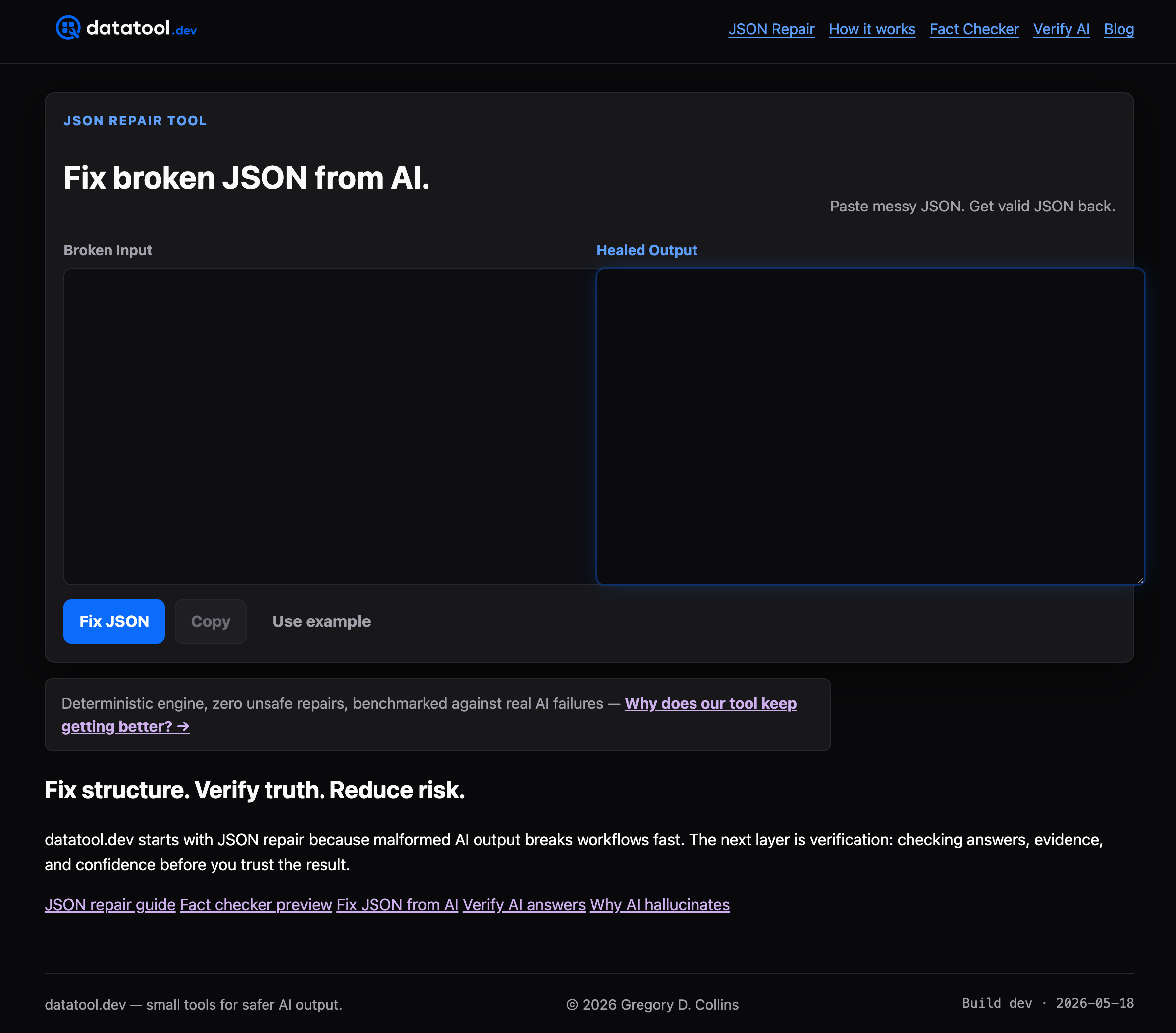
Even with structured outputs and strict schemas, real production pipelines encounter malformed JSON. Truncated responses, invalid escaping, wrapped outputs, partial objects. Datatool is built specifically for these failures. Paste broken JSON from any LLM and get valid, schema-compliant JSON back. Datatool handles broken AI JSON repair across all major output formats, integrates with Pydantic and Zod workflows, and reduces the manual repair work that slows down data engineering teams. Fix broken JSON from AI. Trust your pipeline.
FAQ
What is the difference between JSON mode and structured outputs?
JSON mode guarantees valid JSON syntax but applies no schema enforcement. Structured outputs use constrained decoding to guarantee that every field, type, and value in the response matches your defined schema exactly.
When should I use tool calling instead of structured outputs?
Use tool calling when your workflow requires fetching external data, executing functions with side effects, or running multi-step agent interactions. For simple data extraction or transformation, structured outputs are faster and less complex.
Why do structured outputs add latency on the first request?
The first request requires the API to compile your JSON Schema into a finite state machine for constrained decoding. Subsequent requests reuse the compiled grammar, so latency returns to near-normal levels.
What is the refusal field in structured outputs and why does it matter?
When a model declines to respond for safety reasons, the parsed output object is null and only the refusal field is populated. Skipping a check for this field causes runtime errors in production whenever a safety filter triggers.
How do Pydantic and Zod improve AI output validation?
They go beyond JSON Schema enforcement by validating semantic constraints, such as date ranges, enum membership, and cross-field logic, that constrained decoding cannot check. Use them as a second validation layer after parsing.