

Retry logic for malformed AI responses is a systematic process that combines heuristic repair, structured error feedback, and loop guards to recover valid output from large language models. Without it, a single bad JSON response from GPT-4o or Claude can silently break a pipeline. The core problem is not that models fail. It is that most developers retry blindly, sending the same prompt again and hoping for a different result. Tools like Pydantic, Zod, and agentcast exist precisely because blind retrying is ineffective compared to targeted retry loops with specific error feedback. This guide covers the full stack: pre-retry repair, error feedback loops, loop guards, and message phrasing.
What pre-retry repairs fix malformed AI responses?
Most malformed AI output never needs a second model call. A large share of failures come from predictable formatting quirks that a heuristic repair function can fix in microseconds.
Common issues include:
- Trailing commas in arrays or objects (
[1, 2, 3,]) - Unquoted keys (
{name: "Alice"}instead of{"name": "Alice"}) - Single quotes used instead of double quotes
- Markdown code fences wrapping the JSON (
```json ... ```) - NaN or Infinity values, which are not valid JSON
Libraries like json_repair and fast-json-repair handle all of these cases. Heuristic repair before retrying fixes common JSON output issues without spending extra model calls. That matters because each model call adds latency and cost.
Here is a minimal Python pattern showing the repair step before any retry:
from json_repair import repair_json
import json

raw = '{"name": "Alice", "age": 30,}'  # trailing comma — invalid JSON

try:
    parsed = json.loads(raw)
except json.JSONDecodeError:
    fixed = repair_json(raw)
    parsed = json.loads(fixed)

The repair_json call strips the trailing comma and returns valid JSON. No model call required.
For latency-sensitive paths, agentcast exposes a repairOnly flag. Setting repairOnly to true triggers heuristic fixes and validation but skips the retry call entirely. Use it when you need speed over completeness.
Pro Tip: Strip Markdown fences first. Models like GPT-4o frequently wrap JSON in triple backticks even when instructed not to. A single regex strip before parsing eliminates one of the most common failure modes.
How to implement error feedback retry loops
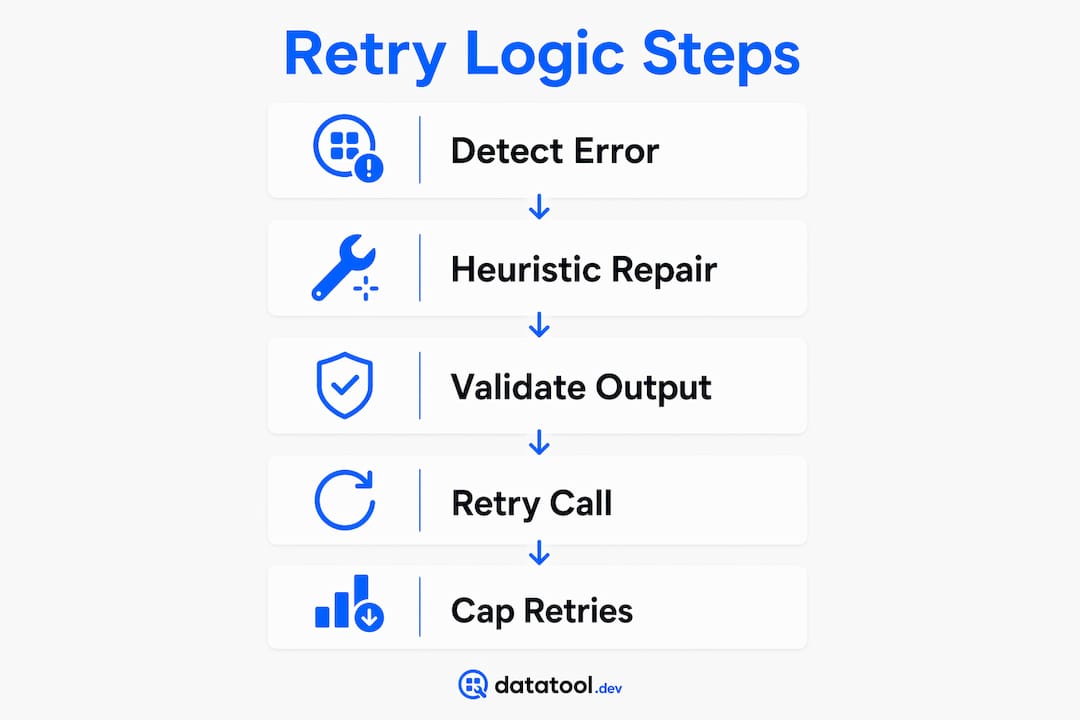
When heuristic repair fails, the next step is sending the parse or schema error back to the model. This is the StructuredRetry pattern. It works by appending the exact error message to the follow-up prompt so the model knows what it got wrong.
The steps are:
- Call the model and receive the raw response.
- Attempt heuristic repair with
json_repairor equivalent. - Run schema validation with Pydantic or Zod.
- If validation fails, extract the field-level error message.
- Build a new prompt that includes the original output and the specific error.
- Call the model again with the enriched prompt.
- Cap retries at 1–2 attempts on the hot path.
Structured validation errors with exact field paths improve retry fix rates to 85–95% on the second attempt for capable models. Generic errors like "invalid JSON" give the model nothing to work with. Field-level errors like "field dob expected format YYYY-MM-DD, received 13/40" give it a precise target.
Here is a pseudocode sketch of the loop:
MAX_RETRIES = 2
attempt = 0
error_context = None

while attempt <= MAX_RETRIES:
    response = call_model(build_prompt(original_prompt, error_context))
    repaired = repair_json(response)
    result, errors = validate_schema(repaired)  # Pydantic or Zod
    if result:
        return result
    error_context = format_errors(errors)  # field-level messages
    attempt += 1

raise MaxRetriesExceeded("Schema validation failed after retries.")
Retry counts capped at 1–2 keep latency under control. Beyond two retries, the problem is almost always the prompt or schema, not the model.
Pro Tip: Log every failed retry with the full error context. After a week of production traffic, those logs will show you exactly which schema fields the model consistently misunderstands. Fix the schema or prompt, and the retry rate drops.
| Retry attempt | Error context sent | Expected fix rate |
|---|---|---|
| 0 (initial call) | None | Baseline |
| 1 (with field errors) | Field path + format hint | 85–95% for capable models |
| 2 (final attempt) | Full prior output + errors | Diminishing returns |
| 3+ | Not recommended | Prompt or schema needs rework |
What safeguards prevent infinite retry loops?
Naive retry implementations cause retry storms. Without classifying errors as retryable or non-retryable, models reattempt the same broken action indefinitely. This burns tokens, adds latency, and can cascade across an entire agent system.
Classify every error before deciding to retry:
- Transient errors (network timeout, rate limit): retry without feedback.
- Recoverable errors (schema mismatch, parse failure): retry with error feedback.
- Fatal errors (model refuses, content policy block): abort immediately.
Per-tool retry budgets tied to argument hashes are the most reliable guard. Track how many times a specific tool has been called with a specific input. If the count exceeds your cap, abort and surface the error upstream.
"When your tool returns garbage, agents loop forever." The fix is a 30-line guard that tracks retry counts per input hash and raises a hard stop when the budget is exceeded.
Here is a minimal guard in Python:
retry_counts = {}

def guarded_call(tool_name, args, max_retries=2):
    key = (tool_name, hash(str(args)))
    retry_counts[key] = retry_counts.get(key, 0) + 1
    if retry_counts[key] > max_retries:
        raise FatalToolError(f"{tool_name} exceeded retry budget.")
    return call_tool(tool_name, args)
Tracking per-tool retry counts with caps and classifying errors prevents runaway retries. Build this guard before you ship any agent to production.
How should you phrase error messages for AI self-correction?
The phrasing of the error you send back to the model is as important as the retry count itself. Raw stack traces confuse models. Plain-language descriptions fix them.
Clear, actionable error messages significantly improve AI model self-corrections during retry attempts. The difference between a good and bad error message is concrete:
- Bad:
ValidationError: value is not a valid integer (type=type_error.integer) - Good:
Field 'age' must be an integer. Received "thirty". Use a number like 30. - Bad:
KeyError: 'dob' - Good:
Field 'dob' is missing. Include it as a string in YYYY-MM-DD format.
Name the field. State the expected format. Show an example value. That three-part structure gives the model everything it needs to self-correct on the next attempt. Avoid dumping raw exception objects or internal tracebacks into the prompt. Models do not parse Python exceptions reliably.
Also signal retryability explicitly in your system prompt. A phrase like "If you receive an error marked RETRY, correct only the field described. If marked FATAL, stop." gives the model a clear behavioral contract. This reduces hallucinated recovery attempts that produce new errors.
Cap retry frequency at the system level too. Two retries on the hot path is the practical ceiling. If you need more, the schema or prompt needs rework, not more attempts.
Key Takeaways
Effective retry logic for malformed AI responses requires heuristic repair first, targeted error feedback second, and hard loop guards throughout.
| Point | Details |
|---|---|
| Repair before retrying | Use json_repair or fast-json-repair to fix trailing commas, fences, and bad quotes before calling the model again. |
| Send field-level errors | Include exact field paths and format hints in the retry prompt to reach 85–95% fix rates on the second attempt. |
| Cap retries at 1–2 | Beyond two retries, the prompt or schema needs rework. More retries add latency without improving success rates. |
| Classify errors before retrying | Split errors into transient, recoverable, and fatal. Only recoverable errors warrant a feedback retry. |
| Guard against infinite loops | Use per-tool retry budgets tied to argument hashes to prevent retry storms in agent systems. |
What I have learned from building retry systems in production
The biggest mistake I see developers make is treating retry logic as an afterthought. They ship a pipeline, it breaks on a malformed response, and they add a bare try/except with a loop. That loop has no error classification, no budget, and no feedback. It just calls the model again. That is how you get a $200 API bill from a single bad prompt.
The second mistake is over-engineering the retry count. I have seen systems configured for five or six retries. Error feedback changes retries from brute force to precise targeted diagnosis. If the model cannot fix a field-level error in two attempts, the schema is wrong. Add a sixth retry and you are just paying more for the same failure.
The part that actually moves the needle is the error message phrasing. I spent two weeks tuning retry prompts on a structured extraction pipeline. Switching from raw Pydantic exception strings to plain-language field descriptions cut the retry rate by more than half. The model understood what it got wrong. That is the whole game.
Monitor your retry failures. Every failed second attempt is a signal. Cluster them by field name and you will find two or three schema fields responsible for most of your failures. Fix those fields, and your retry rate drops to near zero.
— Gregory
Datatool for fixing malformed AI JSON in your pipeline
Broken JSON from LLMs is not a rare edge case. It is a daily reality for any team running structured AI workflows.
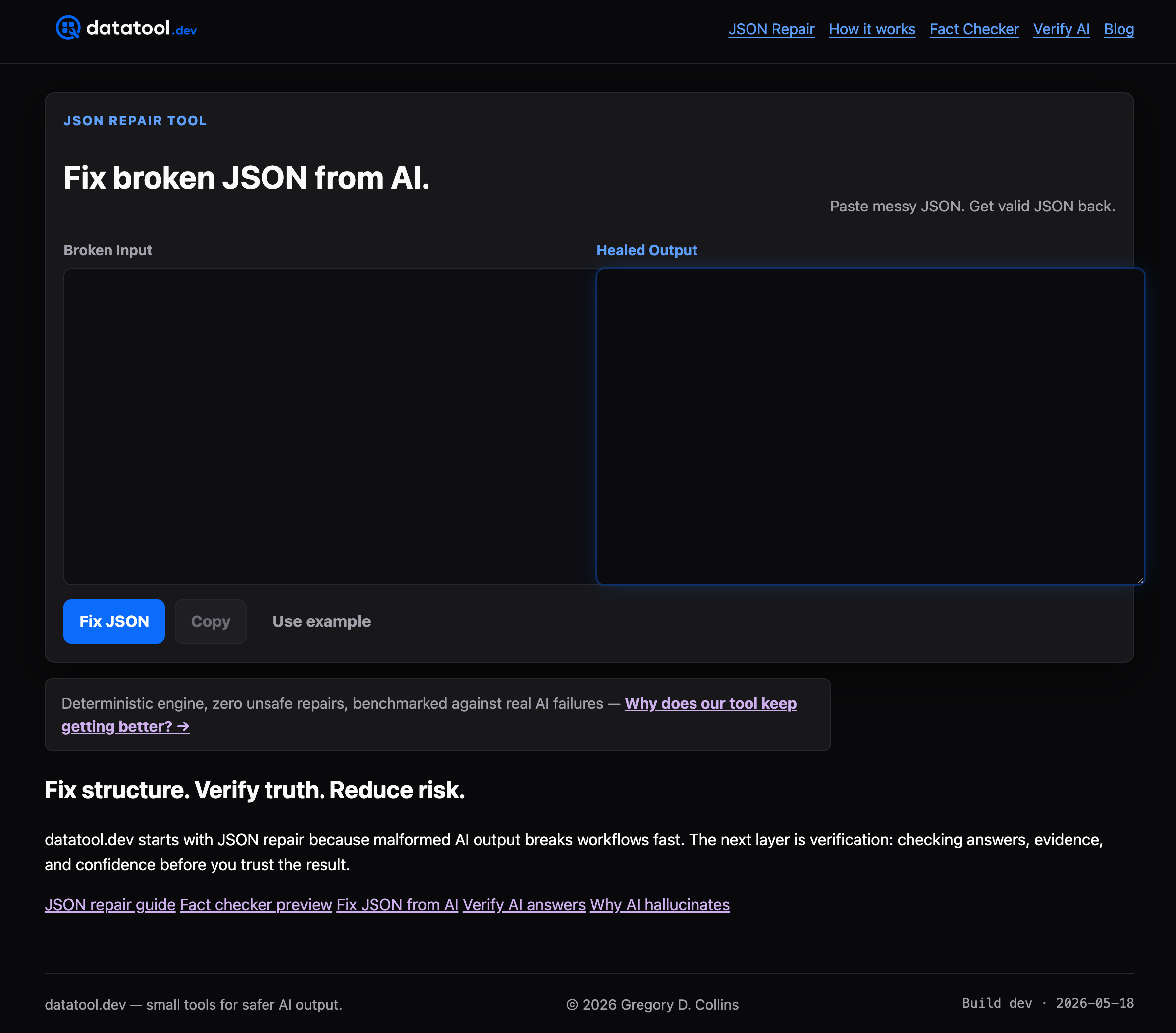
Datatool is built for exactly this problem. It handles broken JSON, wrapped responses, partial objects, invalid escaping, truncation, and schema drift from real LLM output. You can fix broken AI JSON directly in the browser or integrate Datatool's repair and validation tools into your retry pipeline. For teams building agent systems or data extraction workflows, Datatool also covers schema enforcement approaches that pair directly with the retry patterns covered here. Paste malformed output. Get valid JSON back. No extra model calls required.
FAQ
What is retry logic for malformed AI responses?
Retry logic for malformed AI responses is a structured process that repairs, validates, and re-requests AI output when it fails to parse or match a schema. It combines heuristic fixes, error feedback, and loop guards to recover valid data without manual intervention.
How many retries should I allow for AI response errors?
Cap retries at 1–2 on the hot path. Beyond two attempts, the failure is almost always a prompt or schema problem, not a transient model error.
What is the StructuredRetry pattern?
The StructuredRetry pattern appends the exact parse or schema error to the follow-up prompt, giving the model specific information about what it got wrong. This approach improves correction rates dramatically compared to blind retries.
How do I prevent infinite retry loops in AI agents?
Use per-tool retry budgets tied to argument hashes and classify errors as transient, recoverable, or fatal before retrying. Naive retrying without error classification causes agents to loop indefinitely on the same broken action.
Which libraries handle AI response validation and repair?
Pydantic and Zod handle schema validation with field-level error output. For JSON repair, json_repair and fast-json-repair fix common formatting issues. Agentcast combines validation, repair, and retry into a single workflow for LLM JSON responses.