

AI response normalization is defined as the set of techniques that scale, standardize, and constrain AI model outputs to ensure stable training and reliable, schema-adherent results in production. The term covers two distinct engineering concerns: numerical normalization inside the model (z-score, RMSNorm, embedding L2 normalization) and structured output normalization at the API boundary (JSON Schema enforcement, constrained decoding, runtime validation). Both failure modes are real, both are costly, and conflating them is the most common mistake practitioners make. This guide covers both with enough specificity to act on.
What is AI response normalization in numerical terms?
Numerical normalization is the process of rescaling activations, rewards, or embeddings so that training gradients stay stable and inference results stay consistent. Without it, models diverge, embeddings mislead, and reward signals collapse into noise.
The most common numerical AI data normalization techniques used in production are:
- Z-score normalization: Subtracts the mean and divides by the standard deviation. GRPO uses this to calculate relative advantages across a group of responses per prompt, eliminating the need for a separate critic network and reducing reward variance.
- RMSNorm: Skips mean subtraction entirely, which cuts training time by 7%–64% compared to LayerNorm. It is now the internal activation norm of choice in most modern LLMs.
- Min-max scaling: Compresses values into a fixed range (typically 0–1). Useful for input features but sensitive to outliers.
- L2 embedding normalization: Scales embedding vectors to unit length before storage. Skipping this step causes dot product similarity to skew by vector magnitude rather than semantic relevance, producing silent retrieval bugs.
Pro Tip: Normalize embeddings before storage, not at query time. Normalizing at query time wastes compute and risks inconsistency if your normalization parameters drift between the stored vectors and the live query.
The most dangerous failure mode in this category is normalization mismatch between training and inference. If you normalize inputs during training but fail to save and reapply those exact mean and standard deviation parameters at inference, accuracy degrades quietly with no obvious error signal. Save your scaler artifacts. Version them alongside your model checkpoints.
How does structured output normalization work?
Structured output normalization is the enforcement of a specific response schema at the decoding level, so the model cannot produce output that violates your data contract. This is different from JSON Mode. JSON Mode guarantees parsable JSON but does not enforce field presence, types, or nesting. Strict schema enforcement does.

The two leading implementations are OpenAI Structured Outputs and Anthropic's tool_use API. Both apply JSON Schema constraints during token generation, not after. That distinction matters: post-generation validation catches errors but cannot fix them. Constrained decoding prevents them. Industry practice shows 95%–99% conformance rates when schema enforcement is applied at the decoding level with runtime validation layered on top.
Here is how to structure a schema correctly for production use:
- Declare all required fields explicitly. Do not rely on the model to infer what is mandatory.
- Use null unions for optional fields. Define optional fields as
{"type": ["string", "null"]}rather than omitting them. This prevents schema drift when the model returns unexpected nulls. - Validate at runtime with Pydantic or Zod. Runtime validation tools catch semantic violations that JSON Schema cannot, such as a date field that is structurally valid but logically impossible.
- Return canonical error objects on failure. Never let a validation failure propagate as raw model output. Define a standard error envelope and return it consistently.
Pro Tip: Treat your JSON Schema as source code. Store it in version control, review it in PRs, and tag releases. Schema drift is the leading cause of silent ingestion failures in AI pipelines.
| Feature | JSON Mode | Structured Outputs (Strict) |
|---|---|---|
| Guarantees valid JSON | Yes | Yes |
| Enforces required fields | No | Yes |
| Enforces field types | No | Yes |
| Prevents extra fields | No | Yes |
| Conformance rate | ~80% | 95%–99% |
For a deeper look at common malformed output patterns from real LLM deployments, the Datatool blog covers the failure taxonomy in detail.
What are the common pitfalls in AI response normalization?
Most production failures in AI response standardization fall into three categories: wrong tool for the job, missing runtime validation, and schema drift.
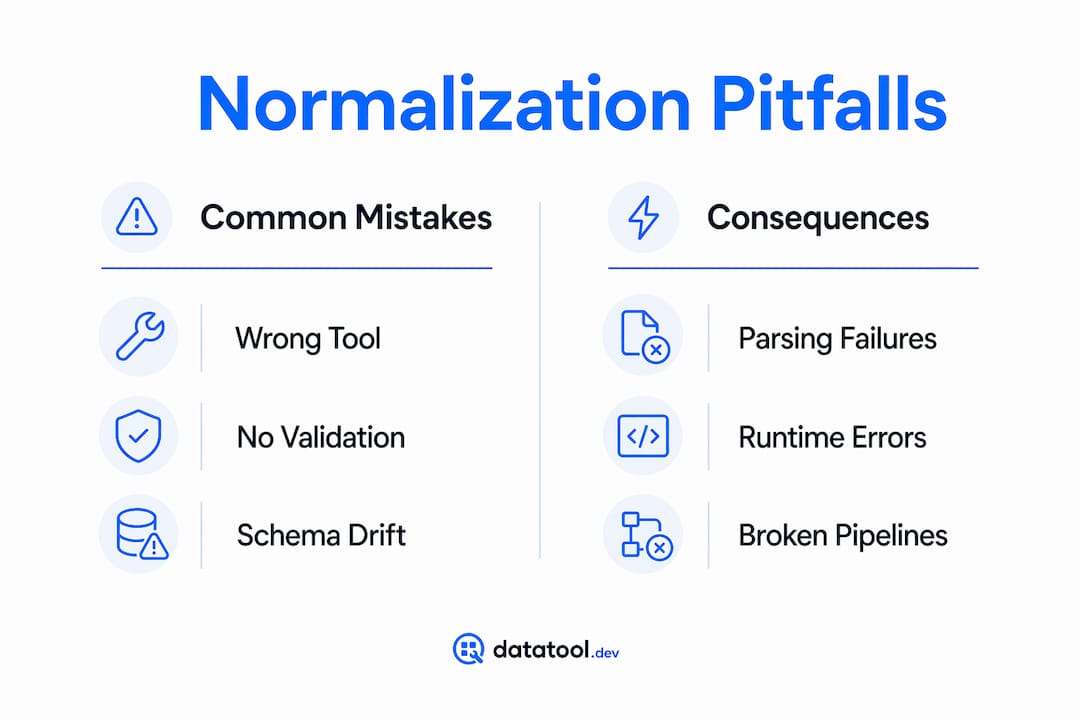
Wrong tool for the job means using JSON Mode when you need strict schema enforcement. JSON Mode is a convenience feature, not a data contract. If your downstream pipeline expects a typed object with required fields, JSON Mode will fail you eventually.
Missing runtime validation is the gap between what the schema guarantees and what your business logic requires. Ajv, Zod, and Pydantic each handle this differently, but all three can catch semantic violations that structural schema enforcement misses. Use at least one.
Schema drift happens when your prompt template evolves but your schema does not, or vice versa. Versioning JSON Schemas alongside prompt templates is the fix. Treat them as a coupled artifact, not independent files.
Here is a concrete example of what breaks and why:
// Model output with JSON Mode — structurally valid, semantically broken
{
  "user_id": null,
  "score": "high",
  "created_at": "yesterday"
}

// Schema-enforced output with Pydantic validation
{
  "user_id": "usr_4821",
  "score": 0.87,
  "created_at": "2026-03-15T10:22:00Z"
}
The first response passes JSON parsing. It fails every downstream check. The second is what constrained decoding plus runtime validation produces. The difference is not the model. It is the enforcement layer.
For teams setting up validation before deployment, the pre-production validation guide from Datatool covers the full setup sequence.
How does normalization affect model evaluation and alignment?
Normalization directly shapes how models score on benchmarks and how humans rate their outputs. This is not a training detail. It is a product quality factor.
In GRPO, z-score reward normalization stabilizes the advantage calculation across response groups. The model learns relative quality within a batch rather than chasing absolute reward values that shift with prompt difficulty. The result is more stable training without the overhead of a value network.
In Direct Alignment Algorithms, regularization of length-normalized probabilities produces over 20% improvement in human preference scores and more than 9% gains on benchmarks like AlpacaEval2. That is a significant lift from a normalization choice, not an architecture change.
| Normalization Method | Benchmark Impact | Human Preference Gain |
|---|---|---|
| GRPO z-score reward norm | Stable training, reduced variance | Indirect via output quality |
| Length-normalized probability regularization | 9%+ on AlpacaEval2 | 20%+ improvement |
| Structured output schema enforcement | Reduced pipeline errors | Higher downstream trust |
The pattern is consistent: normalization applied correctly at the right layer improves both automated metrics and human ratings. Applied incorrectly or skipped, it degrades both.
Key takeaways
AI response normalization requires both numerical stability inside the model and strict schema enforcement at the output boundary to achieve reliable production performance.
| Point | Details |
|---|---|
| Two distinct normalization types | Numerical normalization stabilizes training; structured output normalization enforces response schemas. |
| RMSNorm over LayerNorm | RMSNorm cuts training time by 7%–64% and is now standard in modern LLMs. |
| JSON Mode is not enough | Strict schema enforcement with constrained decoding achieves 95%–99% conformance; JSON Mode does not. |
| Runtime validation is mandatory | Pydantic, Zod, or Ajv catch semantic violations that JSON Schema alone cannot prevent. |
| Version your schemas | Schema drift breaks pipelines silently; treat JSON Schemas as versioned code artifacts. |
Schema is engineering, not plumbing
I have reviewed a lot of AI pipelines that broke in production. The failure pattern is almost always the same: the team treated schema definition as a one-time setup task rather than an ongoing engineering concern. They picked JSON Mode because it was fast to ship, skipped runtime validation because the model "usually" returned the right shape, and never versioned their schemas because they assumed the prompt would stay stable.
That assumption fails the moment you update a prompt, swap a model version, or add a new field to your downstream database. The model does not know your data contract changed. It will keep returning the old shape, and your pipeline will silently ingest garbage.
The teams that get this right treat their JSON Schema the same way they treat their API contract. It lives in version control. It has a changelog. It gets reviewed before a prompt update ships. They also run Pydantic or Zod validation on every response, not just during testing. That layered approach is what structured output enforcement actually looks like in practice.
The normalization techniques will keep evolving as LLM architectures change. RMSNorm replaced LayerNorm. Something will eventually improve on RMSNorm. But the discipline of treating output contracts as first-class engineering artifacts is not going to become less important. Build that habit now.
— Gregory
Fix malformed AI output with Datatool
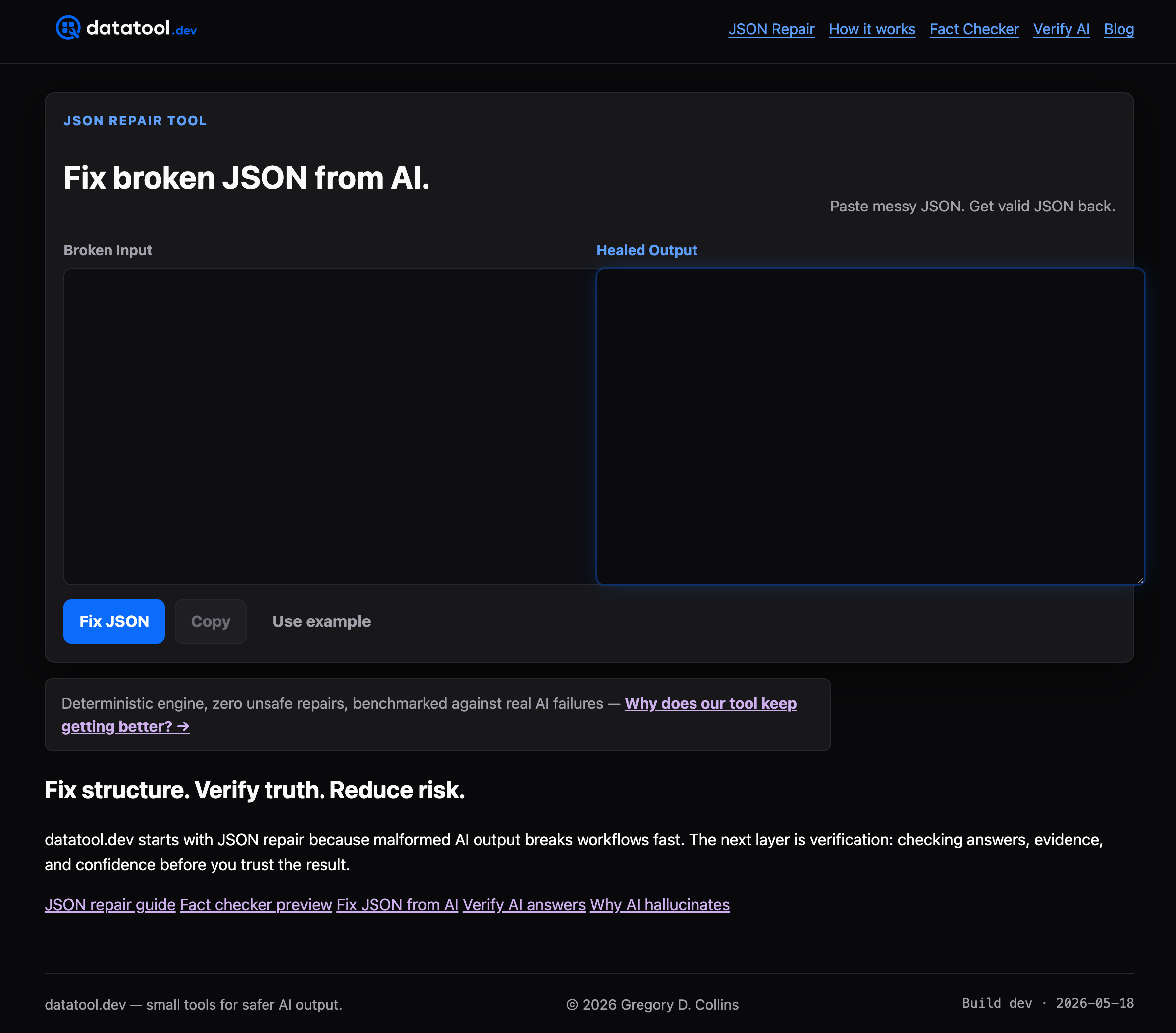
Broken JSON from LLMs is not a rare edge case. It is a daily production reality. Datatool is built specifically for this problem. It repairs malformed AI output including broken JSON, wrapped responses, partial objects, invalid escaping, truncation, and schema drift. You paste the broken output. You get valid, schema-conformant JSON back.
Datatool integrates with JSON Schema validation and runtime error detection so you can catch failures before they reach your database. For teams running high-volume LLM pipelines, it reduces the manual triage that eats engineering time. Fix broken JSON from AI and get your pipeline back to reliable output fast.
For teams scaling AI agents in production, the BRDGIT guide on scaling AI agents covers the broader tooling context for constraining LLM output reliably.
FAQ
What is the difference between JSON mode and structured outputs?
JSON Mode guarantees the model returns parsable JSON but does not enforce field presence or types. Structured Outputs apply JSON Schema constraints during decoding, achieving 95%–99% conformance rates.
Why does normalization mismatch break inference?
If training normalization parameters (mean and standard deviation) are not saved and reapplied at inference, the model receives differently scaled inputs than it was trained on, causing quiet accuracy degradation.
What runtime validation tools work with AI outputs?
Pydantic (Python), Zod (TypeScript), and Ajv (JavaScript) are the standard choices. Each validates AI responses against a schema at runtime and catches semantic violations that JSON Schema alone cannot detect.
How does rmsnorm differ from LayerNorm?
RMSNorm skips mean subtraction and only scales by root mean square, reducing training time by 7%–64% compared to LayerNorm. Most modern LLMs now use RMSNorm as their default internal activation normalization.
What causes schema drift in AI pipelines?
Schema drift occurs when prompt templates or model versions change without a corresponding update to the JSON Schema. Versioning schemas alongside prompts in source control prevents the silent ingestion failures that result.