

What is AI output calibration?
AI output calibration is the process of aligning a model's predicted confidence probabilities with its true accuracy. A well-calibrated model is one where an outcome predicted with probability p occurs p fraction of the time in reality. If a model says it's 80% confident, it should be correct 80% of the time across all instances where it reports that confidence level.

Most large language models fail this standard out of the box. They tend toward overconfidence, reporting high certainty on answers that are wrong. The primary metric for measuring this gap is Expected Calibration Error (ECE). An ECE of 0 means perfect calibration. Higher values mean the model's confidence signals are unreliable.
Calibration is a distinct property from accuracy. A model can be highly accurate and still be poorly calibrated, producing confidence scores that don't predict when it's right versus wrong. That distinction matters in production.
- A well-calibrated model's confidence score is a reliable signal for routing, abstention, and human escalation.
- An uncalibrated model's confidence score is noise, regardless of its accuracy rate.
- ECE, reliability diagrams, and Maximum Calibration Error (MCE) are the standard tools for measuring calibration quality.
Table of Contents
- Why calibration is essential for AI reliability
- Response calibration vs. capability calibration
- Core techniques for calibrating AI model output
- Common calibration failure modes
- How to test and improve calibration in practice
- Real-world applications where calibration changes outcomes
- Key Takeaways
Why calibration is essential for AI reliability
Calibration is now treated as a mandatory step in production AI pipelines, comparable to unit testing in software. The reason is straightforward: high-confidence wrong answers are the most dangerous failure mode in any automated system.
Datatool testing shows that high-stakes application failures often trace back to high-confidence hallucinations that went undetected because no calibration check was in place. A model that hallucinates with 95% stated confidence will pass most naive output checks. Without calibration, you have no principled way to catch it.
- Calibration enables reliable confidence interpretation for both automated decisions and human-in-the-loop workflows.
- Poorly calibrated models cause overtrust when overconfident and undertrust when underconfident. Both are operational risks.
- Calibration is the trust infrastructure that makes AI confidence scores actionable rather than decorative.
Response calibration vs. capability calibration
Two distinct calibration types exist, and conflating them leads to bad system design. Research published in 2026 formally distinguishes them.
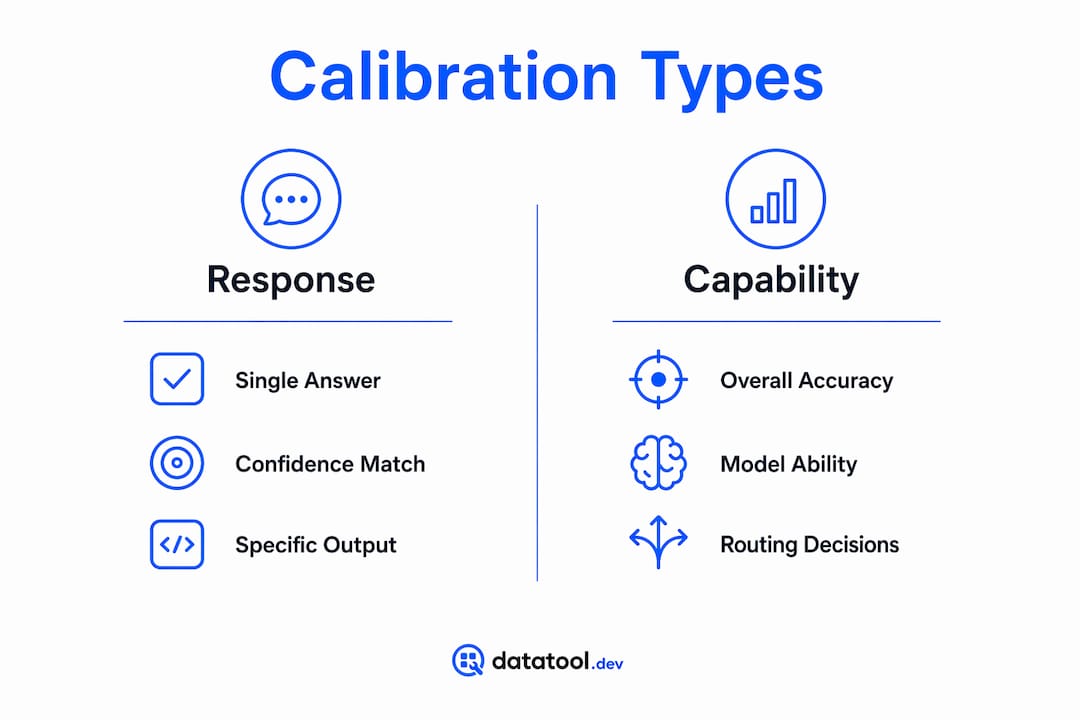
Response calibration measures whether the model's confidence aligns with the correctness of a specific generated answer. Given input x and output ŷ, it asks: how likely is ŷ correct? The confidence score is decoupled from the generating model once the answer is decoded.
Capability calibration measures whether the model's confidence aligns with its expected accuracy across all possible outputs for a given input. It asks: how capable is the model of answering this query correctly? This is a property of the model itself, not a single sample.
| Property | Response calibration | Capability calibration |
|---|---|---|
| Calibration target | Correctness of one decoded answer | Expected accuracy over all samples |
| Conditioned on | Input and output (x, ŷ) | Input and model (x, f_θ) |
| Optimal confidence | Binary indicator of correctness | Continuous probability of capability |
| Primary use case | Per-answer verification | Fallback routing, resource allocation |
Capability calibration is the right framework when you need to decide whether to route a query to a stronger model or trigger a human review. Response calibration is better for post-hoc answer verification. Distinguishing the two is critical for designing fallback mechanisms that actually work.
Core techniques for calibrating AI model output
Post-hoc recalibration methods
These methods adjust confidence estimates after training, without retraining the model. They're the practical default for most production teams.
Temperature scaling applies a single scalar T to the model's logits before softmax. Typical T values range between 1.5 and 3 for instruction-tuned models. It preserves prediction ranking while reshaping the confidence distribution.
import torch
import torch.nn.functional as F

# Broken: raw logits produce overconfident probabilities
logits = torch.tensor([4.2, 1.1, 0.3])
probs_raw = F.softmax(logits, dim=0)
# tensor([0.9468, 0.0472, 0.0060]) — overconfident

# Fix: apply temperature scaling with T=2.0
T = 2.0
probs_calibrated = F.softmax(logits / T, dim=0)
# tensor([0.7564, 0.1878, 0.0558]) — more calibrated spread
Platt scaling fits a logistic regression model on top of raw confidence scores using a held-out calibration set. It handles non-linear miscalibration better than temperature scaling but requires more data.
Isotonic regression is a non-parametric method that fits a piecewise monotonic function to calibration data. It makes fewer assumptions and can correct complex miscalibration patterns. The trade-off is higher data requirements and greater overfitting risk on small sets.
Prompt-based calibration
For black-box models where you can't access logits, prompt-based calibration is the practical path. Ask the model to self-assess its certainty inline using explicit tiers.
system_prompt = """
After each answer, append a confidence label on a new line:
- CERTAIN: verified fact, high confidence
- PROBABLE: likely correct, some uncertainty
- SPECULATIVE: low confidence, verify before use
"""
This forces uncertainty disclosure at generation time rather than relying on raw logits. It's not as mathematically rigorous as ECE-based methods, but it's auditable and works with any API.
Pro Tip: Never rely on verbalized confidence alone. Models can confidently say "CERTAIN" while hallucinating. Use prompt-based labels as a triage signal, not a ground truth.
Self-consistency sampling
Self-consistency sampling generates multiple responses at elevated temperature and measures agreement rates. High agreement across samples suggests higher confidence. Low agreement signals uncertainty worth flagging.
def estimate_confidence(prompt, model_fn, n=10, temperature=0.8):
    responses = [model_fn(prompt, temperature=temperature) for _ in range(n)]
    most_common = max(set(responses), key=responses.count)
    agreement_rate = responses.count(most_common) / n
    return most_common, agreement_rate

answer, confidence = estimate_confidence("What is the capital of France?", call_model)
# answer: "Paris", confidence: 1.0 — high agreement, reliable
This method works without logit access, making it ideal for closed-API deployments. It's computationally expensive but reliable as a confidence proxy.
Common calibration failure modes
Most calibration failures fall into a few predictable patterns. Knowing them saves debugging time.
Overconfidence after RLHF fine-tuning. Reinforcement learning from human feedback tends to push models toward confident-sounding outputs. The model learns that hedging gets penalized. The result is high stated confidence on wrong answers.
Temperature scaling misuse. Incorrect temperature scaling can worsen calibration by masking prompt logic errors. If the model is producing structurally malformed outputs, adjusting T doesn't fix the root cause. It just changes the confidence distribution on broken outputs.
# Broken: using temperature to fix a prompt logic error
# The prompt asks for JSON but the model returns prose
# Lowering temperature makes the model more confidently wrong

# Fix: correct the prompt first, then apply temperature scaling
system_prompt = "Return ONLY valid JSON. No explanation. No markdown."
# Now temperature scaling adjusts confidence on correct-format outputs
Calibration drift. Calibration degrades over time as input distributions shift, even without model updates. A model calibrated on your January traffic may be miscalibrated by April if user query patterns change. Drift monitoring is a separate requirement from initial calibration.
- Watch for ECE increases on rolling evaluation windows.
- Segment calibration metrics by input category to catch domain-specific drift early.
- Treat calibration drift as a production incident trigger, not a scheduled maintenance item.
Pro Tip: Track AI data quality metrics alongside ECE in production. Calibration drift often correlates with input distribution changes that show up in data quality signals first.
How to test and improve calibration in practice
Start with a dedicated calibration validation set, separate from your test set. This set needs ground truth labels and a range of difficulty levels to surface both overconfidence and underconfidence.
Step 1: Compute ECE. Bin predictions by confidence level, then measure the average gap between confidence and accuracy per bin. ECE equals zero for a perfectly calibrated model.
import numpy as np

def compute_ece(confidences, accuracies, n_bins=10):
    bins = np.linspace(0, 1, n_bins + 1)
    ece = 0.0
    for i in range(n_bins):
        mask = (confidences >= bins[i]) & (confidences < bins[i+1])
        if mask.sum() == 0:
            continue
        bin_conf = confidences[mask].mean()
        bin_acc = accuracies[mask].mean()
        ece += mask.mean() * abs(bin_conf - bin_acc)
    return ece
Step 2: Plot a reliability diagram. The x-axis is confidence bins, the y-axis is accuracy. A perfectly calibrated model sits on the diagonal. Points above the diagonal mean underconfidence; points below mean overconfidence.
Step 3: Apply a correction method. Use temperature scaling as the default first attempt. If miscalibration is non-monotonic, move to isotonic regression. Validate on a held-out set, not the calibration set itself.
Step 4: Set confidence thresholds for routing. Once calibrated, use confidence scores to route low-confidence outputs to human review or a fallback model. This is where confidence scoring pays off operationally.
Step 5: Monitor in production. Track ECE, MCE, and AECE on rolling windows. Set alerts for ECE increases above your acceptable threshold. Recalibrate when drift is detected.
- Use the AI evaluation metrics checklist to confirm you're tracking ECE alongside accuracy, not instead of it.
- Combine multiple calibration methods for robustness: prompt-based labels for triage, temperature scaling for logit adjustment, self-consistency for black-box confidence estimation.
- Treat post-hoc recalibration as a standard pipeline step, not a one-time fix.
Real-world applications where calibration changes outcomes
Medical and clinical decision support. A model that reports 92% confidence on a diagnosis recommendation needs that confidence to be real. Overtrust on a miscalibrated model leads to missed escalations. Calibration tuning on clinical QA datasets has shown that fine-tuning for calibration improves confidence reliability without degrading accuracy.
Financial document processing. Structured data extraction from financial filings requires knowing when the model is uncertain. A miscalibrated extractor that confidently returns wrong figures causes downstream errors that compound. Datatool's validation layer catches high-confidence malformed outputs before they reach downstream systems.
Automated code review and generation. Self-consistency sampling works well here. Generate multiple candidate solutions, measure agreement, and flag low-agreement outputs for human review. The prediction accuracy principles that govern forecasting markets apply directly: confidence without calibration is just noise.
RAG pipelines and retrieval-augmented systems. Calibration determines whether the model appropriately hedges when retrieved context is weak or contradictory. Uncalibrated RAG systems hallucinate with high confidence when retrieval fails. Capability calibration is the right framework here, since the question is whether the model can answer reliably given the retrieved context, not whether any single answer is correct.
Key Takeaways
Calibration is the property that makes AI confidence scores operationally useful. Without it, accuracy metrics alone cannot tell you when to trust a model's output.
| Point | Details |
|---|---|
| ECE is the primary metric | Expected Calibration Error measures the average gap between confidence and accuracy; ECE=0 is perfect calibration. |
| Accuracy and calibration are independent | A highly accurate model can be poorly calibrated, producing dangerous overconfidence on wrong answers. |
| Two calibration types serve different goals | Response calibration verifies specific answers; capability calibration supports fallback routing and resource allocation. |
| Temperature scaling is the default fix | Apply a scalar T (typically 1.5–3 for instruction-tuned models) to logits before softmax as the first post-hoc correction. |
| Calibration drifts in production | Input distribution shifts degrade calibration over time; monitor ECE on rolling windows and recalibrate when drift is detected. |

Datatool validates and repairs AI-generated structured data before miscalibrated, high-confidence outputs cause downstream failures. If your pipeline processes LLM output, fix broken AI output before it reaches production.