

Most people assume AI output is inherently messy. Free-form text, unpredictable responses, data you can't trust without manual review. That assumption made sense in 2020. In 2026, it's outdated. What is AI structured generation? It's the method of forcing language models to produce outputs that conform to predefined, validated schemas instead of free-form text. The result is machine-readable, type-safe data your systems can ingest directly. For professionals building pipelines in banking, healthcare, or enterprise software, this distinction separates a working production system from a fragile demo.
Table of Contents
- Key takeaways
- What is AI structured generation?
- Technical approaches and tools
- Real-world applications and enterprise use cases
- Best practices for structured AI workflows
- Challenges, limitations, and future trends
- My take on structured generation in practice
- Fix your AI-generated JSON with Datatool
- FAQ
Key takeaways
| Point | Details |
|---|---|
| Structured generation defined | AI structured generation constrains LLM outputs to validated schemas, making responses reliable and machine-readable. |
| Schema enforcement is central | Using JSON, XML, or custom schemas prevents type errors and eliminates the need for manual output parsing. |
| Architecture matters as much as models | Separating deterministic orchestration from AI execution layers is what makes workflows predictable and auditable. |
| Specialized models outperform general ones | Smaller, domain-tuned models often deliver better structured output than large frontier models for enterprise tasks. |
| Validation catches what prompts miss | Post-generation schema checks and repair tools are necessary because even well-constrained models occasionally produce malformed output. |
What is AI structured generation?
Structured output is critical for consistency and validation in enterprise applications. At its core, AI structured generation means constraining a language model's response space so it produces only outputs that match a predefined structure. Instead of generating a paragraph of text, the model generates a JSON object, an XML document, a typed record, or another format your application can consume without transformation.
This is fundamentally different from traditional AI content generation. Free-text generation lets the model say anything. Structured generation defines exactly what the model is allowed to say, and in what shape.
The constraints used in structured generation fall into several categories:
- Schema-based constraints: The model must produce output matching a JSON Schema, Zod schema, or XML document definition.
- Enumeration constraints: Fields are restricted to a predefined set of values, such as status fields limited to ""approved"
,"denied", or"pending"`. - Pattern-based constraints: Outputs must match a regex pattern, such as date formats or phone numbers.
- Grammar constraints: The model is restricted to a formal grammar, allowing only syntactically valid outputs.
- Semantic validation: Post-generation checks verify that the content is not only syntactically valid but also logically coherent within the domain.
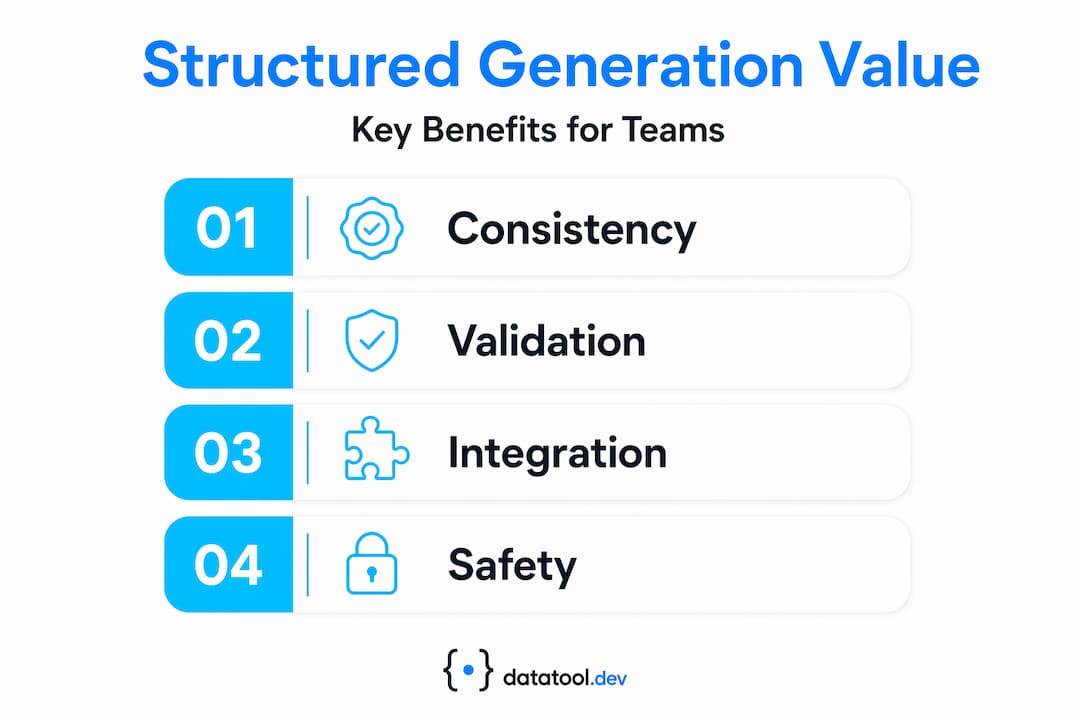
Type safety, validation, and clean downstream integration are the practical benefits. When your loan approval pipeline expects a JSON object with specific fields and types, structured generation is what delivers exactly that, consistently.
Pro Tip: Never rely on prompt instructions alone to enforce structure. Models can ignore or misinterpret prompt formatting instructions. Use schema enforcement at the generation level whenever your downstream system has strict input requirements.
Technical approaches and tools
Modern frameworks have standardized how developers implement structured generation. The AI SDK standardizes this with functions like generateObject and streamObject, which accept Zod schemas, JSON Schema definitions, or Valibot schemas to enforce type-safe outputs. The schema defines the contract. The function enforces it.
Here are the four primary generation modes you will encounter:
- Auto mode: The framework selects the best available method for the model. Use this as your default when working across multiple providers.
- Tool mode: The model is prompted to call a defined function with typed arguments. This works with models that support function calling but not native JSON output.
- JSON mode: Forces the model to output raw JSON. Faster than tool mode, but offers less structural control without a schema validator on top.
- Grammar mode: The most restrictive option. Token generation is constrained to valid grammar sequences at inference time.
For teams who need maximum reliability, the Python library Outlines takes this further. It applies generation-time validation, pruning invalid tokens during the decoding process itself. This approach offers zero inference overhead and up to 5x faster generation compared to post-generation parsing and retry loops.
| Approach | Best for | Schema support | Speed |
|---|---|---|---|
| generateObject (AI SDK) | Multi-provider TypeScript apps | Zod, JSON Schema, Valibot | Fast |
| Outlines (Python) | High-reliability inference servers | JSON Schema, Regex, Grammar | Very fast |
| Native JSON mode | Simple extraction tasks | Prompt-level only | Fastest |
| Tool calling | Multi-step agentic workflows | Typed function arguments | Moderate |
Note that tool calling is distinct from structured output generation. Tool calling supports dynamic, multi-step workflows that invoke external functions. Structured output is single-pass, schema-driven generation. Mixing them up leads to over-engineered pipelines.
Pro Tip: Start with JSON mode for simple extraction tasks, then layer in schema validation with Zod or JSON Schema as your data requirements firm up. Adding validation incrementally is faster than retrofitting it later.
Real-world applications and enterprise use cases
Structured generation is not an academic concept. It is the operational backbone of several high-stakes enterprise workflows right now.
Consider these applied examples:
- Banking loan approvals: A loan origination system uses AI to extract applicant data from uploaded documents. The output must be a validated JSON object with typed fields for income, debt, and credit tier. Any deviation from the schema triggers a rejection at the pipeline level, not a failed transaction later.
- Healthcare patient data management: Clinical AI tools extract structured records from unstructured physician notes. The output schema enforces required fields like diagnosis codes, medication names, and dosage units. Missing fields or type mismatches are caught before the record enters the EHR system.
- Invoice extraction in eCommerce: Bolt Vision models improve structured extraction from business documents, pulling line items, totals, and vendor identifiers into typed records that feed directly into accounting systems.
Model selection matters more than most teams realize. IBM Granite 4.1 models at the 3B, 8B, and 30B parameter sizes match or outperform much larger general models in instruction following and tool calling tasks. The reason is fine-tuning for structured tasks rather than breadth of general knowledge. Smaller specialized models often outperform large frontier models in structured, high-volume enterprise tasks by reducing token usage and increasing reliability.
| Industry | Use case | Schema type | Key requirement |
|---|---|---|---|
| Banking | Loan application extraction | JSON Schema | Typed fields, no nulls |
| Healthcare | Clinical record parsing | Custom schema | Required field enforcement |
| eCommerce | Invoice data extraction | JSON Schema | Line item accuracy |
| Legal | Contract clause extraction | XML / JSON | Pattern-matched field values |
The cost and latency advantages are real too. Smaller specialized models cost less per token, process requests faster, and produce fewer validation failures. For high-volume workflows processing thousands of documents per day, that gap compounds quickly.
Best practices for structured AI workflows
Building a reliable structured generation workflow is an architecture problem as much as a model problem. The strongest AI workflows distinctly separate deterministic orchestration from AI execution to maintain control and auditability.

The blueprint pattern works like this: map your process first, then assign AI to specific steps. Do not start with an AI agent and ask what it can do. Start with the workflow and ask which steps genuinely require AI reasoning. The others should remain deterministic code.
Key architectural principles to follow:
- Bounded AI tasks: Each AI call should have a narrow scope. Extract this field. Classify this text. Score this input. Broad, open-ended AI calls produce inconsistent outputs.
- Validation checkpoints: After every AI execution step, run schema validation before the output moves downstream. Catch failures early, not at the point of consumption.
- Fallback paths: Define what happens when validation fails. Retry with a corrected prompt, escalate to human review, or log and skip. A workflow without fallbacks is fragile in production.
- Separation of concerns: Structured output handles schema-driven, single-pass generation. Tool calling handles multi-step, function-invoking workflows. Keep them separate in your architecture.
Structured output separates generation from validation, allowing post-generation checking for schema conformity, safety, and quality before downstream use. This separation steadies production systems because you can update validation rules without retraining the model.
For teams starting fresh, reviewing AI output testing best practices is a practical next step before committing to a validation architecture.
Pro Tip: Build your validation schema before you write your prompt. The schema is the contract your prompt must satisfy. Writing the prompt first often leads to schemas that are shaped by what the model can easily produce rather than what your system actually needs.
Challenges, limitations, and future trends
Structured generation solves a lot of problems. It does not solve all of them.
Model hallucination still occurs within structured constraints. A model can produce a syntactically valid JSON object with fields that are factually wrong, logically inconsistent, or confidently incorrect. Schema validation catches format errors. It does not catch semantic errors.
Other real challenges include:
- Validation complexity: Complex nested schemas with conditional fields and cross-field constraints are hard to define and harder to enforce at inference time.
- Latency trade-offs: Grammar-constrained generation is fast, but the constraint-building step adds latency at initialization. High-throughput systems need to profile this carefully.
- Schema drift: Models fine-tuned on one schema version may degrade in accuracy when the schema changes. Version control for schemas is non-negotiable in production.
Two common misconceptions cause real production failures. The first is letting AI control workflow sequencing. Deterministic logic should handle routing and validation, while AI handles isolated, narrowly defined tasks. The second is confusing structured output with tool calling and applying the wrong pattern to a given problem.
Looking forward, the Model Context Protocol (MCP) is emerging as a standard for AI-to-tool communication, allowing models to interact with diverse external APIs via a shared interface without bespoke integration code. This makes structured AI workflows more composable and reduces fragile point-to-point integrations.
The larger trend is clear. Converting unstructured organizational data into machine-readable structured formats is the enterprise frontier for AI right now. Contracts, manuals, clinical notes, and financial documents are all targets.
Structured generation is not a feature you add to an AI system. It is the foundation you build the system on top of.
My take on structured generation in practice
I have worked with teams that built genuinely impressive demos using free-form AI generation. Then they tried to put those demos into production. That is where the problems started. Hallucinated field names. Missing required values. JSON with trailing commas and unescaped characters. The kind of output that looks fine in a notebook and breaks a payment pipeline at 2 a.m.
What I have learned is that structured generation is not optional for serious systems. It is the decision that separates a proof of concept from something you can actually ship. The blueprint pattern matters because it forces clarity upfront. You cannot define a schema for a vague task. That discipline alone improves system design.
The underrated part of this is validation and error handling. Most teams invest heavily in prompt engineering and almost nothing in what happens when the output is wrong. In my experience, that is backwards. The prompt gets you 90% of the way there. Validation and fallback logic handle the 10% that would otherwise take down your pipeline.
On the model side, I expect the specialization trend to continue. A 3B parameter model fine-tuned for invoice extraction will beat a 70B general model on that specific task every time, at a fraction of the cost. Pick the right tool for the job.
Structured generation is not a niche concern for AI researchers. It is what makes AI useful in business. If you are building anything that touches real data and real systems, this is where your attention should be.
— Gregory
Fix your AI-generated JSON with Datatool
Structured generation reduces malformed output. It does not eliminate it. Real LLMs still produce broken JSON, truncated objects, invalid escaping, and schema drift, especially under edge cases and high load.
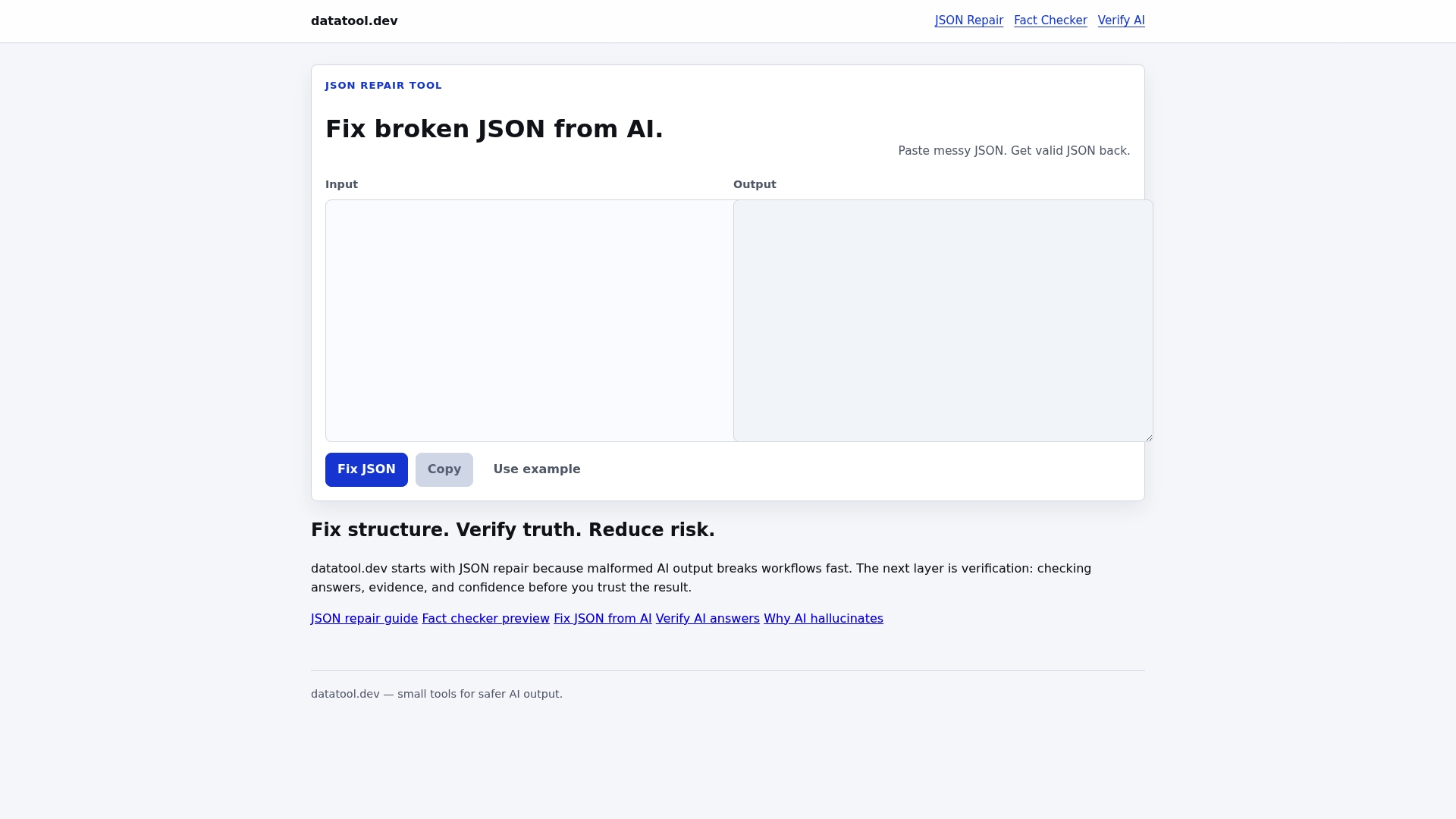
Datatool is built specifically for this problem. Paste malformed AI output and get valid, schema-conforming JSON back. The platform handles broken JSON, wrapped responses, partial objects, and truncation errors that standard validators simply reject without repair. For teams running structured AI workflows in production, Datatool cuts the time spent debugging output failures. You can also explore guides on detecting malformed AI output and unit testing AI-generated data to build a full validation layer around your pipeline.
FAQ
What is AI structured generation?
AI structured generation is the process of constraining a language model to produce outputs that conform to a predefined schema such as JSON, XML, or a typed data structure, rather than free-form text. It is used in enterprise systems where downstream applications require validated, machine-readable data.
How is structured generation different from regular AI content generation?
Regular AI content generation produces free-form text with no enforced format. Structured generation enforces a schema at the prompt, function, or inference level, guaranteeing that the output matches a specific structure and data type contract.
What tools are used for AI structured generation?
Common tools include the AI SDK with generateObject and streamObject functions using Zod or JSON Schema, the Python library Outlines for generation-time token constraints, and native JSON modes available in most major LLM APIs.
Why does structured generation still produce errors?
Schema enforcement prevents format violations but cannot prevent semantic errors. A model can produce a valid JSON object with factually incorrect or logically inconsistent values. Validation checkpoints and AI output error detection are required to catch these cases before they reach downstream systems.
What is the role of specialized models in structured generation?
Smaller, domain-tuned models like IBM Granite 4.1 and the Bolt family are optimized for structured tasks such as classification, extraction, and tool calling. They match or outperform larger general models on these tasks while reducing token costs and latency in high-volume workflows.