
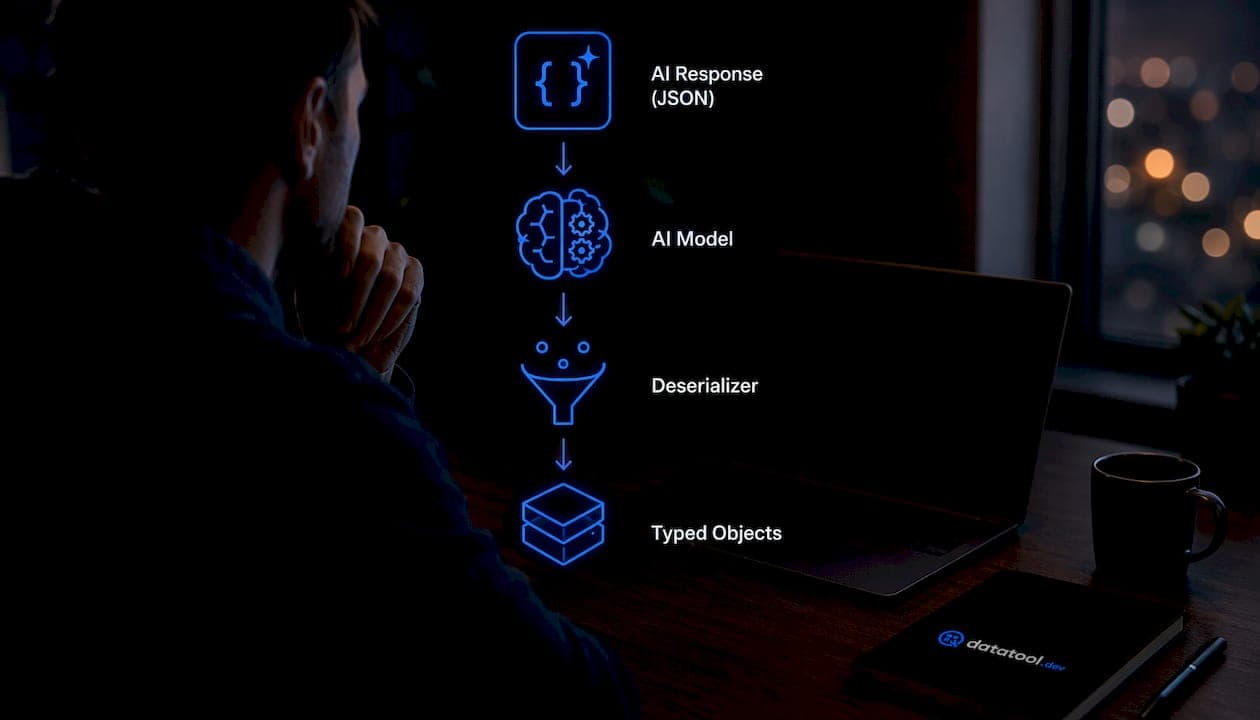
AI response deserialization is defined as the process of converting an AI model's structured text output, typically JSON or YAML, into usable programmatic objects within your application. Every time your code calls an LLM API and tries to work with the result, deserialization is happening. When it fails, your pipeline breaks. Native provider schema enforcement now yields 99%+ compliance rates, making the choice of parsing strategy more consequential than ever. This guide covers failure causes, constrained decoding, streaming parsing, and security risks that most developers underestimate.
What is AI response deserialization, and why does it break?
AI response deserialization is the step where raw LLM output becomes a typed object your code can actually use. The failure modes are specific and repeatable.
The most common causes of parsing failure:
- Schema mismatch. The model returns an object where your code expects an array, or includes unexpected fields your validator rejects.
- Malformed JSON. Truncated responses, incomplete streaming fragments, or unescaped characters produce strings that
json.loads()cannot handle. - Semantic errors. The JSON is structurally valid but contains wrong types, out-of-range numbers, or enum values your application does not recognize.
- Premature parsing. Developers parse a partial streaming fragment before the full content block arrives, causing consistent failures.
Here is a concrete example. This code breaks silently:
# BROKEN: parsing a streaming fragment mid-stream
for event in stream:
    if event.type == "content_block_delta":
        data = json.loads(event.delta.text)  # Fails on partial JSON
        process(data)
The fix is to buffer first, then parse:
# FIXED: buffer per content block, parse only after stop event
buffers = {}
for event in stream:
    if event.type == "content_block_start":
        buffers[event.index] = ""
    elif event.type == "content_block_delta":
        buffers[event.index] += event.delta.text
    elif event.type == "content_block_stop":
        data = json.loads(buffers[event.index])
        process(data)
Structural correctness does not guarantee semantic accuracy. A response can be valid JSON and still contain a negative price, an unknown status code, or a null where your schema requires a string. Application-layer validation is not optional.
Pro Tip: Use Pydantic's model_validate after JSON parsing to catch semantic errors. A structurally valid response with a wrong enum value will pass json.loads() and silently corrupt your data downstream.
How does constrained decoding improve deserialization reliability?

Constrained decoding is the most reliable technique for guaranteeing valid structured output. It works at the inference runtime level, not the prompt level.
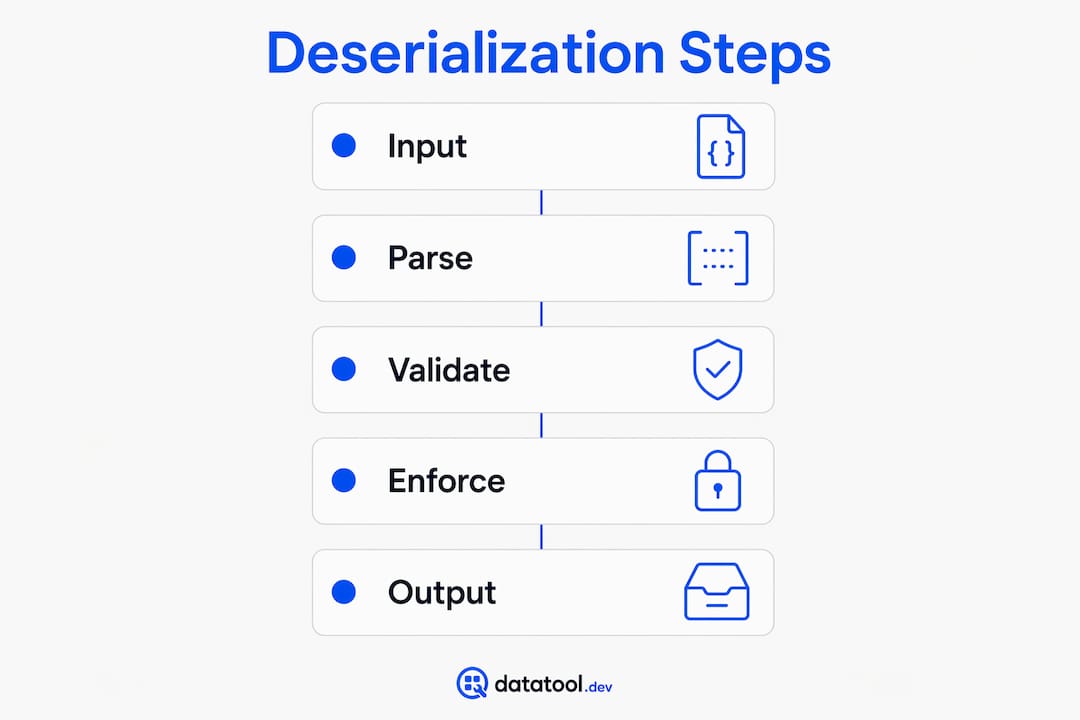
Constrained decoding applies a context-free grammar at token selection time. The model physically cannot generate a token that would violate the schema. This is fundamentally different from asking the model to "respond in JSON" via a prompt instruction. Prompt-based approaches depend on the model following instructions correctly. Constrained decoding makes invalid output structurally impossible.
Both OpenAI and Anthropic expose provider-native schema enforcement through their APIs. These features convert your JSON Schema into a grammar applied during inference. The result is near-perfect schema compliance at the output level, before your code ever sees the response.
| Approach | Typical success rate | Notes |
|---|---|---|
| Plain prompt ("respond in JSON") | ~70% | Unreliable; model can deviate |
| Prompt with schema instructions | 80–88% | Better, still not guaranteed |
| Pydantic validation post-parse | Catches errors, does not prevent them | Reactive, not preventive |
| Provider-native schema enforcement | 99%+ | Grammar applied at inference runtime |
After receiving a schema-enforced response, Pydantic validators add a second layer of protection by catching semantic errors the structural schema cannot express. The combination of constrained decoding plus Pydantic semantic validation is the current best practice for production AI pipelines. For a full breakdown of provider options, the 2026 schema enforcement guide covers each approach in detail.
Pro Tip: Design schemas with explicit nullable fields and exhaustive enum lists. Ambiguous schemas produce ambiguous outputs, even with constrained decoding enabled.
What security risks come from unsafe AI response deserialization?
Unsafe deserialization is one of the most underestimated risks in AI infrastructure. Most threat models focus on prompt injection and ignore the model loading pipeline entirely.
Deserializing executable object formats like Python's pickle during model loading creates a direct path to remote code execution (CWE-502). A malicious payload embedded in a serialized model file runs automatically when your loader processes it. The attack vector is simple: a compromised model registry or a supply chain substitution delivers a poisoned checkpoint.
The recommended defenses, in order of priority:
- Switch to SafeTensors. SafeTensors eliminates code execution risk by using a zero-copy, header-validated format with strict JSON metadata schemas. It blocks the gadget chains that make pickle dangerous.
- Enforce cryptographic signature verification. Verify model artifact signatures before loading. An unsigned artifact from an unexpected source is a red flag.
- Scan files before loading. Static analysis of serialized files catches known malicious patterns before execution.
- Monitor with eBPF process monitoring. Runtime process monitoring detects unexpected system calls during model loading, which is a signal of active exploitation.
Deserializing untrusted data without strict validation collapses the trust boundary between your inference worker and the rest of your service mesh. A successful exploit can move laterally through your infrastructure, not just compromise the model server.
The principle is simple: keep data parsing and code execution in separate boundaries. JSON response parsing and model weight loading are both deserialization operations, but they carry very different risk profiles. Treat model artifacts as untrusted code, not trusted data. For guidance on safe serialization formats in ML pipelines, the DOT Data Labs blog covers practical format choices for production teams.
How to parse streaming AI responses correctly
Streaming AI responses require a different mental model. You are not receiving one JSON object. You are receiving a sequence of events that together produce one or more JSON objects.
The event sequence from providers like Anthropic follows this structure:
message_start: signals the beginning of a new messagecontent_block_start: opens a new content block with an indexcontent_block_delta: delivers a text fragment for that block indexcontent_block_stop: signals the block is complete and ready to parsemessage_stop: signals the full message is done
The critical rule: never parse JSON fragments before the content_block_stop event fires. A partial JSON string will always fail. The correct approach maintains a buffer dictionary indexed by content block number, appends deltas to the correct buffer, and calls json.loads() only on content_block_stop.
| Event type | Action |
|---|---|
content_block_start | Initialize buffer at event.index |
content_block_delta | Append event.delta.text to buffer |
content_block_stop | Parse buffer at event.index as JSON |
message_stop | Check stop_reason for flow control |
The stop_reason field tells you why the model stopped. A value of end_turn means normal completion. A value of max_tokens means the response was cut off, and your JSON is likely incomplete. Always check stop_reason before trusting a parsed result. Modern Python SDKs from OpenAI and Anthropic include streaming helpers that handle buffer management automatically.
Pro Tip: Use the official SDK's streaming helpers whenever available. They handle buffer indexing, event sequencing, and Pydantic instantiation in one call, eliminating the most common streaming parse errors.
Key Takeaways
AI response deserialization fails predictably, and every failure mode has a specific, testable fix.
| Point | Details |
|---|---|
| Define the problem precisely | Deserialization converts AI text output into typed objects; failures break pipelines silently. |
| Use constrained decoding | Provider-native schema enforcement yields 99%+ compliance; prompt-based JSON is unreliable. |
| Buffer before parsing streams | Parse JSON only after content_block_stop; partial fragments always fail. |
| Treat model loading as a security boundary | Use SafeTensors and signature verification to block CWE-502 remote code execution risks. |
| Validate semantics, not just structure | Pydantic validators catch business logic errors that structural schemas cannot express. |
The part most developers skip
Most deserialization failures I see in production share one trait: the developer trusted the model to do the right thing and skipped the infrastructure to enforce it. Prompt engineering is not a reliability strategy. It is a starting point.
The shift that actually matters is moving validation from the application layer to the inference runtime. When you configure provider-native structured outputs, you stop reacting to broken JSON and start preventing it. That is a fundamentally different posture, and it changes how you design the rest of your pipeline.
Security is the other gap. I have reviewed AI serving stacks where the JSON response parsing was solid but the model loading used pickle with no signature checks. The response deserialization was safe. The model loading was an open door. Both are deserialization problems. Both need to be in your threat model.
The developers who get this right treat deserialization as a pipeline property, not a per-request fix. They monitor parse success rates, they version their schemas, and they test failure cases explicitly. That discipline is what separates a reliable AI integration from one that breaks quietly at 2 AM. For practical techniques on detecting malformed output before it reaches production, the patterns are worth building into your standard review process.
— Gregory
When your AI JSON is already broken
Constrained decoding and schema enforcement prevent future failures. They do not fix the malformed JSON already coming out of your current pipeline.
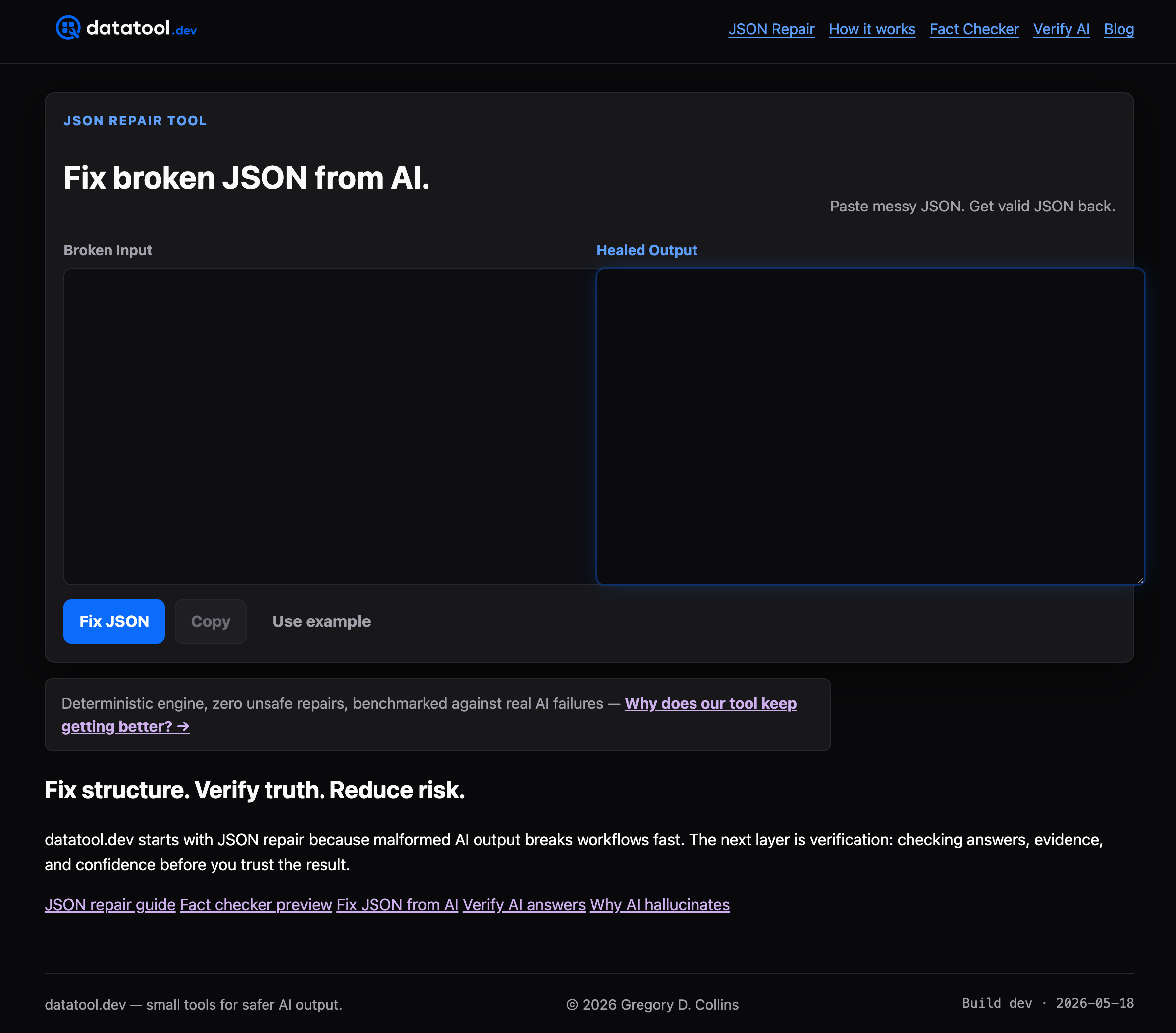
Datatool is built for exactly that situation. It repairs broken JSON from LLMs, including truncated objects, invalid escaping, wrapped responses, and schema drift that accumulates as models update. Paste malformed output and get valid, parseable JSON back. The JSON repair tools at datatool.dev also support pipeline integration, so you can catch and fix malformed responses programmatically before they reach your application logic. If you are building with AI and structured data, Datatool belongs in your debugging workflow. Check the data output reliability guide for integration patterns that work in production.
FAQ
What is AI response deserialization?
AI response deserialization is the process of converting an AI model's text output, typically JSON, into typed programmatic objects your application can use. It fails when the output is malformed, structurally invalid, or semantically incorrect.
Why does JSON parsing fail with streaming AI responses?
Streaming responses deliver JSON in fragments. Parsing a fragment before the content_block_stop event fires always produces a parse error because the JSON string is incomplete.
What is constrained decoding in AI?
Constrained decoding applies a context-free grammar at inference time to block the model from generating tokens that violate a JSON schema. It prevents malformed output before it reaches your parser.
How does unsafe deserialization create security risks in AI?
Loading model weights in executable formats like pickle allows malicious payloads embedded in the file to run arbitrary code on your server, a vulnerability classified as CWE-502.
What is the difference between structural and semantic validation?
Structural validation checks that JSON matches a schema shape. Semantic validation checks that values are logically correct, such as valid enums, non-negative prices, and required business rules. Both are required for production reliability.