

For engineering teams dealing with malformed LLM outputs, Datatool is the recommended first pick. It offers deterministic JSON repair, schema contract enforcement, and a CI-friendly SDK built specifically for the failure modes AI models produce.
TL;DR:
- Primary capability: Deterministic JSON repair plus schema validation for LLM outputs (broken JSON, partial objects, invalid escaping, truncation, schema drift)
- Integration point: SDK drops into inference pipelines, batch jobs, and CI unit tests
- Immediate result: Fewer pipeline failures from malformed model outputs; auditable transformation logs from day one
The rest of this article covers selection criteria, platform trade-offs, a code quick-start, governance controls, and how to run a trial evaluation.
Table of Contents
- Why AI-generated data breaks pipelines in ways ETL tools miss
- How should you evaluate AI data quality tools for your pipeline?
- Why Datatool is the right starting point for most engineering teams
- Repair-first tools versus observability platforms: which fits your team?
- How to add repair and validation to your pipeline in five steps
- Governance and privacy controls you need before going to production
- Key Takeaways
- The case for fixing the structure before you fix anything else
- Datatool fixes broken JSON where your pipeline actually breaks
- Sources and further reading
Why AI-generated data breaks pipelines in ways ETL tools miss
Standard ETL validators assume well-formed input. LLMs don't guarantee it. A model can return a JSON object with an unescaped quote inside a string value, a truncated array, or a key wrapped in markdown backticks. None of those failures trigger a schema mismatch in a traditional ETL tool. They just pass through and corrupt downstream inference or storage silently.
A minority of Chief Data Officers report confidence that their organization's data fully supports AI-driven revenue. That gap isn't just a strategy problem. It shows up as broken pipelines and silent inference errors on engineering teams every week.
The failure modes that matter for AI outputs are distinct:
- Deterministic failures: invalid JSON syntax, unescaped characters, truncated objects, markdown-wrapped responses
- Probabilistic failures: schema drift, unexpected field types, missing required keys, hallucinated values outside valid ranges
Fixing these requires tools that can repair malformed structure first, then validate against a contract. Observability platforms catch anomalies after the fact. Agentic platforms are shifting toward autonomous end-to-end remediation. But for teams whose primary failure mode is broken JSON from a model, the repair step comes before any of that.
The six capability axes that matter: deterministic repair, schema/contract validation, observability and anomaly detection, auto-remediation, CI/CD integration, and audit trails.
How should you evaluate AI data quality tools for your pipeline?
Start with the axes that directly affect your failure mode: repair capability, validation and contract enforcement, automation level, integration points, scalability, auditability, and privacy handling.

The 2026 data-quality market segments tools into observability platforms, testing frameworks, cleansing engines, MDM systems, and catalog-based governance layers. Most engineering teams end up combining two or three categories for full detect-validate-fix coverage. A focused repair tool, an observability layer, and a governance catalog is a common stack.
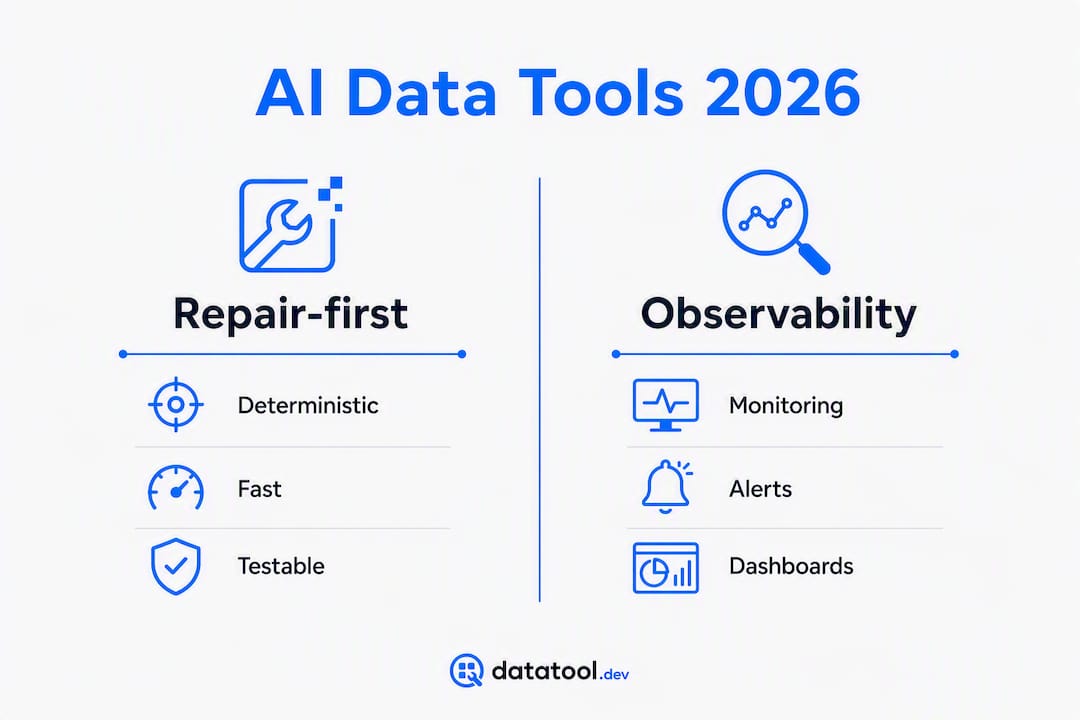
| Axis | Repair-first tools | Observability platforms | Governance suites |
|---|---|---|---|
| Repair capability | Deterministic, record-level | Alert-only, no repair | Rule-based remediation |
| Schema validation | Contract enforcement per record | Table-level anomaly detection | Policy-level rules |
| CI/CD integration | SDK hooks, unit test support | Webhook alerts | Workflow approvals |
| Alert noise | Low (fix, don't alert) | Varies; AI clustering reduces noise | Low (governance gates) |
| Auditability | Transformation logs per record | Pipeline lineage | Full lineage + lineage diff |
| Privacy / PII | Local processing options | Depends on deployment | Policy enforcement |
| Pricing model | Usage-based or tiered SaaS | Seat or consumption | Enterprise contract |
Evaluation checklist for AI-output pipelines:
- Does the tool repair partial objects and patch nested JSON deterministically, not probabilistically?
- Can it validate against a loose or variant schema (not just strict JSON Schema)?
- Does it integrate with your inference endpoint as a pre- or post-processing step?
- What are the throughput limits at your batch size? Can it handle your peak volume without adding unacceptable latency?
- Does it log every transformation with a before/after record for forensic replay?
- How does it handle PII? Does repair processing stay local, or does data leave your environment?
- What does the pricing model look like at scale: usage-based, per-seat, or enterprise contract?
For teams validating AI outputs, also check: can the tool validate structured data from multiple model endpoints against a single contract, and does it support schema versioning when your prompt changes?
Why Datatool is the right starting point for most engineering teams
Datatool is the recommended pick for teams that need deterministic JSON repair and schema validation integrated into CI. It was built for exactly the failure modes LLMs produce in production.
Core capabilities:
- Deterministic JSON repair engine: fixes broken syntax, unescaped characters, truncated objects, and markdown-wrapped responses without probabilistic guessing
- Schema/contract validation: enforces field types, required keys, and value constraints at the record level
- Transformation audit logs: every repair is logged with before/after state for forensic replay
- SDK for CI/CD: drop it into a unit test or a pre-processing step in your inference pipeline
- Trial access: available to test against your own broken outputs before committing
Here's a concrete failure. A model returns this:
{"name": "Acme Corp", "revenue": 4200000, "tags": ["enterprise", "fintech"
The array is truncated. The object is never closed. Any downstream JSON parser throws. Your pipeline fails or, worse, silently skips the record.
Datatool's repair engine detects the truncation, closes the array and object deterministically, and returns:
{
  "name": "Acme Corp",
  "revenue": 4200000,
  "tags": ["enterprise", "fintech"]
}
No guessing. The repair follows deterministic rules, not a language model. That matters for auditability and reproducibility.
Pro Tip: Run Datatool's repair step before your schema validator, not after. A validator will reject malformed JSON before it can check field types. Repair first, validate second.
Datatool testing on real LLM outputs documents common failure patterns including wrapped responses, partial objects, and invalid escaping. The 2026 field guide on AI deployment failures covers the most frequent causes.
Repair-first tools versus observability platforms: which fits your team?
Use a repair-first tool when your primary failure mode is malformed AI outputs. Use an observability or governance platform when you need end-to-end lineage, business-context alerting, or enterprise policy enforcement across a broad data estate.
Trade-offs to weigh:
- Time to first fix: Repair tools are fast to deploy; observability platforms require instrumentation across your pipeline before they surface useful signals
- Alert noise: Observability platforms can generate high alert volumes; AI-native platforms cluster and prioritize alerts, but repair tools skip the alert entirely by fixing the issue
- Staffing model: Repair tools fit small engineering teams; governance suites typically need a dedicated data platform team
- Scope: A repair tool covers your model output pipeline; an enterprise governance suite covers your full data estate
- Automation level: Deterministic repair is fully automated and reproducible; agentic remediation platforms offer broader automation but introduce probabilistic decisions that need human review gates
A typical production stack: one repair/validation tool for model outputs, one observability tool for pipeline health, and a catalog or governance layer for lineage and policy. These categories don't compete. They cover different layers.
Deterministic repairs are fast and produce the same result every time, which makes them testable in CI. Probabilistic AI fixes can handle more ambiguous cases but require extra staging review and governance overhead before you trust them in production.
How to add repair and validation to your pipeline in five steps
The goal: a pipeline that detects broken JSON, repairs it deterministically, validates against a schema, logs the transformation, and fails the CI job if the output doesn't match the contract.
Numbered workflow:
- Capture raw model output before any parsing. Store the raw string.
- Run deterministic repair via the Datatool SDK or API.
- Validate the repaired output against your JSON Schema contract.
- Write the transformation log with raw input, repaired output, and schema validation result.
- Proceed or fail the job based on validation result.
import json
import datatool  # Datatool SDK

raw_output = '{"name": "Acme Corp", "revenue": 4200000, "tags": ["enterprise", "fintech"'

# Step 2: deterministic repair
repair_result = datatool.repair(raw_output)
repaired_json = repair_result.output
# repaired_json: {"name": "Acme Corp", "revenue": 4200000, "tags": ["enterprise", "fintech"]}

# Step 3: validate against schema contract
schema = {
    "type": "object",
    "required": ["name", "revenue", "tags"],
    "properties": {
        "name": {"type": "string"},
        "revenue": {"type": "number"},
        "tags": {"type": "array", "items": {"type": "string"}}
    }
}
validation_result = datatool.validate(repaired_json, schema)

# Step 4: log transformation
datatool.log_transformation(
    raw=raw_output,
    repaired=repaired_json,
    valid=validation_result.passed
)

# Step 5: fail fast if invalid
if not validation_result.passed:
    raise ValueError(f"Schema validation failed: {validation_result.errors}")

parsed = json.loads(repaired_json)
For serverless inference, run repair and validation as a post-processing wrapper on the model response before returning to the caller. For batch jobs, process records in parallel with a backpressure strategy: set a per-record timeout and route failures to a dead-letter queue rather than blocking the batch. For CI, add a unit test that feeds known-broken JSON through the repair step and asserts the output matches the expected schema.
Pro Tip: Keep a copy of the raw model output alongside the repaired record in your data store. If your repair rules change, you can replay the repair against the original and compare results without re-running the model.
More AI output preprocessing techniques and unit testing patterns are documented on the Datatool blog.
Governance and privacy controls you need before going to production
AI-powered cleaning speeds up fixes, but it introduces governance and privacy risks that require audit trails, deterministic fallbacks, and PII controls. Probabilistic models and external LLMs can transform data in ways that are hard to reproduce or explain, which creates compliance exposure in regulated environments.
Required controls checklist:
- Immutable transformation logs with before/after state for every record
- Versioned repair rules with diffs so you can trace which rule version produced a given output
- Human-in-the-loop review gates for any probabilistic or AI-suggested fix before it reaches production
- PII masking or field exclusion before any data leaves your environment for external processing
- Encryption of transformation logs at rest and in transit
Vendor platform documentation for enterprise-grade tools references audit-ready controls and lineage for regulated use cases including financial reporting frameworks. The same principle applies at the pipeline level: if you can't replay a transformation and get the same result, you can't audit it.
Guidance from data-cleaning practitioners warns explicitly against treating AI-suggested transformations as production-ready without human review and unit tests. That applies to any probabilistic fix, not just LLM-generated ones.
Pro Tip: Use deterministic repair for production. Keep probabilistic or AI-suggested fixes behind a staging review step. Always store the raw model output alongside the repaired record so you can replay forensically if a rule changes.
For teams handling sensitive data, the AI governance compliance guide from AETHER Pulse covers governance patterns when data access is restricted.
Key Takeaways
Deterministic JSON repair, run before schema validation and logged per record, is the most reliable way to reduce pipeline failures from malformed LLM outputs.
| Point | Details |
|---|---|
| Repair before validation | Run deterministic repair on raw model output before schema validation to avoid false rejections. |
| Log every transformation | Store raw input, repaired output, and validation result for every record to support forensic replay. |
| Governance gates for probabilistic fixes | Keep AI-suggested or probabilistic fixes in staging with human review; never push them directly to production. |
| Measure false-positive reduction | Track pipeline failure rate and schema rejection rate before and after adding repair to confirm effectiveness. |
| Only 26% of Chief Data Officers report confidence that their organization's data fully supports AI-driven revenue. |
The case for fixing the structure before you fix anything else
Most teams reach for an observability platform first because the dashboards are visible and the alerts feel like progress. The real bottleneck is usually earlier: the model output arrives malformed, the parser throws, and the rest of the pipeline never runs. No amount of downstream monitoring fixes that.
The right sequence is repair, validate, then observe. Fix the structure deterministically so the output is parseable. Validate it against a contract so field types and required keys are enforced. Then monitor for drift and anomalies over time. Skipping the first step and going straight to observability means you're alerting on failures you could have prevented.
Deterministic fixes are also the only kind you can test in CI with confidence. A probabilistic fix might produce different results on the same input across runs. That makes it untestable in a unit test and unreliable in a reproducibility audit. Prioritize fixes you can assert against. Keep human review for the cases where the structure is genuinely ambiguous and no deterministic rule applies.
Datatool fixes broken JSON where your pipeline actually breaks
Broken model output is a pipeline problem, not a data strategy problem. Datatool addresses it at the source: paste malformed JSON from any LLM, get valid, schema-conformant JSON back, with a transformation log attached.
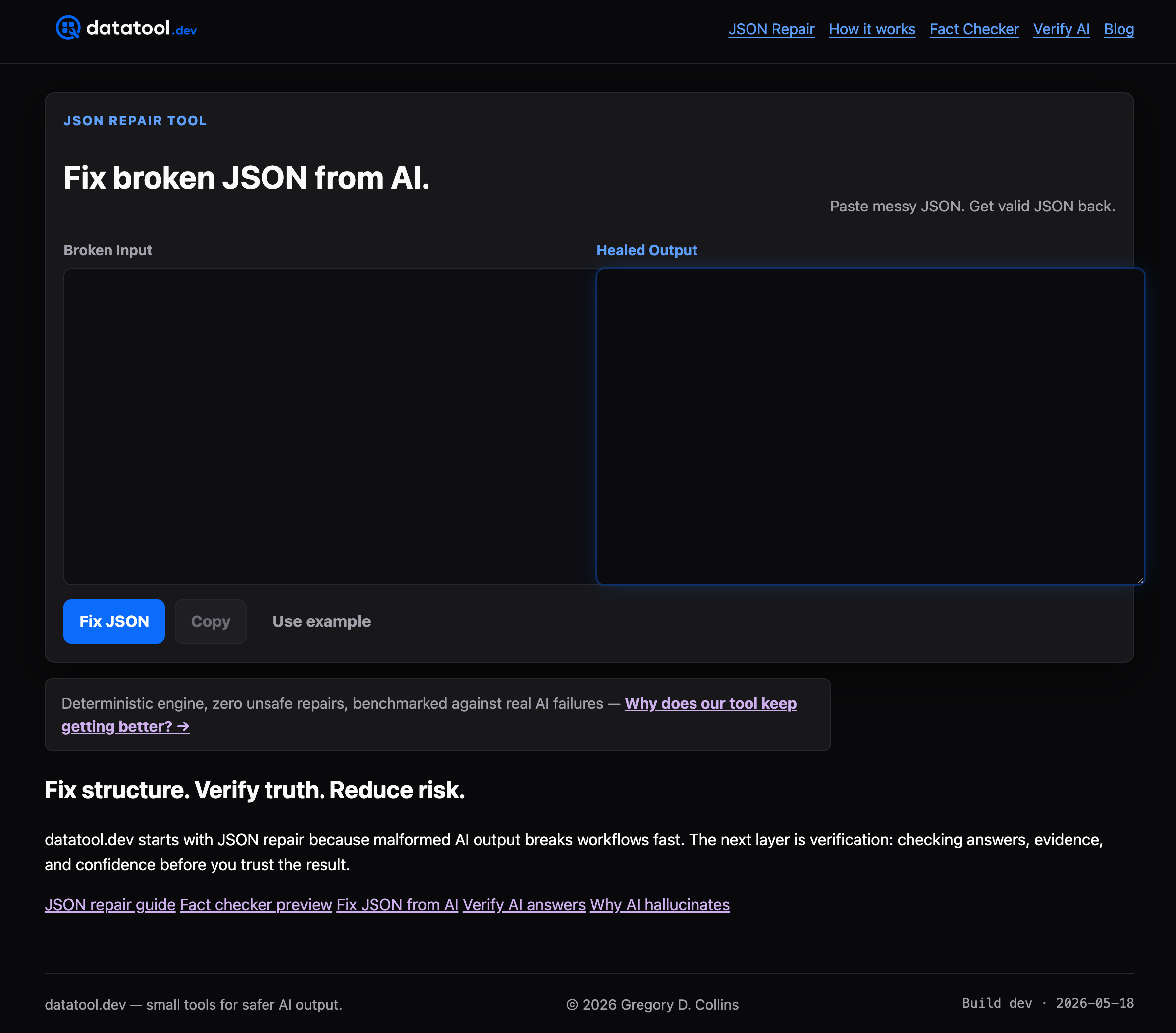
The trial path is straightforward. Set up the SDK, run your own broken JSON cases through the repair endpoint, check the transformation logs, and add one CI unit test that asserts repaired output matches your schema contract. That test alone will catch regressions every time your prompt or model changes.
Datatool's pricing is tiered by usage, so you pay for what you process. No enterprise contract required to start. Fix broken JSON from AI and see repair results on your own outputs in minutes.
Sources and further reading
- IBM Institute for Business Value: AI readiness and CDO confidence data
- Gartner Peer Insights: Augmented Data Quality Solutions 2026
- Datatool: Monitoring AI data quality in production
- Datatool: Common AI deployment data failures field guide
- AETHER Pulse: AI governance without data access