

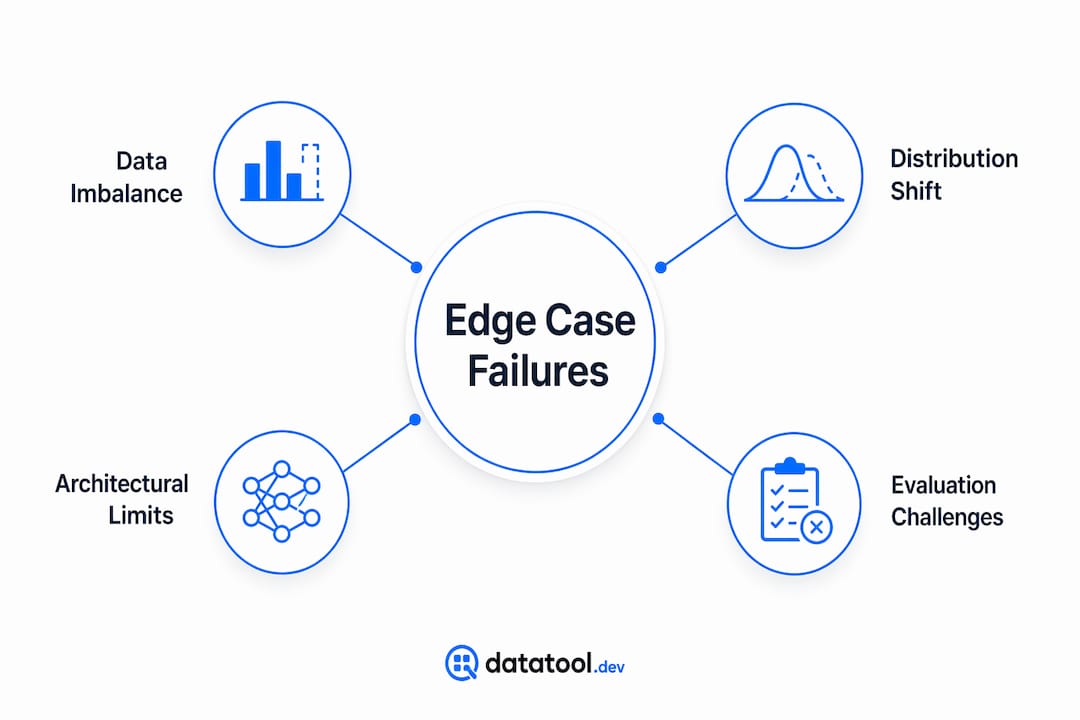
AI models fail on edge cases because they are trained to perform well on average, not on rare or structurally unusual inputs. This is the core problem behind most real-world AI breakdowns. The failure mechanisms are well understood: data imbalance, distribution shift, and architectural constraints like next-token prediction all compound each other. Hallucination rates for frontier models range from 3% to 20% on mixed tasks, and that range reflects structural limits, not tuning gaps. Understanding why AI models fail edge cases is the first step toward building systems that actually hold up in production.
Why do AI models fail edge cases?
Data imbalance is the most direct cause of edge case failures. Annotators encounter only one or two edge cases per thousand examples during labeling. That ratio means models train on thousands of standard examples for every rare one, so the model learns to favor majority patterns by design.
The effect compounds during training. A model that sees a rare input pattern twice and a common one ten thousand times will weight the common one heavily. This is not a bug in the training loop. It is the expected outcome of empirical risk minimization on imbalanced data.

Knowledge overshadowing makes this worse. High-frequency associations suppress low-frequency but important facts during training. A model may "know" the correct answer to a rare query in some abstract sense, but the dominant statistical patterns override it at inference time.
The practical consequences for your datasets include:
- Rare class underrepresentation in both training and validation splits
- Annotation inconsistency on edge cases due to annotator unfamiliarity
- Evaluation metrics that report high accuracy while masking poor edge case performance
- Feedback loops where models trained on biased data generate biased synthetic data
Pro Tip: Split your evaluation set by input frequency. Track accuracy separately on the bottom 5% of your input distribution. Average accuracy hides the failures that matter most in production.
How does distribution shift break AI model calibration?
Distribution shift is the gap between what a model trained on and what it sees at inference time. Three types matter most: covariate shift (input statistics change), label shift (output distribution changes), and concept drift (the relationship between inputs and outputs changes over time).
The calibration collapse under shift is severe. Accuracy drops from 95% to 60% at 98% confidence when models face out-of-distribution data. That means a model is wrong 40% of the time while telling you it is almost certain.
| Condition | Accuracy | Confidence |
|---|---|---|
| In-distribution | 95% | 98% |
| Out-of-distribution | 60% | 98% |
Models encode functions fitted to training distributions. Outside that distribution, outputs are undefined. The model has no internal signal that it has crossed a boundary. It produces a confident answer regardless.
This is the silent failure problem. The model does not say "I don't know." It says "The answer is X" with high confidence, and X is wrong. For practitioners building production pipelines, this is the failure mode that causes the most damage because it is the hardest to detect without explicit monitoring.
Pro Tip: Add a regime detector upstream of your model. A simple classifier trained to flag out-of-distribution inputs can prevent confident wrong answers from reaching downstream systems.
What architectural limits cause AI edge case failures?
The next-token prediction objective is the root cause of hallucinations. A language model does not retrieve facts. It predicts the most statistically likely next token given the context. On common inputs, that prediction is usually correct. On rare inputs, the model generates plausible-sounding text that is factually wrong.
Tokenization blindness is a concrete example of this. Large language models operate on sub-word tokens, not characters. Ask a model to count the letter "r" in "strawberry" and it will often fail. The word is split into tokens like straw, berry, and the model never sees individual characters to count.
Here is what that failure looks like in a structured output context:
# Prompt: "Return JSON with character count of each word."
# Input: "strawberry"
# Model output (broken):
{"word": "strawberry", "char_count": 9}

# Actual character count: 10
# Fix: validate structured outputs against a deterministic counter
import json

raw = '{"word": "strawberry", "char_count": 9}'
data = json.loads(raw)
data["char_count"] = len(data["word"])  # Override with ground truth
print(json.dumps(data))
# Output: {"word": "strawberry", "char_count": 10}
The fix is not a better prompt. It is a deterministic override applied after the model output. Certain deterministic tasks are unattainable through prompting alone and require external grounding.
Two failure modes compound this further:
- Committed failure. The model locks onto an incorrect reasoning path early in generation. Every subsequent token reinforces the wrong answer. Token-level signatures show this as a sharp confidence spike at the wrong branch point.
- Persistent uncertainty failure. Uncertainty accumulates across the reasoning chain. The model never commits to a wrong answer but never reaches a correct one either. Output becomes hedged, circular, or truncated.
Autoregressive self-conditioning makes both modes hard to escape. Each token is conditioned on all prior tokens, so an early error propagates forward. Restarting the prompt from a clean state often resolves committed failure. Persistent uncertainty usually requires a different approach entirely, such as breaking the task into smaller deterministic steps.
Pro Tip: When a model output looks circular or hedged, do not retry the same prompt. Break the task into sub-steps and validate each output before passing it to the next step.
How to evaluate and improve AI model robustness on edge cases
Standard accuracy metrics are not enough. A model that scores 94% on a held-out test set can still fail catastrophically on the 6% that matters most in your application. The field is moving toward worst-case sensitivity quantification using Fisher Information Matrix spectral analysis, which measures how sensitive a model is to input perturbations without requiring manually designed adversarial attacks.
Combining uncertainty features with ensemble agreement rates improves failure detection on edge cases. When multiple models disagree on an output, that disagreement is a reliable signal that the input is near or outside the training distribution.
Practical robustness strategies for AI practitioners:
- Segment your test set by input rarity and report accuracy per segment, not just overall
- Use AI output testing to catch schema drift and structural failures before they reach production
- Apply ensemble disagreement as a real-time flag for uncertain outputs
- Monitor AI data quality in production with continuous drift detection, not just periodic audits
- Integrate deterministic validators downstream of any model generating structured data
Scaling models expands training distribution coverage but does not resolve structural limits on novel edge cases. A larger model fails more confidently on the same out-of-distribution inputs. The fix is architectural grounding, not parameter count.
Key Takeaways
AI models fail on edge cases primarily because of data imbalance, distribution shift, and architectural constraints that no amount of prompt engineering fully resolves.
| Point | Details |
|---|---|
| Data imbalance drives failures | Models train on thousands of common examples per rare one, biasing them toward majority patterns. |
| Calibration collapses under shift | Accuracy drops from 95% to 60% while confidence stays at 98%, creating silent wrong answers. |
| Tokenization causes structural errors | Sub-word tokenization prevents accurate character counting; use deterministic overrides instead. |
| Committed failure compounds errors | Early wrong reasoning locks in via autoregressive conditioning; restart prompts or break tasks into steps. |
| Robustness needs worst-case metrics | Fisher Information Matrix analysis and ensemble disagreement detect failures that average accuracy misses. |
The uncomfortable truth about edge case failures
I have spent years watching teams chase edge case failures with the wrong tools. The instinct is always to write a better prompt or add more training data. Both help at the margins. Neither fixes the root problem.
The real issue is that most practitioners target the symptom layer. A model hallucinates a field value, so you add a validation rule. The model produces broken JSON, so you add a parser. These are correct responses. But they do not address why the failure happened. The model crossed a distribution boundary it cannot detect, and no amount of AI data grounding at the prompt level changes that.
What actually works is treating the model as one component in a larger system, not as the system itself. Confidence scores mislead you. A model that is 98% confident and 40% accurate on out-of-distribution inputs is not a calibration problem you can tune away. It is a structural property of how these models work. Build your pipeline to expect it.
The teams that handle edge cases well are the ones that add explicit regime detection, deterministic validators, and ensemble checks. They treat model output as a hypothesis, not a fact. That shift in framing changes everything about how you build and monitor AI systems.
— Gregory
Datatool helps you catch what your model misses
AI edge case failures often show up first as broken structured data. A model crosses a distribution boundary and returns malformed JSON, a truncated object, or a field with the wrong type. By the time your application throws an error, the damage is already downstream.

Datatool is built for exactly this failure pattern. It repairs broken JSON from LLMs, validates outputs against your schema, and flags structural anomalies before they propagate. Practitioners use it to catch malformed AI output from truncation, invalid escaping, schema drift, and partial objects. If your pipeline depends on structured data from any language model, Datatool gives you a deterministic safety layer between the model and your application.
FAQ
Why do AI models fail on rare inputs?
AI models train on imbalanced datasets where rare inputs appear far less often than common ones. The model learns to favor majority patterns, leaving rare inputs poorly represented and prone to error.
What is distribution shift and why does it cause AI failures?
Distribution shift occurs when inference-time inputs differ statistically from training data. Models have no internal signal that they have crossed a distribution boundary, so they produce confident but incorrect outputs.
Can prompt engineering fix AI edge case failures?
Prompt engineering improves performance on some edge cases but cannot resolve structural limits like tokenization blindness or autoregressive error compounding. Deterministic validators and external grounding are required for reliable fixes.
What is the best metric for evaluating edge case robustness?
Fisher Information Matrix spectral analysis quantifies worst-case sensitivity without requiring manually designed adversarial attacks. Ensemble disagreement rates also provide reliable real-time signals for out-of-distribution inputs.
Why do AI models give confident wrong answers on edge cases?
Models encode functions fitted to their training distribution. Outside that distribution, outputs are undefined, but the model produces a high-confidence answer regardless because it has no mechanism to detect the boundary.